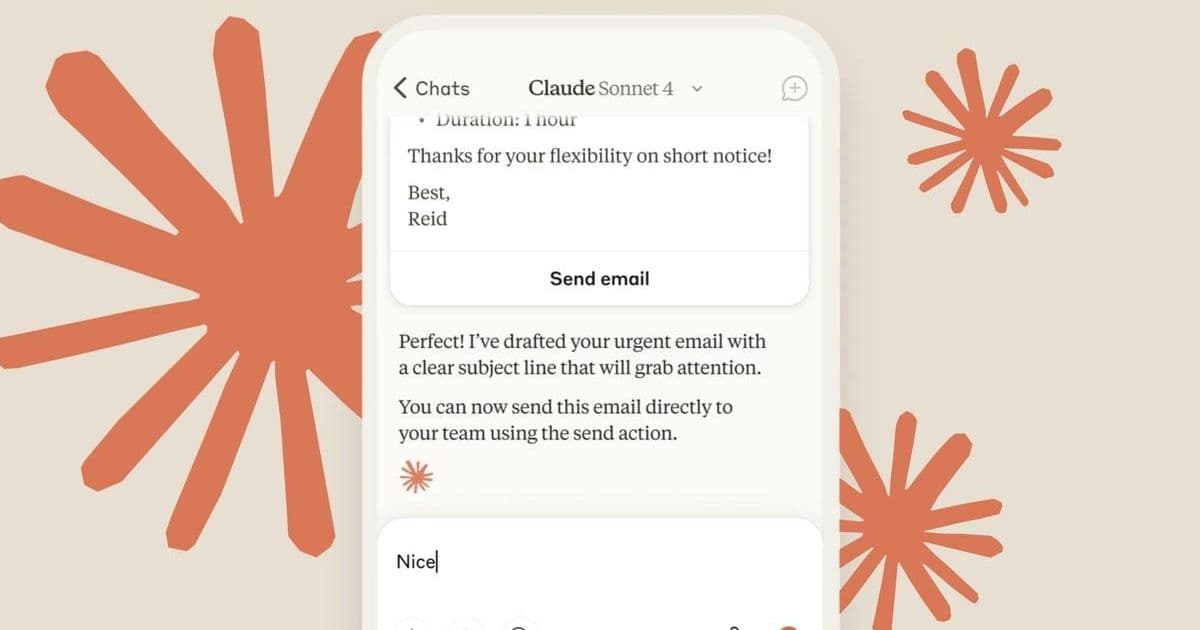
Anthropic has expanded its Claude mobile app to generate editable templates for emails, texts, and calendar events, requiring users to manually review and send them. This move positions Claude as a multiuse AI agent but highlights current limitations in automation and integration dependencies. For developers, it signals a shift toward context-aware AI assistants that bridge communication gaps while emphasizing user control.
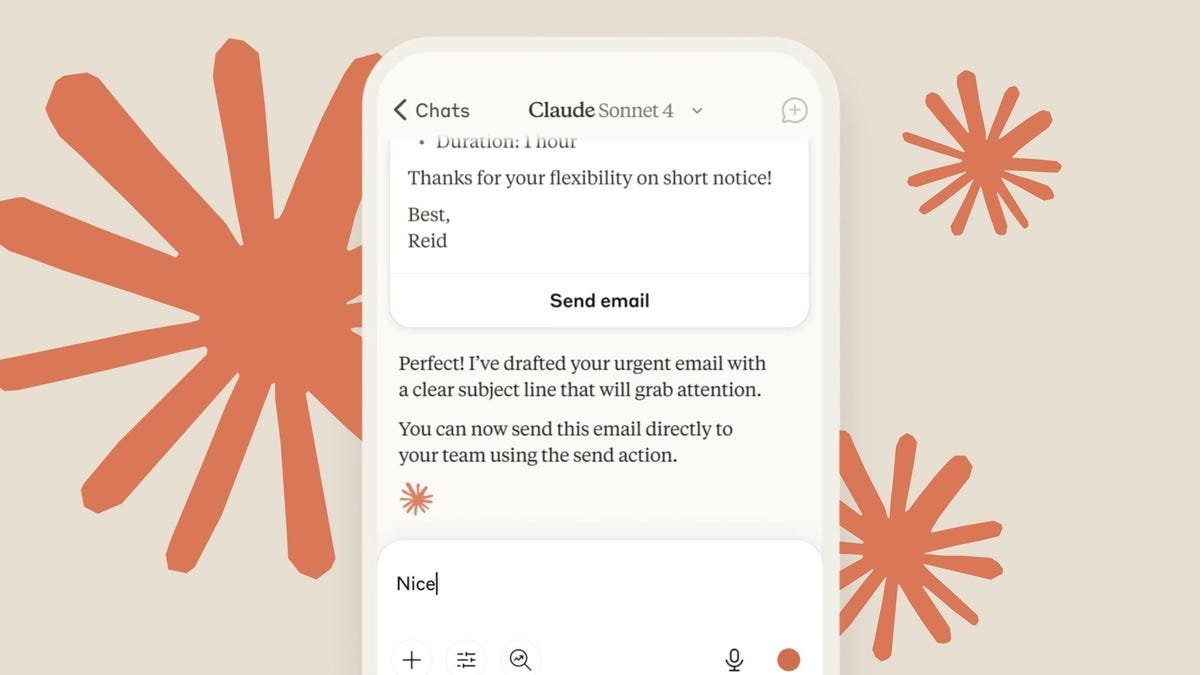
Anthropic is pushing Claude beyond conversational AI into the realm of practical daily assistance, with its mobile app now capable of drafting emails, text messages, and calendar events based on user prompts. Announced via an X post, this update targets iOS and Android users, allowing them to generate templates that can be transferred to apps like Gmail, Messages, or Slack—but only after manual review and approval. While this reduces the friction of composing routine communications, it stops short of full automation, underscoring the cautious balance AI firms are striking between efficiency and reliability.
How Claude's Drafting Features Work
Users start by prompting Claude with details such as the recipient, context, and desired tone—for example, "Draft a polite follow-up email to a client about a delayed project." Claude then produces an editable template. From there:
- For emails and texts: The app offers an "Open in App" button to directly load the draft into Gmail, Messages, or other supported platforms. Users must click send themselves.
- For calendar events: On iOS, clicking "Add to Calendar" auto-populates Apple Calendar. For Google Calendar, however, details must be manually copied and pasted—a notable gap in seamless integration.
This workflow highlights Claude's role as a co-pilot rather than an autonomous agent. As Webb Wright notes in the source article, "Claude generates a template of a message, which you can then either use or adjust with further prompting." The emphasis on user oversight aligns with broader industry trends where AI handles heavy lifting but defers final decisions to humans to prevent errors like miscommunication or scheduling conflicts.
Integrations and Limitations: The Fine Print
Powering these features are integrations with tools like Google Workspace (Drive, Gmail, Calendar), but access is tiered. Free users get basic template generation, while advanced connectors—such as direct links to Canva, Asana, and Figma—are reserved for Pro, Max, Claude for Work, and Enterprise subscribers. This monetization strategy isn't just about revenue; it reflects Anthropic's focus on attracting business users who need robust, secure AI tools for complex workflows. Yet, the partial automation (e.g., manual steps for Google Calendar) reveals technical hurdles in achieving true cross-platform interoperability—a pain point developers know all too well from API inconsistencies.
Claude's Evolution as a Multiuse AI Agent
This update isn't isolated. It builds on Anthropic's recent strides, like April's Google Workspace integration and the July launch of a "connectors" directory, which turns Claude into a hub for third-party app interactions. For tech leaders, this signals a deliberate pivot from Claude as a chatbot to a versatile agent capable of orchestrating tasks across tools. In competitive terms, it inches Claude closer to rivals like ChatGPT's custom GPTs but with a stronger emphasis on enterprise-grade security and ethical boundaries—Anthropic's hallmark.
However, the reliance on templates and user mediation raises questions. Will developers embrace this as a productivity boon, or see it as half-baked automation? As AI assistants grow more agentic, the industry must grapple with trust and efficiency trade-offs—Claude's approach prioritizes safety, but at the cost of speed. For now, it offers a glimpse into a future where AI drafts our drudgery, yet keeps us firmly in the driver's seat.
Source: ZDNET
Comments
Please log in or register to join the discussion