A comprehensive analysis of the Smart Doorbell X3 sold on Temu reveals a cascade of critical flaws—from unauthenticated device takeover and credential leakage via UART to unencrypted media streams and immutable per‑device passwords. The research shows how an attacker can silently reassign a doorbell, impersonate it in live calls, and use a single physical access point to compromise an entire home network.
Anyone on the Internet Can Ring Your Doorbell
Published 2026‑05‑06 – 39 min read
Thesis
The Smart Doorbell X3, marketed on Temu and backed by the Naxclow platform, is not a single vulnerable gadget but a platform‑wide failure of authentication, key management, and secure onboarding. By chaining together a handful of predictable identifiers, a hard‑coded signing secret, and plaintext credential exposure, an attacker can silently steal any device, impersonate it in live video calls, and harvest the homeowner’s Wi‑Fi keys with only a screwdriver and a UART adapter.
Key Findings
1. Platform‑wide silent takeover (Critical)
- Two signed HTTP POSTs—confirm and bind—are sufficient to reassign any doorbell to an attacker’s account.
- The backend never verifies that the request originates from the current owner or from the device itself.
- Because device IDs are sequential (
1e2023XXXXXX) and the signature algorithm uses a static secret, an attacker can enumerate the entire fleet and hijack each unit in minutes.
2. One‑shot credential lift (Critical)
- A signed request to the signaling‑config endpoint returns the device’s permanent relay password (
devToken). - No additional authentication is required; the server trusts only the forged SHA‑1 signature.
- Possession of this token lets an attacker register on the relay as the target device, effectively becoming the doorbell.
3. Live impersonation of a doorbell (Critical)
- With the leaked
devToken, an attacker can:- Register on the relay as the victim device.
- Send a forged “doorbell pressed” alert, causing the owner’s phone to ring.
- Answer the call and stream arbitrary MJPEG video and two‑way audio.
- The real doorbell stays online and never knows it has been replaced.
4. Persistent per‑device passwords (Critical)
devTokenand the account‑sidecliTokenare stored server‑side and never rotate, even after factory reset or rebinding.- Once lifted, they remain valid for the lifetime of the device record, rendering any later patch ineffective.
5. Wi‑Fi credentials leak via UART (High)
- During boot the firmware prints the home SSID, PSK, and derived WPA keys to the UART console.
- The UART header is exposed on the front panel; gaining access requires only a screwdriver and a few seconds of patience.
- This single foothold grants full LAN compromise.
6. Unencrypted media and signaling (High)
- The P2P video/audio stream is sent in clear MJPEG and PCM packets after NAT hole‑punching.
- Call‑setup messages expose device ID, account ID, public/private IPs, NAT ports, and both long‑lived tokens in plaintext.
- Anyone on the path can capture live video/audio without breaking encryption.
7. Predictable device identifiers (High)
- Device IDs follow the pattern
1e2023XXXXXXwhere1eis a locally administered MAC prefix,2023is a batch tag, and the final six hex digits are a simple counter. - The enumeration space is trivially searchable, enabling fleet‑wide attacks.
8. Unauthenticated device‑code minting (High)
- A signed request with a known batch prefix returns the next free sequential ID.
- The minted ID is not bound to the requesting account until a separate bind step, allowing attackers to grow the namespace at will.
9. Unauthenticated alert delivery (Medium)
- The alert endpoint accepts a device ID, an image, and a forged signature. No further checks are performed.
- An attacker can ring any owner’s phone with a custom image, effectively spoofing a visitor.
10. Hard‑coded signing salt (Medium)
- The signature is a truncated SHA‑1 over alphabetically‑sorted parameters plus a constant string (
sercret). - The same constant appears on every device; once recovered, it enables forging of any request on the platform.
11. Plain HTTP control plane (Medium)
- All control‑plane traffic (device‑to‑backend alerts, token fetches) uses HTTP on port 80, even though the same host serves TLS on 443.
- No TLS termination on the device side means traffic can be intercepted or modified trivially.
12. Verbose UART debug shell (Medium)
- The production firmware drops into an interactive RT‑Thread shell exposing commands such as
device_code,write_device_code,fal read, andprintenv. - These commands allow arbitrary flash reads, firmware dumping, and even overwriting the device’s identity without authentication.
Implications
- User privacy is shattered – An attacker can watch the front door and converse with the homeowner while pretending to be a visitor.
- Physical security is compromised – By reassigning a doorbell, the attacker can silence the real device, preventing the homeowner from receiving legitimate alerts.
- Network security collapses – The UART‑exposed Wi‑Fi keys give immediate LAN access, turning a single IoT device into a gateway for ransomware, credential theft, or lateral movement.
- Vendor remediation is nearly impossible – The firmware lacks an OTA partition; even if Naxclow released a patched image, existing units cannot receive it over the air. A hardware recall would be the only reliable fix.
- Scale of impact – Because the same firmware and backend serve multiple rebadged brands, the vulnerability likely affects dozens of listings on Temu and possibly other Chinese marketplaces.
Counter‑Perspectives & Mitigation Paths
| Issue | Practical Mitigation |
|---|---|
| Static signing secret | Rotate the secret server‑side and embed a per‑device secret during manufacturing. Use HMAC‑SHA256 with a device‑unique key stored in secure flash. |
| Plaintext tokens | Issue short‑lived session tokens that are refreshed on each call and bind them to a TLS‑protected channel. |
| UART debug exposure | Remove the debug console from production firmware or lock it behind a password protected bootloader. Disable JTAG/UART pins in the final silicon package. |
| Unencrypted media | Enforce SRTP or DTLS for the P2P leg; at minimum encrypt the video payload with a key derived from the per‑session handshake. |
| Predictable IDs | Use a true random 128‑bit UUID for each device; do not expose the generation counter. |
| OTA partition missing | Add a dedicated download partition and a secure bootloader that verifies signed images before flashing. |
| HTTP control plane | Switch all device‑to‑backend communication to HTTPS with certificate pinning. |
| Unauthenticated bind/confirm | Require the current owner’s token (or a proof‑of‑possession challenge) before allowing a device to be rebound. |
Even with these patches, the existing deployed fleet remains vulnerable because the hardware cannot receive OTA updates. Users should isolate such devices on a guest VLAN, disable any local network access beyond the internet, and consider replacing them with hardware that supports secure OTA and encrypted media.
Disclosure Timeline
- 2026‑04‑01 – Initial lab testing on owned units.
- 2026‑04‑29 – Coordinated disclosure sent to Naxclow via discovered email addresses and the in‑app feedback form.
- 2026‑05‑06 – Publication of this sanitized report after one week with no substantive response.
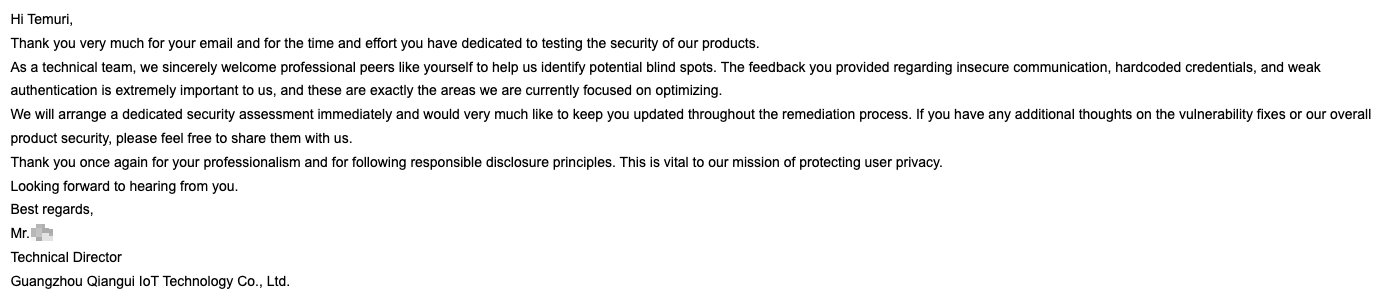
- 2026‑05‑07 – Naxclow acknowledged the report and opened an internal review (see email in the image above).
Takeaways for Practitioners
- Treat every UART header as a backdoor – Even cheap MCUs expose full memory when a console is left enabled.
- Never trust a static “signature” – If the secret is baked into firmware, the whole protocol collapses to an integrity check, not authentication.
- Per‑device credentials must rotate – Long‑lived passwords that survive factory reset are a recipe for perpetual compromise.
- Encrypt everything that traverses the internet – Plain HTTP, clear‑text media, and exposed STUN parameters give attackers a free data stream.
- Vendor‑side OTA is not optional – Without a path to push fixes, any discovered flaw becomes a permanent field‑wide risk.
Final Thoughts
The Smart Doorbell X3 illustrates how a single insecure design decision—a hard‑coded signing salt—can cascade into a suite of systemic failures when combined with poor key management, exposed debug interfaces, and an unauthenticated onboarding flow. The result is a platform where anyone on the internet can ring, hijack, or silently steal a front‑door camera. Until the vendor either recalls the hardware or provides a secure OTA mechanism, the safest advice remains: segregate, monitor, and replace.
For the full technical dump, firmware extraction scripts, and a proof‑of‑concept client, please contact me through the coordinated disclosure channel.
Comments
Please log in or register to join the discussion