
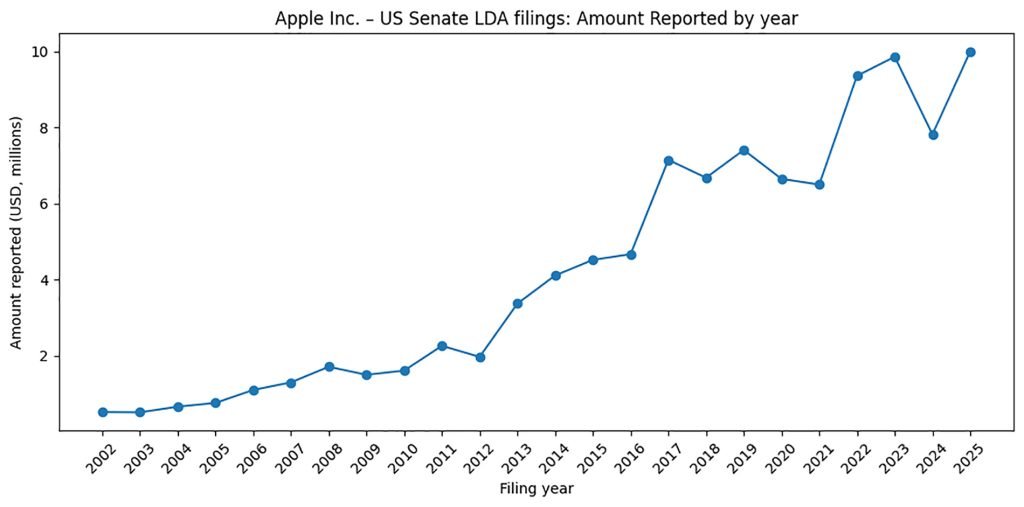
Apple's federal lobbying expenditure surged to a record $10 million in 2025, marking a nearly 30% year-over-year increase as the company intensified its efforts to influence legislation on App Store regulation, AI policy, and semiconductor manufacturing.
Apple's federal lobbying spending reached an unprecedented $10 million in 2025, representing a 27.9% increase from the previous year and establishing the company's highest annual lobbying total on record. This significant escalation in political spending reflects the intensifying regulatory pressures facing the tech giant, particularly around its App Store operations and broader market practices.

The quarterly breakdown reveals consistent investment throughout the year, with spending rising in every quarter: $2.45 million in Q1, $2.29 million in Q2, $2.53 million in Q3, and peaking at $2.73 million in Q4. This steady progression suggests a deliberate, strategic approach to lobbying rather than reactive spending in response to specific events.
The App Store Battle Front and Center
What makes Apple's lobbying strategy particularly noteworthy is the persistent focus on App Store-related legislation throughout 2025. Every quarterly filing from Apple's lobbying disclosures listed the same three bills: the App Store Accountability Act, the Open App Markets Act, and the App Store Freedom Act. These pieces of legislation represent the core battleground where Apple is fighting to maintain its current business model against mounting pressure for greater competition and developer choice.
For mobile developers, this ongoing legislative battle has direct implications. The App Store Accountability Act would impose new transparency requirements on platform operators, while the Open App Markets Act and App Store Freedom Act both seek to create alternative distribution channels and payment systems outside Apple's walled garden. Apple's substantial investment in lobbying against these measures signals how critical maintaining control over iOS app distribution and monetization is to its business model.
A Comprehensive Federal Reach
Apple's lobbying efforts extended far beyond congressional offices. The company's disclosed lobbying contacts spanned nearly the entire federal government, including:
- Executive Office of the President: Influencing policy at the highest levels of the executive branch
- Congress: Direct engagement with lawmakers on relevant committees
- Federal Communications Commission (FCC): Critical for telecommunications and connectivity issues
- Environmental Protection Agency (EPA): Relevant for Apple's environmental commitments and manufacturing regulations
- Department of Commerce: Important for trade policy and international competitiveness
- Department of Defense: Significant for security and supply chain considerations
- Department of Energy: Relevant for data center operations and energy efficiency
- Department of Health and Human Services (HHS): Important for health technology initiatives
- United States Trade Representative (USTR): Key for international trade negotiations and tariffs
This comprehensive approach demonstrates Apple's recognition that regulatory challenges affect multiple aspects of its business, from hardware manufacturing to software services to international trade.
Context Within the Tech Industry
Apple's $10 million lobbying expenditure, while substantial, places it fourth among major tech companies when properly contextualized. According to Bloomberg's analysis of tech sector lobbying spending for 2025:
- Meta: $26.2 million
- Amazon: $17.7 million
- Google: $13.1 million
- Apple: $10 million (would have ranked fourth)
- Microsoft: $9.3 million
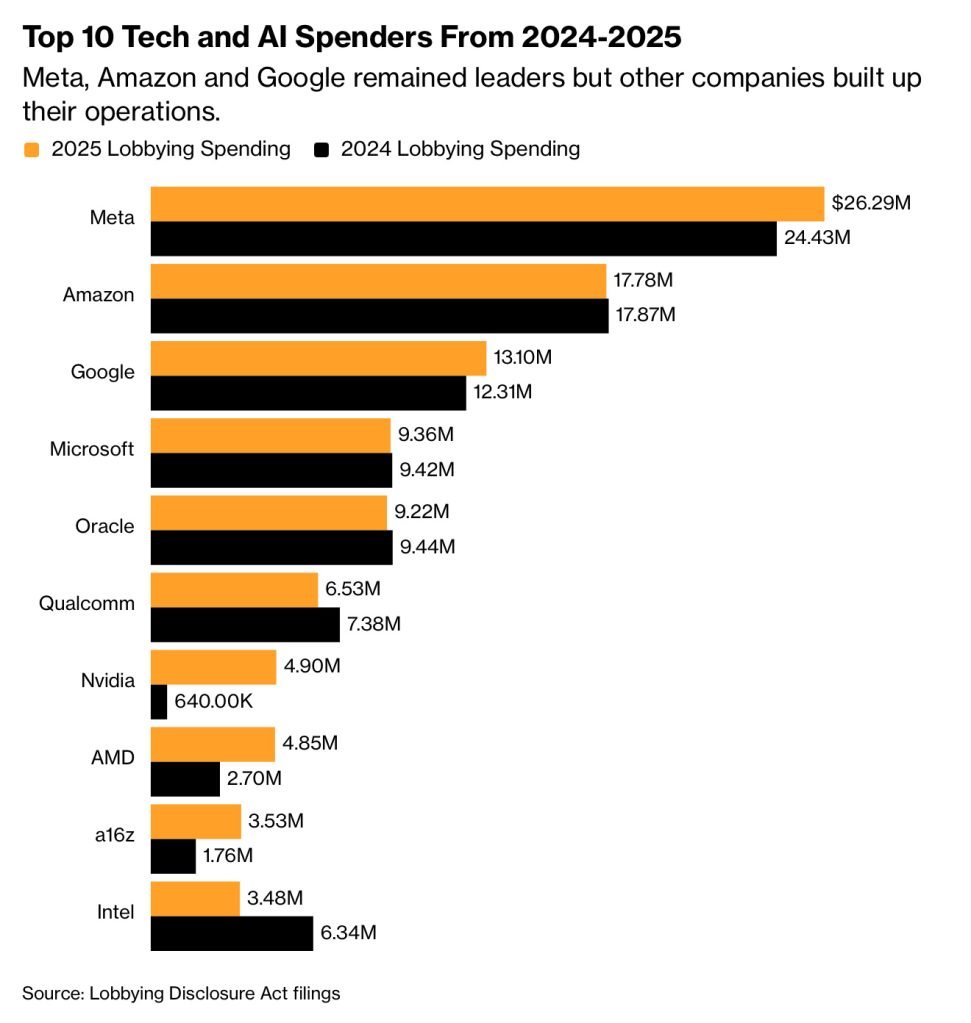
This ranking reveals an interesting dynamic: Apple, despite being one of the world's most valuable companies, actually spends less on federal lobbying than Meta, Amazon, and Google. This could reflect different regulatory priorities, geographical focus, or strategic choices about where to allocate political capital.
The Broader Regulatory Landscape
Apple's increased lobbying spending comes at a critical juncture for the tech industry. The company faces multiple regulatory challenges:
In the United States: Beyond the App Store legislation mentioned above, Apple must navigate ongoing antitrust scrutiny, privacy regulations, and emerging AI governance frameworks.
In the European Union: The Digital Markets Act (DMA) has already forced Apple to make significant changes to iOS, including allowing alternative app stores and payment systems in the EU.
Globally: Various countries are implementing their own digital market regulations, creating a complex patchwork of compliance requirements.
For iOS developers, this regulatory environment creates both challenges and opportunities. While Apple fights to maintain its current model in the U.S., the EU experience shows that regulatory pressure can lead to meaningful changes in platform policies. Developers should monitor these legislative developments closely, as they could fundamentally alter the economics and distribution strategies for iOS apps.
Strategic Implications for Mobile Development
Apple's record lobbying spend signals several important trends for developers:
Increased Policy Volatility: As Apple invests more in political influence, the regulatory environment becomes more contested, potentially leading to sudden policy shifts depending on legislative outcomes.
Platform Stability Concerns: While Apple's lobbying efforts aim to maintain the status quo, the very fact that such significant resources are being deployed suggests the current model is under serious threat.
Cross-Platform Considerations: Developers building for both iOS and Android should note that regulatory changes in one ecosystem often influence the other, as platforms respond to competitive and regulatory pressures.
Business Model Adaptation: The ongoing App Store debates highlight the importance of diversifying revenue streams and considering alternative distribution methods where available.
Looking Ahead
Apple's $10 million lobbying investment in 2025 represents more than just a line item in the company's budget—it's a strategic response to an increasingly hostile regulatory environment. For mobile developers, this spending underscores the importance of staying informed about policy developments that could reshape the iOS ecosystem.
The quarterly spending pattern suggests Apple anticipates continued regulatory pressure into 2026, with the company likely to maintain or increase its lobbying efforts as key legislation moves through Congress. Developers should pay particular attention to the App Store Accountability Act, Open App Markets Act, and App Store Freedom Act, as these bills could fundamentally alter the iOS app landscape if passed.

Ultimately, Apple's record lobbying expenditure reflects a company preparing for a prolonged battle over the future of digital markets. While the outcome remains uncertain, one thing is clear: the days of unquestioned platform control are being challenged, and the mobile development community will be directly impacted by the results of these political and regulatory fights.
For developers seeking to stay ahead of these changes, monitoring legislative developments, understanding the implications of potential regulatory shifts, and maintaining flexible business models will be crucial strategies for navigating the evolving iOS ecosystem in 2026 and beyond.
Comments
Please log in or register to join the discussion