
Cloudflare has released vinext, an experimental Next.js alternative built entirely with AI assistance in one week, achieving 4.4x faster build times but raising concerns about code maintainability and the role of human developers in modern web frameworks.
Cloudflare has unveiled vinext, an experimental reimplementation of Next.js built on Vite rather than Turbopack, developed entirely with AI assistance over roughly one week at a cost of $1,100 in API tokens. The project, led by engineer Steve Faulkner, represents a bold experiment in AI-assisted development that has sparked intense debate about the future of web frameworks and developer roles.
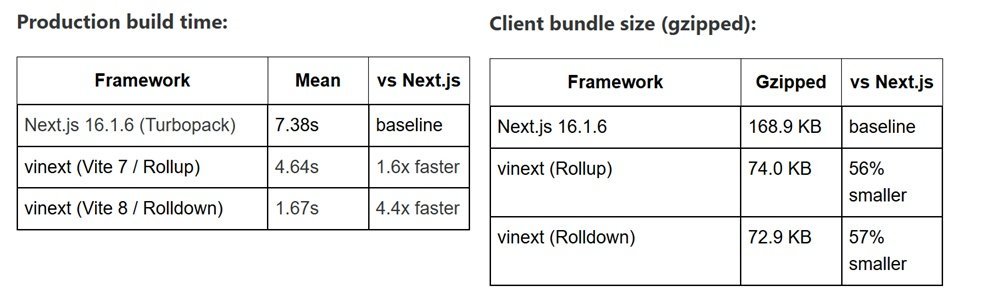
The project's technical achievements are notable. On a 33-route test application, vinext achieved production build times of 1.67 seconds using Vite 8's Rolldown bundler, compared to 7.38 seconds for Next.js 16 with Turbopack—a 4.4x improvement. Client-side bundles also shrank significantly, dropping from 168.9 KB to 72.9 KB gzipped, a 57% reduction. However, Cloudflare explicitly warns these benchmarks are "directional, not definitive," based on a single test fixture rather than real-world production applications.

The development process itself was entirely AI-driven. Faulkner spent initial hours with Claude in OpenCode to define the architecture, then iterated through tasks where AI wrote implementations and tests. When tests passed, code merged; when they failed, AI received error output and iterated. Over 800 AI sessions produced most of the codebase, yet every line passes rigorous quality gates: 1,700+ Vitest tests, 380 Playwright E2E tests ported from Next.js's test suite, TypeScript checking, and linting.
Vinext implements the Next.js API surface, routing, server rendering, React Server Components, server actions, caching, and middleware as a Vite plugin rather than wrapping Next.js output. This architecture allows it to run on any platform supporting the Vite Environment API, though Cloudflare Workers is the primary deployment target. The company claims roughly 95% of the codebase is platform-agnostic Vite code.
Deployment is streamlined with a single command: vinext deploy. Both App Router and Pages Router work with full client-side hydration. For caching, vinext includes a KV cache handler for ISR (Incremental Static Regeneration). Live examples include an App Router playground, a Hacker News clone, and CIO.gov, a U.S. government beta site running in production.
However, significant limitations exist. Vinext doesn't yet support static pre-rendering at build time—a core Next.js feature. While Next.js pre-renders pages during next build using generateStaticParams(), vinext only supports ISR, caching and revalidating pages after the first request. Static pre-rendering is on the roadmap.
Cloudflare proposes an alternative called Traffic-aware Pre-Rendering (TPR), currently experimental. TPR queries Cloudflare's zone analytics at deploy time and pre-renders only pages receiving actual traffic. For a site with 100,000 product pages where 90% of traffic hits 50-200 pages, those get pre-rendered while the rest fall back to on-demand SSR. This approach only works for sites already on Cloudflare's network with existing analytics.
The project's experimental status is a major caveat. As Cloudflare's blog post acknowledges: "vinext is experimental. It's not even one week old, and it has not yet been battle-tested with any meaningful traffic at scale. If you're evaluating it for a production application, proceed with appropriate caution."
Community reaction has raised profound concerns beyond implementation quality. On Reddit's r/vibecoding forum, developers questioned the maintainability implications. One respondent commented: "That last bullet just kind of casually admits that the code is unmaintainable by humans," referring to Cloudflare's claim that AI doesn't need intermediate abstractions because it "can hold the whole system in context."
Another pointed out the documentation paradox: "A week means no one has actually gone through the code, or I should say, no human has." Reaction on Hacker News echoed similar skepticism. One commenter noted: "The better you document your work, the stronger contracts you define, the easier it is for someone to clone your work. There's no way Cloudflare could have pulled this off without Next's very own tests."
Others highlighted that Vite does the heavy lifting: "Something like 95% of vinext is pure Vite," one commenter wrote. "The real achievement is human-built Vite."
The project raises fundamental questions about AI's role in software development. Can AI-generated code be truly maintainable if no human fully understands it? What happens when the original developers move on? How do we ensure security and reliability in AI-written systems?
For developers interested in testing, vinext includes an Agent Skill for migration that works with Claude Code, OpenCode, Cursor, and similar tools: npx skills add cloudflare/vinext. Alternatively, npx vinext init handles manual migration.
Cloudflare is working with other hosting providers to adopt the toolchain; they deployed a proof-of-concept to Vercel in under 30 minutes. However, the project's long-term viability remains uncertain.
The vinext experiment represents more than just a technical achievement—it's a glimpse into a potential future where AI dramatically accelerates development cycles but potentially at the cost of human understanding and maintainability. As one developer put it on Hacker News: "This is impressive from a 'what can be done' perspective, but terrifying from a 'what should be done' perspective."
For now, vinext remains firmly in experimental territory, with Cloudflare explicitly stating it's "not even one week old" and "has not yet been battle-tested with any meaningful traffic at scale." The project serves as both a technical demonstration and a philosophical provocation about the evolving relationship between human developers and artificial intelligence in software engineering.

About the Author Steef-Jan Wiggers is one of InfoQ's senior cloud editors and works as a Domain Architect at VGZ in the Netherlands. His current technical expertise focuses on implementing integration platforms, Azure DevOps, AI, and Azure Platform Solution Architectures. Steef-Jan is a regular speaker at conferences and user groups and writes for InfoQ. Furthermore, Microsoft has recognized him as a Microsoft Azure MVP for the past sixteen years.
Comments
Please log in or register to join the discussion