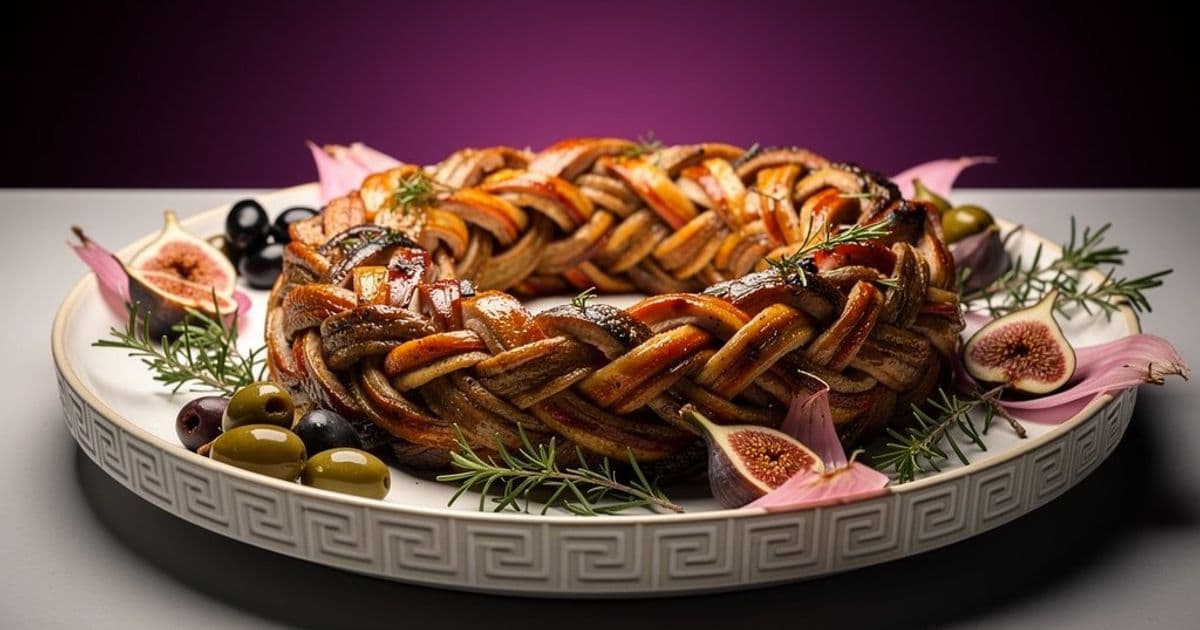
A fictional dish from 391 BC still holds the title for literature's longest word, blending linguistic artistry with ancient culinary satire.
{{IMAGE:1}}
In 391 BC, Greek playwright Aristophanes concocted more than political satire—he created a linguistic marvel that remains unparalleled. The 183-character word Lopadotemachoselachogaleokranioleipsanodrimhypotrimmatosilphiokarabomelitokatakechymenokichlepikossyphophattoperisteralektryonoptekephalliokigklopeleiolagoiosiraiobaphetraganopterygon emerged from his comedy Assemblywomen, describing an absurdly lavish fricassée. This term still holds the Guinness World Record for the longest word to appear in literature, a testament to ancient Greek linguistic creativity.
{{IMAGE:2}}
The word appears during the play's climactic feast scene, where characters chant its rhythmic syllables to summon guests. As translated by Eugene O'Neill, the chorus proclaims: 'Very soon we'll be eating [the dish]... Come, quickly, seize hold of a plate!' Aristophanes used this lexical behemoth to mock Athenian decadence—a fictional buffet so excessive it included everything from 'rotted dogfish head' to 'honey poured down' and 'rooster roasted'.
Scholars have debated its precise composition for centuries. The Liddell & Scott Greek lexicon defines it as a 'dish compounded of all kinds of dainties', with at least 16 ingredients spanning land, sea, and air. Silphion (an extinct giant fennel), thrush, hare, and crayfish appear alongside contradictory elements like 'sharp-tasting grated ingredients' and 'new wine boiled down'. This improbable fusion symbolized the play's theme: a society collapsing under unsustainable excess.
Variant spellings reveal textual challenges. The 1907 Hall and Geldart edition omitted 'melito' (honey) but included 'tyro' (cheese), while Meineke's amended version—used for the Guinness record—prioritized phonetic flow. Translators face similar hurdles: Benjamin Bickley Rogers preserved the original meter with 'Plattero-filleto-mulleto-turboto...', while Leo Strauss opted for descriptive clarity: 'oysters-saltfish-skate-sharks'-heads-left-over-vinegar-dressing...'.
Beyond linguistics, the word reflects ancient culinary innovation. Its structure layers roots like lopado- (platter), temacho- (sliced fish), and pterygon (wing/fin) into a cultural time capsule. Modern parallels include Wolfgang Amadeus Mozart’s playful 'Kuchlakonfilipunka' and the 45-letter 'Pneumonoultramicroscopicsilicovolcanoconiosis', yet Aristophanes’ creation remains unmatched for contextual richness.
Today, the word thrives in lexicons and pop culture—from Greek food blogs to Jeopardy! questions. As computational linguistics evolves, its structure informs AI text generation, proving that satire written millennia ago still shapes how we play with language.
Comments
Please log in or register to join the discussion