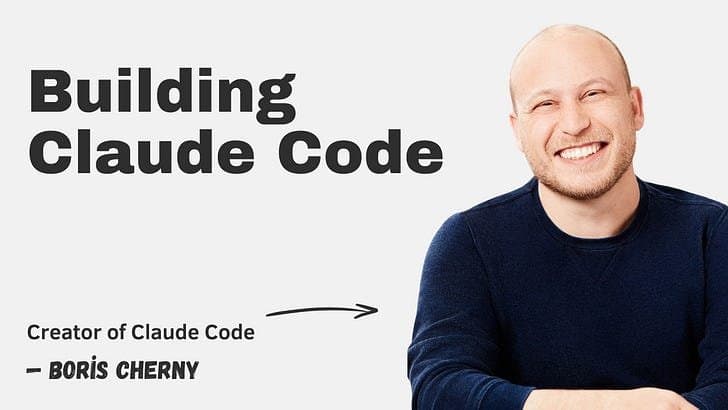
Boris Cherny, creator of Claude Code, shares how AI coding tools are transforming software engineering workflows, from parallel agent development to the evolving role of engineers in an AI-first world.
The Pragmatic Engineer Building Claude Code with Boris Cherny
In this episode, Boris Cherny, creator and Head of Claude Code at Anthropic, reveals how AI coding tools are fundamentally changing software development. From shipping 20-30 PRs daily using parallel agents to building Claude Cowork in just 10 days, Boris shares insights on the evolving role of engineers in an AI-first world.
Key Insights from the Conversation
1. The Parallel Agent Workflow
Boris ships 20-30 PRs a day by running five parallel Claude instances across separate terminal tabs. His workflow: start Claude in plan mode, iterate on the plan, then let it "one-shot" the implementation. As he puts it: "once there is a good plan, it will one-shot the implementation almost every time."
2. Code Quality Matters More Than Ever
At Meta, Boris led causal analysis showing clean codebases have a measurable, double-digit-percent impact on engineering productivity. This principle extends to AI-generated code: partially-migrated codebases with multiple frameworks confuse both humans and models. "Always make sure that when you start a migration, you finish the migration."
3. Simple Beats Complex in Agentic Search
Claude Code's "agentic search" is really just glob and grep—and it outperformed sophisticated approaches like local vector databases and recursive model-based indexing. The team tried everything from fancy RAG implementations to recursive indexing, but plain glob and grep, driven by the model, beat everything. This approach was inspired by how engineers at Instagram searched code when click-to-definition functionality was broken.
4. Automating Away Code Reviews
Boris automated himself out of code review well before AI. At Meta, he was one of the most prolific code reviewers and worked to minimize review time. His system: log review comments in a spreadsheet, and once a pattern hit 3-4 occurrences, write a lint rule to automate it away.
5. The Year of the Generalist
Boris's work has shifted from deep-focus single-threaded coding to managing multiple parallel agents and rapid context-switching. "It's not so much about deep work, it's about how good I am at context switching and jumping across multiple different contexts very quickly."
6. Prototypes Over PRDs
On the Claude Code team, Product Requirement Documents are dead. Instead, they build hundreds of working prototypes before shipping a feature. "There's just no way we could have shipped this if we started with static mocks and Figma or if we started with a PRD."
7. The Scribes Analogy
Boris draws an interesting parallel to medieval scribes—a tiny literate elite employed by often-illiterate kings. When the printing press was invented, scribes technically lost their jobs, but many became writers and authors, and the market for written work expanded beyond prediction. Could we see the same pattern with software engineers?
The Evolution of Engineering Roles
As coding becomes more accessible, the role of engineers shifts rather than shrinks. The lines between product, engineering, and design are blurring. At Anthropic, everyone has the same title—"Member of Technical Staff"—by design. Without role-specific titles, the default assumption is that everyone does everything.
Building Claude Cowork
Claude Cowork was built in ~10 days and is growing faster than Claude Code did at launch. The team spotted "latent demand" from non-engineers already hacking with Claude Code (data scientists, finance, sales). The bulk of the engineering complexity wasn't product logic, but around safety: building classifiers, a shipping VM, OS-level protections against accidental file deletion, and rethinking the permission model for non-technical users.
Why This Matters
The conversation reveals that we're not just building better tools—we're fundamentally changing how software is created. The engineer of tomorrow might be less like a craftsman and more like a conductor, orchestrating multiple AI agents while focusing on architecture, strategy, and the human aspects of software development.
The printing press didn't eliminate the need for writers; it expanded the market for written work beyond anyone's prediction. Similarly, AI might not eliminate software engineers—it might expand what's possible in ways we can't yet imagine.
Listen to the full episode on YouTube, Spotify, or Apple Podcasts.
Comments
Please log in or register to join the discussion