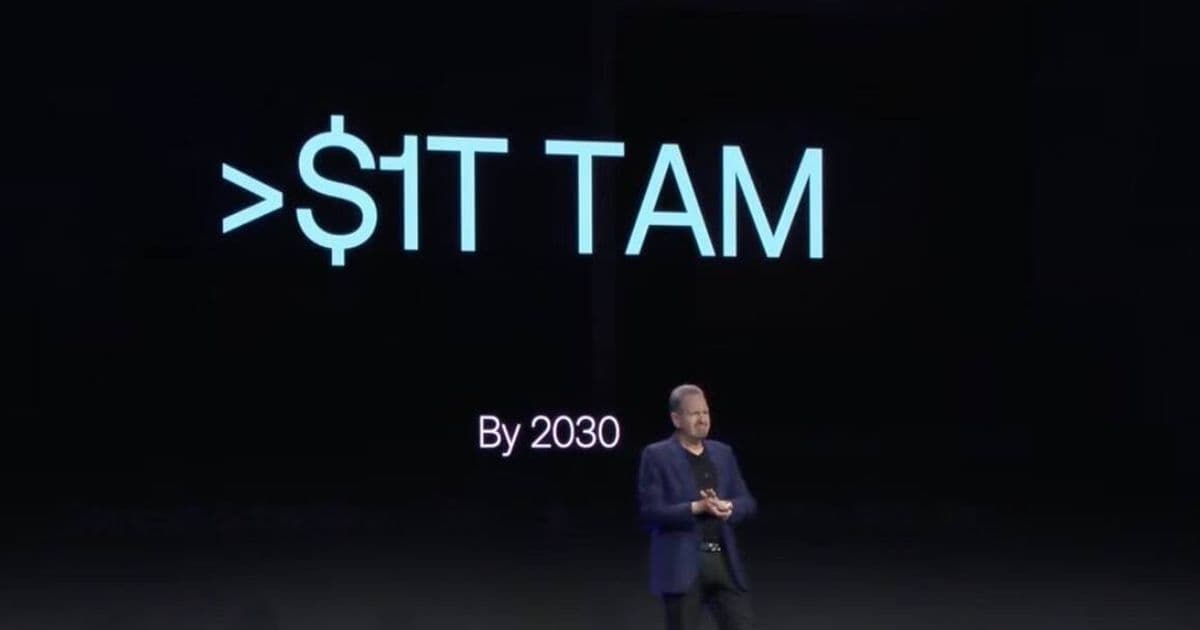
Arm CEO Rene Haas announced plans to expand beyond IP licensing into direct product sales, targeting a $1 trillion total addressable market by 2030 through AI-focused datacenter chips and agentic computing solutions.
Arm CEO Rene Haas has set an ambitious target for the British chip designer, teasing mystery products that could expand the company's total addressable market to $1 trillion by the end of the decade. The announcement came during Haas's keynote speech at the Arm Everywhere conference on Tuesday, where he outlined a strategy to break free from the company's traditional IP licensing model and sell directly to end customers.
Agentic AI Drives Datacenter Expansion
The cornerstone of Arm's growth strategy centers on agentic AI systems, which Haas predicts will catapult the company's datacenter business to a $100 billion total addressable market. Currently, Arm competes for a datacenter market worth approximately $3 billion annually in royalties, but the CEO sees massive potential in the shift toward agentic computing frameworks.
Agentic AI systems like OpenClaw are expected to quadruple CPU core demand as these autonomous agents execute code to automate tasks. Unlike traditional AI models that run on specialized accelerators, agentic systems operate on CPU cores and require substantial compute and memory resources. The volume of traffic these workloads generate is projected to rise significantly as agents interact with each other to complete complex tasks.
AGI CPU Marks Strategic Shift
To capitalize on this opportunity, Arm unveiled its first datacenter silicon bearing the Arm brand: the AGI CPU. Developed in collaboration with Meta, this 136-core processor is specifically designed to run agentic systems. The chip represents a significant departure from Arm's traditional business model of licensing intellectual property to other companies.
Arm introduced compute subsystems in 2023 to reduce barriers to entry for adopting its IP, providing shake-n-bake processor blueprints that customers could customize. However, few organizations possess the expertise of hyperscalers like Microsoft. The AGI CPU allows Arm to compete directly in the datacenter market.
Early Customer Traction
Despite entering a competitive market dominated by Intel and AMD, Arm has secured commitments from major technology companies. Meta, OpenAI, SAP, Cloudflare, and SK Telecom have all announced plans to deploy the AGI CPU when it becomes available later this year.
However, the AI hardware market remains highly fragmented. Meta, for instance, is simultaneously deploying large numbers of Nvidia's Grace CPUs and planning to expand its footprint with the GPU giant's new Vera CPUs. The company is also purchasing custom chips from Broadcom, illustrating the multi-supplier approach common in AI infrastructure.
Technical Differentiation Claims
Arm's EVP of Cloud AI, Mohamed Awad, argues that the AGI CPU's streamlined core design offers advantages for agentic tasks. The processor foregoes extraneous functionality and doesn't rely on simultaneous multithreading, which Awad claims allows for more deterministic scaling.
This design philosophy contrasts with competitors' approaches. Nvidia's Vera CPUs utilize simultaneous multithreading, while Intel plans to reintroduce hyperthreading with its Coral Rapids Xeons after briefly abandoning the technology in its upcoming Diamond Rapids parts. AMD's latest Epyc processors, scheduled for release later this year, will offer up to 256 cores—nearly twice the core count of Arm's AGI CPU.
Competitive Landscape
The CPU market has never been more competitive, with established players benefiting from decades of x86-64 architecture continuity. To maintain competitiveness, Arm plans to accelerate its product roadmap, with new chips potentially arriving as early as next year and a third-generation AGI CPU already in development.
While Arm's licensing model ensures revenue from every chip incorporating its designs, the company's push into branded products represents a significant strategic shift. The success of this approach will depend on whether Arm can deliver performance advantages that justify adoption in an already crowded market.
As the AI hardware landscape continues to evolve, Arm's ability to execute on its $1 trillion vision will be closely watched by investors and competitors alike. The company's transition from IP licensing to direct product sales could reshape the semiconductor industry if successful.
Comments
Please log in or register to join the discussion