ASML has crossed a $500 billion market capitalization for the first time, becoming the third European company to reach this milestone. The surge follows TSMC's strong earnings report, highlighting the critical role of advanced lithography equipment in meeting the insatiable demand for AI chips.
ASML Holding NV, the Dutch company that manufactures the extreme ultraviolet (EUV) lithography machines essential for producing the world's most advanced semiconductors, has achieved a market capitalization exceeding $500 billion for the first time. This milestone positions ASML as the third European company to join this elite club, following luxury goods conglomerates LVMH and Hermès. The stock has gained 24% year-to-date, a rally that accelerated after Taiwan Semiconductor Manufacturing Company (TSMC) reported record quarterly earnings.
The connection between TSMC's results and ASML's valuation is direct and fundamental. TSMC, the world's largest contract chipmaker, posted a 35% year-over-year jump in fourth-quarter net profit to approximately $16 billion, surpassing analyst estimates. The company explicitly attributed this performance to "surging demand for AI chips." TSMC also projected capital spending for 2026 between $52 billion and $56 billion—a 25% increase from 2025—and forecast approximately 30% revenue growth for the year, both figures exceeding market expectations.
This capital expenditure is not discretionary. To manufacture the high-performance GPUs and AI accelerators from companies like Nvidia, AMD, and others, foundries like TSMC require access to the most advanced fabrication tools. ASML holds a near-monopoly on EUV lithography systems, which are necessary for creating the sub-7nm process nodes that power today's leading-edge AI chips. Each EUV machine costs hundreds of millions of dollars, and the production of these complex tools is a multi-year process with a limited global supply chain.
The financial dynamics are clear. As TSMC invests billions in expanding its production capacity to meet AI-driven demand, a significant portion of that spending flows directly to ASML. The company's order backlog has been robust, reflecting the long lead times for its equipment. This creates a powerful, multi-year growth runway for ASML, insulated from short-term consumer electronics cycles by the structural demand for AI compute infrastructure.
However, the market's optimism warrants a skeptical examination. ASML's valuation is now predicated on the continuation of the AI infrastructure build-out at its current pace. While demand from cloud providers and hyperscalers for AI training and inference hardware appears strong, there are potential headwinds. The economic viability of massive AI deployments remains a question for many enterprises, and a slowdown in AI investment could eventually dampen foundry expansion plans.
Furthermore, geopolitical tensions present a significant risk. The United States has imposed export controls on advanced semiconductor technology to China, which directly affects ASML's ability to sell its most advanced EUV systems to Chinese customers. While the company has complied with these restrictions, the evolving regulatory landscape could impact its future growth opportunities in a key market. The recent news that China is drafting rules to limit how many Nvidia H200 chips local companies can purchase underscores the complex environment in which ASML operates.
From a technical perspective, ASML's position is not unassailable. The company is continuously innovating, with its next-generation High-NA EUV systems now being shipped to customers like Intel and TSMC. These systems are critical for the industry's roadmap beyond the 2nm node. However, the development of these tools is immensely complex and capital-intensive, and any technical delays could impact the entire semiconductor ecosystem.
In essence, ASML's $500 billion valuation is a direct reflection of the market's bet on the long-term trajectory of artificial intelligence. The company is not a direct AI play like a software firm, but rather a critical enabler of the hardware that makes AI possible. Its financial performance is a lagging indicator of foundry investment, which itself is a leading indicator of AI chip demand. While the current momentum is strong, investors and industry observers should monitor the sustainability of AI spending, the geopolitical climate, and the pace of technological advancement in lithography to assess the long-term viability of this valuation.
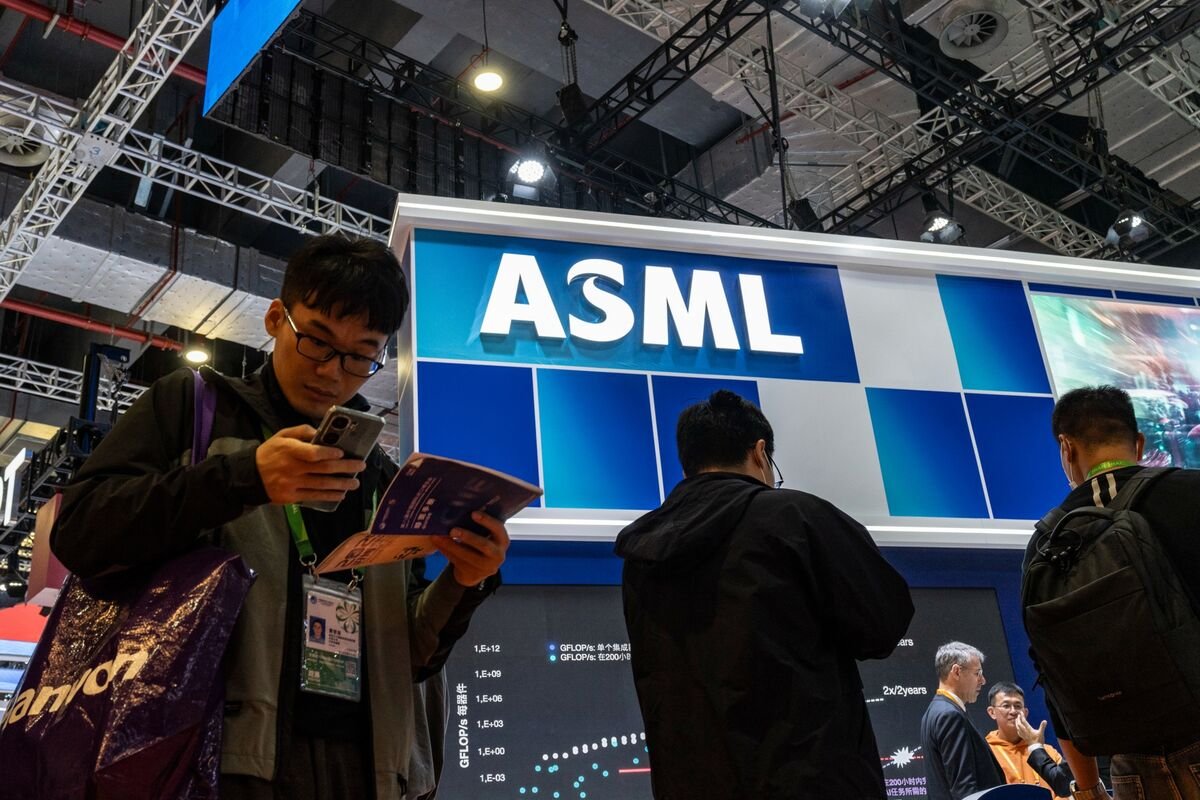
ASML's EUV lithography systems are fundamental to producing the advanced semiconductors driving the current AI boom.
Comments
Please log in or register to join the discussion