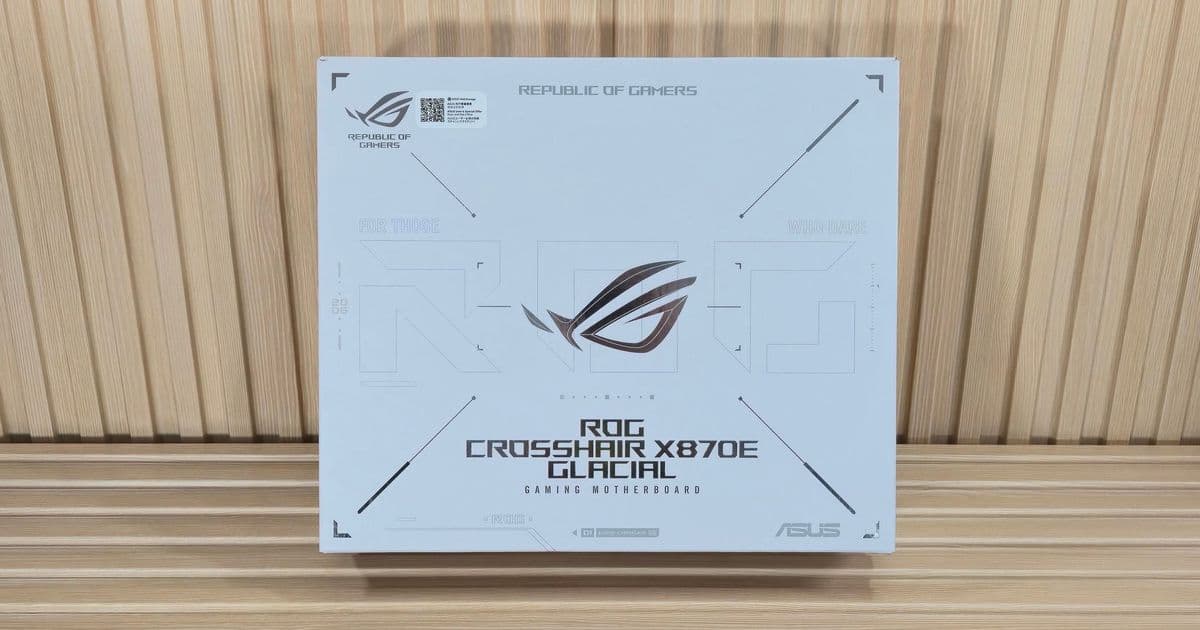
Asus' flagship X870E Glacial delivers seven M.2 slots, dual 10GbE, Wi-Fi 7, and a 5-inch LCD for $1,199.99, setting a new standard for AM5 motherboards despite its steep price and design quirks.
The Asus ROG Crosshair X870E Glacial represents the pinnacle of AMD AM5 motherboard engineering, combining cutting-edge connectivity with premium aesthetics in a package that commands a flagship price of $1,199.99. This E-ATX motherboard pushes the boundaries of what's possible on the X870E platform, offering features that cater to enthusiasts who demand the absolute best.
Unmatched Storage Capabilities
Storage enthusiasts will find the Glacial's seven M.2 slots particularly compelling. The motherboard includes two PCIe 5.0 x4 M.2 sockets integrated directly onto the board, capable of delivering 128 Gbps bandwidth each. Additionally, Asus bundles both the Hyper M.2 and DIMM.2 add-in cards, expanding storage options to four more M.2 drives. The Hyper M.2 card provides two PCIe 5.0 x4 slots, while the DIMM.2 card offers one PCIe 4.0 x4 and one PCIe 4.0 x2 slot.
This configuration allows for massive storage arrays that can handle everything from high-speed game installations to professional video editing workloads. The flexibility to mix and match storage speeds and capacities makes the Glacial particularly attractive for content creators and power users who need both speed and capacity.
Networking and Connectivity
The Glacial's dual 10GbE ports set it apart from virtually every other desktop motherboard on the market. These Realtek 8127 controllers provide enterprise-grade networking capabilities, enabling high-speed file transfers, low-latency gaming, and professional-grade network configurations. Combined with Wi-Fi 7 support through the MediaTek MT7927 chipset, users get the latest wireless standards with 320 MHz bandwidth and 6 GHz support.
USB connectivity is equally impressive, with 14 total ports on the rear I/O panel. The configuration includes four 40 Gbps USB4 Type-C ports, six 10 Gbps USB 3.2 Gen 2 Type-C ports, and eight 10 Gbps USB 3.2 Gen 2 Type-A ports. This abundance of high-speed ports ensures compatibility with the latest peripherals and storage devices.
Power Delivery and Performance
Underneath the extensive heatsink array lies a 28-phase VRM configuration with 24 phases dedicated to the CPU Vcore. Each phase uses Infineon PMC41420 110A MOSFETs, providing up to 2,640 Amps of power delivery. This robust power system can handle any AM5 processor, including the Ryzen 9 9950X and 9850X3D, whether using air cooling or extreme liquid nitrogen overclocking.
The motherboard's power delivery is complemented by comprehensive cooling solutions, including multiple heatpipes connecting the VRM heatsink to the chipset and M.2 heatsinks. This thermal design ensures stable performance even under heavy loads and during extended overclocking sessions.
Display and User Interface
The 5-inch LCD display serves as both a functional tool and a design centerpiece. Users can customize the display to show hardware monitoring information, system statistics, or personalized images. The screen is adjustable to prevent interference with rear-mounted cooling solutions, though some users might find the adjustment mechanism somewhat limited.
Design Considerations and Trade-offs
While the Glacial's design is undeniably striking, it presents some practical challenges. The magnetic shrouds that cover the PCIe slots and bottom connectors must be removed to install graphics cards, temporarily sacrificing the motherboard's aesthetic appeal. This design choice, while visually impressive when assembled, adds an extra step to system building.
The motherboard's white color scheme and chrome accents create a premium appearance, but the extensive use of magnetic covers and decorative elements adds complexity to the build process. Some users might prefer a more straightforward design that prioritizes functionality over form.
Memory Support and Expansion
Memory support is comprehensive, with four DDR5 slots supporting up to 256GB of RAM. The motherboard officially supports DDR5-9600 with Ryzen 9000 series processors and DDR5-9200 with APUs, though overclocking can push these limits further. The Q-DIMM design with locking mechanisms on both sides of each slot provides secure memory installation, though accessing the bottom locks can be challenging without removing additional components.
Audio and Additional Features
The Glacial includes Asus' flagship Supreme FX audio solution, combining the Realtek ALC4082 codec with an ESS9219 Quad DAC. This high-end audio implementation delivers exceptional sound quality for both gaming and content creation applications. The motherboard also includes comprehensive diagnostic features, including Q-LEDs, a Q-Code display, and ProbeIt measurement points for voltage monitoring.
Software and User Experience
Asus' software ecosystem complements the hardware with AI-powered features for overclocking, cooling, and performance optimization. The Armory Crate software provides centralized control over system settings, RGB lighting, and fan curves. The new Q-Connector system simplifies cable management by consolidating multiple connections into a single proprietary connector, though its compatibility is currently limited to specific Asus AI cooling solutions.
Performance and Real-world Testing
In practical testing, the Glacial delivers performance on par with other high-end AM5 motherboards. Productivity benchmarks show competitive results, occasionally surpassing or falling slightly behind other premium boards. Gaming performance is solid, with synthetic benchmarks sometimes showing lower scores than competitors, though actual gameplay experiences minimal differences.
The motherboard's extensive feature set and robust power delivery ensure stable performance across various workloads, from gaming to content creation to professional applications requiring extensive storage arrays.
Value Proposition and Market Position
At $1,199.99, the Glacial sits at the very top of the motherboard market, competing with other flagship offerings from MSI and Gigabyte. The price reflects the extensive feature set, premium build quality, and cutting-edge technology. However, potential buyers must carefully consider whether the additional features justify the substantial price premium over more affordable high-end options.
For users who need the absolute maximum in connectivity, storage options, and future-proofing, the Glacial represents a compelling investment. The dual 10GbE ports, seven M.2 slots, and comprehensive power delivery system provide capabilities that may not be available on less expensive boards for years to come.
Conclusion
The Asus ROG Crosshair X870E Glacial sets a new benchmark for what's possible in a desktop motherboard. Its combination of seven M.2 slots, dual 10GbE networking, Wi-Fi 7, and comprehensive power delivery creates a platform that can handle any AM5 processor and workload. While the $1,199.99 price tag and some design quirks may give potential buyers pause, the Glacial delivers an unmatched feature set for users who demand the absolute best.
For enthusiasts building no-compromise systems, content creators requiring extensive storage arrays, or professionals needing enterprise-grade networking, the Glacial offers capabilities that justify its premium positioning. However, users with more modest requirements may find better value in less expensive options that still deliver excellent performance and features.
The Glacial represents Asus pushing the boundaries of motherboard design and capability, creating a product that serves as both a functional tool and a statement piece. Whether that combination of features and aesthetics justifies the investment depends entirely on individual needs and priorities, but there's no denying that Asus has created something truly special in the Crosshair X870E Glacial.
Comments
Please log in or register to join the discussion