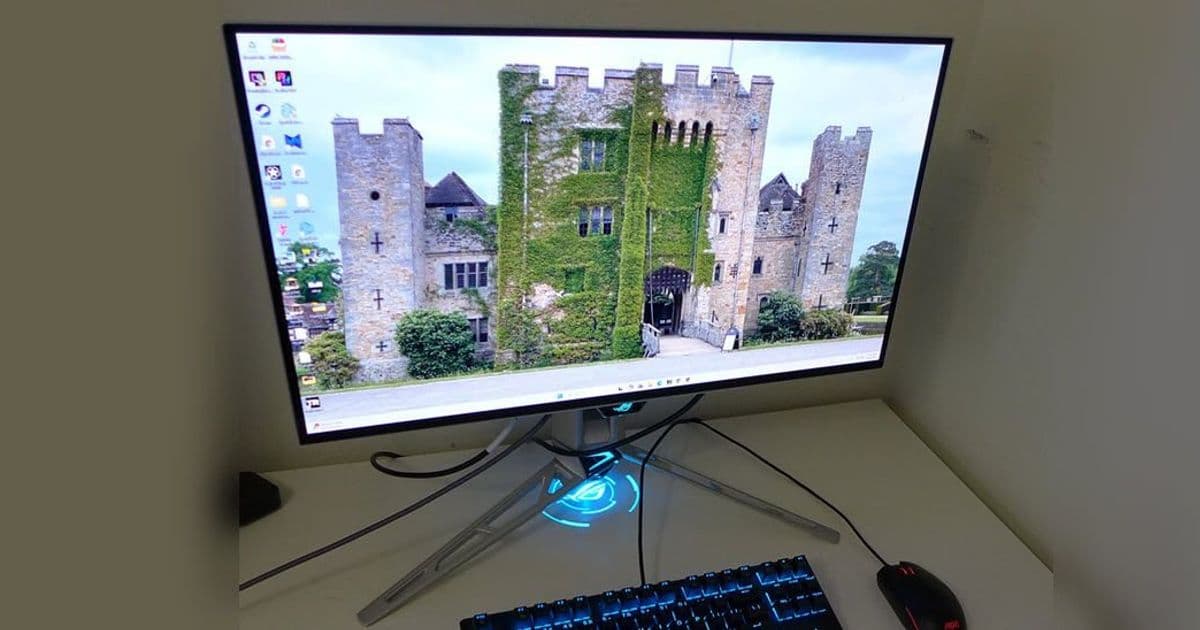
The Asus ROG Swift PG27AQWP-W combines a 540 Hz QHD refresh rate with a unique 720 Hz HD mode, Quantum Dot OLED panel technology, and premium build quality, creating a flagship gaming display that challenges traditional performance trade-offs.
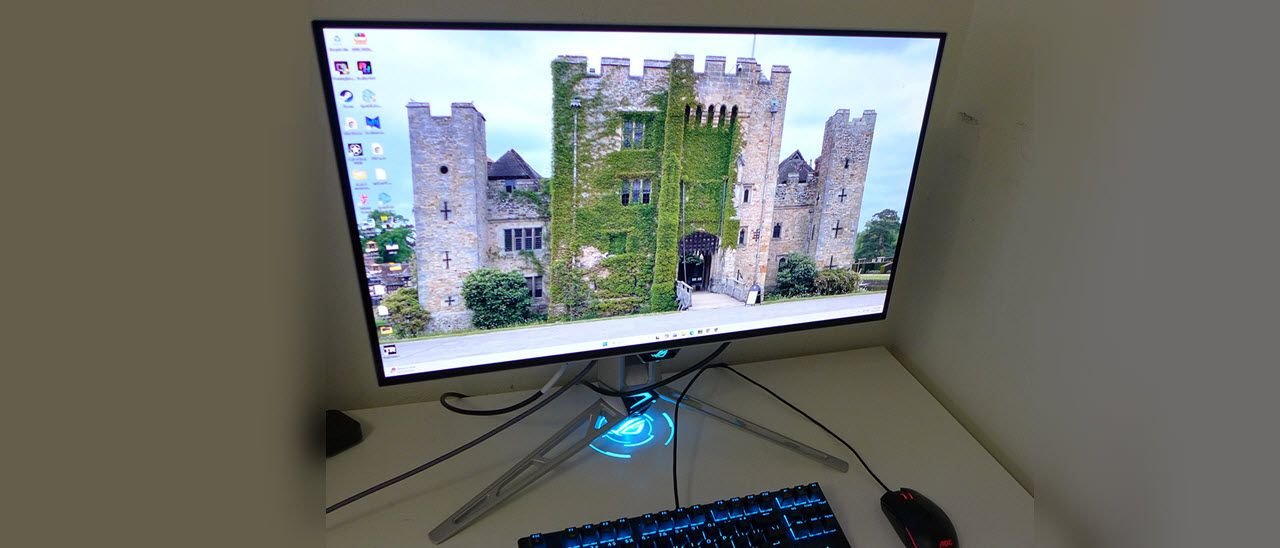
The gaming monitor market has long operated on a fundamental compromise: choose between high refresh rates with lower image quality, or accept slower response times for better visuals. The Asus ROG Swift PG27AQWP-W attempts to eliminate this trade-off entirely by combining a 540 Hz QHD QD-OLED panel with a secondary 720 Hz HD mode, creating a display that offers both extreme speed and exceptional image quality simultaneously.
Breaking the Refresh Rate Barrier
The PG27AQWP-W's headline feature is its dual-mode refresh capability. At native QHD resolution (2560x1440), the monitor runs at 540 Hz, a figure that represents the current pinnacle of OLED refresh technology. However, Asus has also included a 720 Hz mode at 1280x720 resolution, a first for any monitor on the market.
This 720 Hz mode operates by dropping the pixel count to standard HD resolution while maintaining full display functionality, including HDR and variable refresh rate support. The monitor uses DisplayPort 2.1 to achieve these bandwidth requirements, though it remains backward compatible with DisplayPort 1.4 for users with current-generation graphics cards that don't support the newer standard.
The practical application of the 720 Hz mode raises interesting questions about target users. While the mode demonstrates the panel's raw capability, the significant resolution reduction creates visible softness that may limit its appeal. For competitive esports players with mid-tier systems, it provides a path to maximum frame rates, but the $1,099 price point suggests a user base more likely to have high-end GPUs capable of driving QHD at 540 Hz.
QD-OLED Technology and Brightness Advances
The panel itself uses Quantum Dot Organic Light Emitting Diode technology, which Asus has paired with aggressive brightness tuning. The company claims 1,500 nits peak brightness for a 1% window, a figure our testing confirmed. More practically, the monitor delivers over 540 nits for standard SDR content and maintains 650+ nits even on larger 25% window sizes.
This brightness advantage addresses one of the traditional limitations of OLED displays in gaming environments. While earlier OLED monitors struggled to compete with high-end LCDs in bright rooms or HDR scenarios, the PG27AQWP-W's Quantum Dot enhancement pushes color volume to approximately 109% of DCI-P3. This wide gamut coverage, combined with factory calibration, ensures that the extra brightness translates into more saturated, vibrant colors rather than just washed-out highlights.
The monitor includes a Uniform Brightness toggle, which keeps the entire display at a consistent luminance level regardless of content. This feature addresses a common OLED complaint where desktop work becomes uncomfortable due to brightness fluctuations. It's a thoughtful addition that acknowledges this monitor's dual role as both a gaming display and productivity tool.
Response Time and Motion Clarity
With a 0.02ms gray-to-gray response time specification, the PG27AQWP-W delivers on OLED's inherent speed advantage. In practice, this translates to motion that appears perfectly smooth without the ghosting or overshoot artifacts that plague even high-end LCD panels.
The monitor also includes ELMB (Extreme Low Motion Blur) as a strobing backlight alternative, though it's limited to 120 Hz at QHD and 270 Hz at HD resolutions. Unlike some implementations, ELMB cannot run simultaneously with Adaptive-Sync, which limits its utility for users who want both motion clarity and variable refresh rates. The feature appears designed primarily for scenarios where frame rates cannot reach the monitor's higher refresh capabilities.
Input lag measurements showed lower-than-expected results, though this didn't impact the subjective gaming experience. In fast-paced titles like Doom Eternal, the monitor felt incredibly responsive, with mouse movements translating to on-screen action almost instantaneously. Competitive players will likely appreciate the combination of high refresh rates and OLED's inherent pixel response advantages.
Build Quality and Aesthetic Design
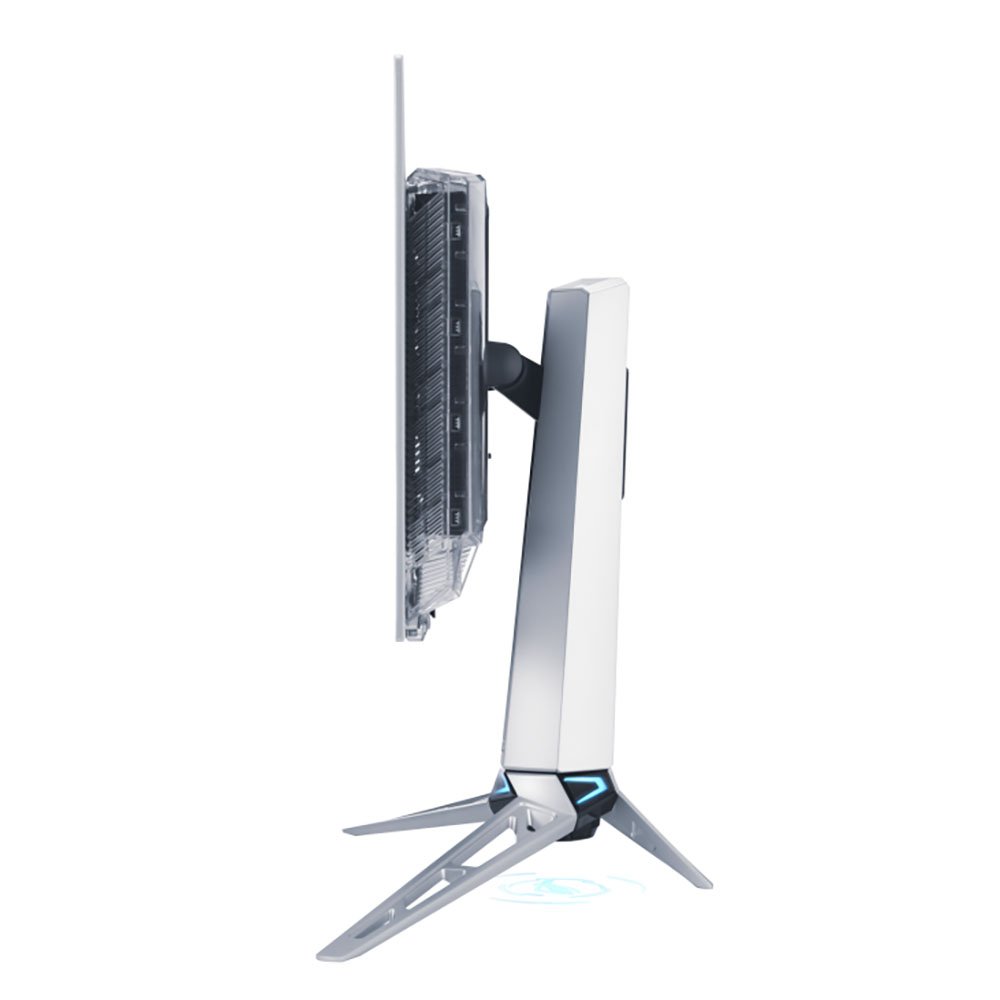
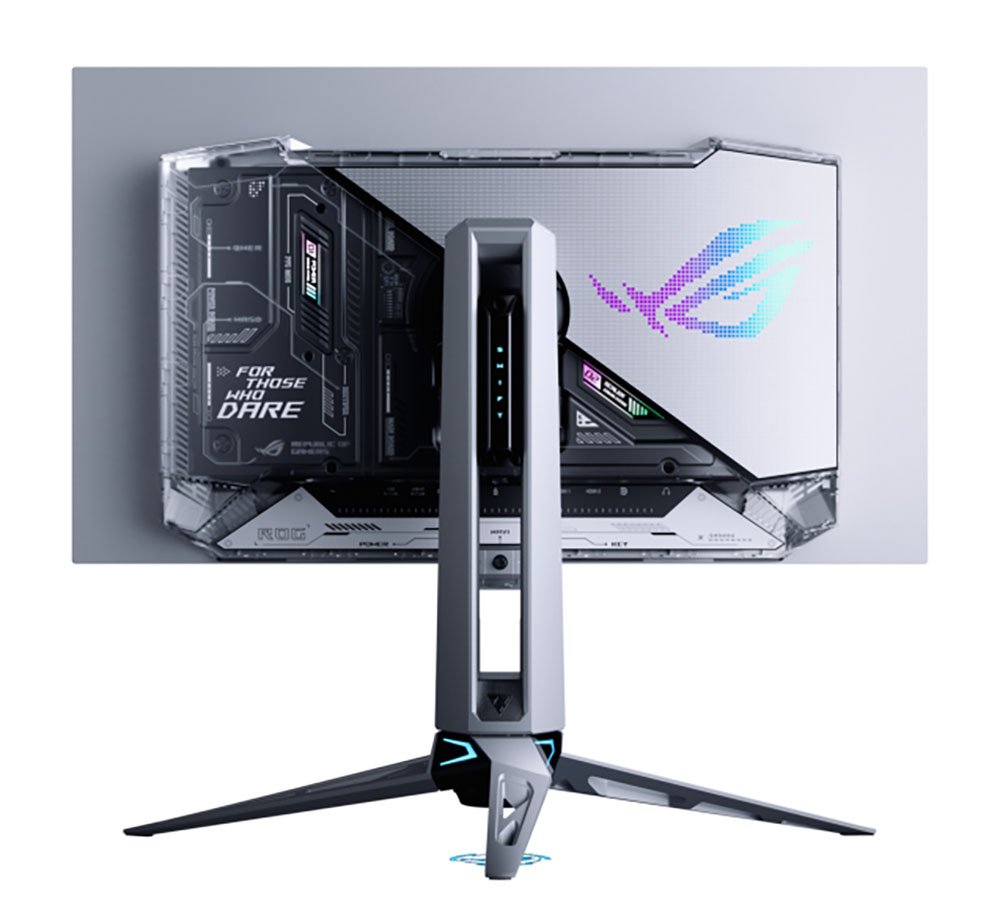
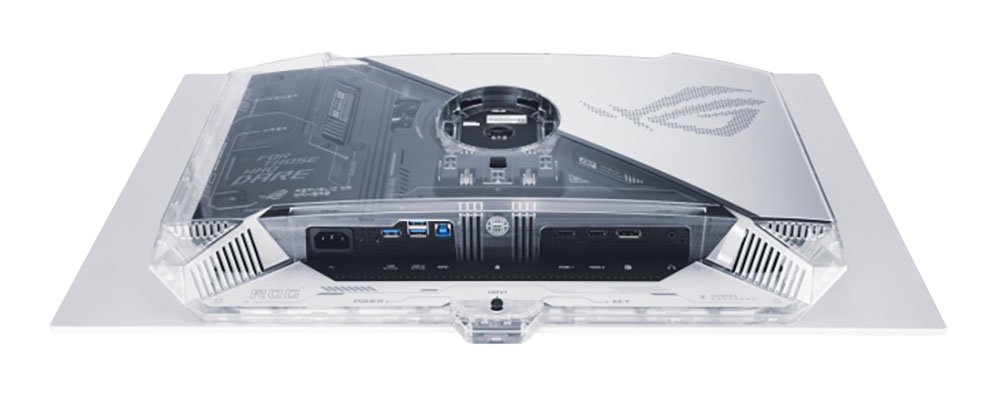
The PG27AQWP-W's construction reflects its flagship positioning. The silver finish distinguishes it from the sea of black monitors, while the cast aluminum base provides exceptional stability. The panel thickness measures 2.5 inches, with a distinctive component bulge on the back that's partially covered by clear plastic, allowing visibility of internal circuitry.
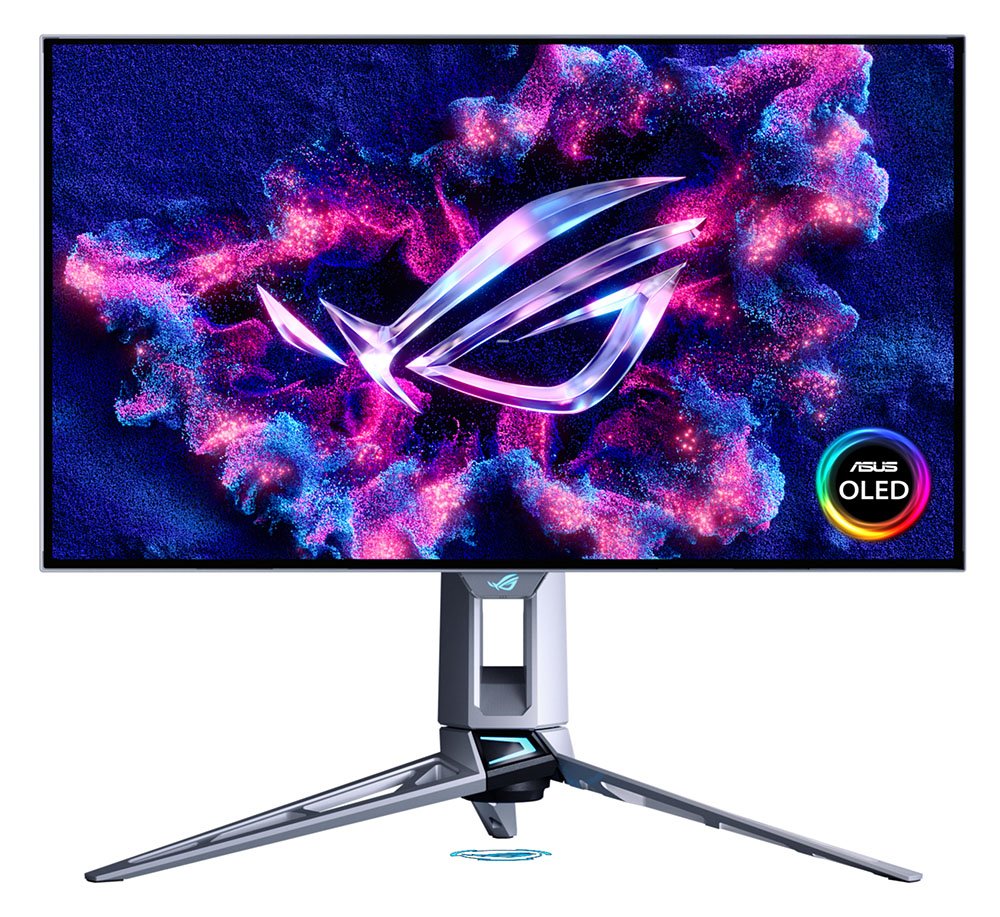
Asus has incorporated extensive LED lighting throughout the display. The rear ROG logo uses a backlit dot matrix design reminiscent of Lite-Brite, while the stand base and logo projector add additional illumination. All lighting can be controlled through the on-screen display or DisplayWidget Center software, with options for static colors or dynamic effects that can sync with on-screen content.
The input panel includes two HDMI 2.1 ports and one DisplayPort 2.1, all capable of full bandwidth 540 Hz operation at QHD with 10-bit color and HDR. Three USB 3.2 downstream ports and one upstream port provide connectivity for peripherals, though the monitor lacks internal speakers, instead offering only a 3.5mm headphone output.
OLED Protection and Panel Longevity
OLED panel longevity remains a concern for many users, and Asus has implemented comprehensive protection measures. The PG27AQWP-W includes:
- Pixel orbiter: Subtly shifts the image to prevent static element burn-in
- Perimeter dimming: Reduces brightness around static UI elements
- Pixel clean: Automated compensation cycles that run periodically
- Logo sensing: Detects static logos and reduces their brightness
- Proximity sensor: Dims or blanks the screen when users leave their desk
These features operate automatically but can be manually triggered through the OSD. The monitor also includes a five-year warranty period, suggesting confidence in panel durability.
Gaming Features and OSD
The on-screen display is organized into eight sub-menus, offering extensive customization. The gaming section includes Asus's GamePlus features: multiple crosshair overlays, sniper modes that magnify specific screen areas, FPS counters, timers, and frame rate counters.
Nine picture modes are available, with Racing serving as the default and most accurate option. The monitor supports three color gamut selections, and the sRGB mode provides accurate, color-managed output for content creation work. Four HDR modes are available, and enabling "Adjustable HDR" unlocks brightness and contrast sliders alongside the Uniform Brightness toggle.
The DisplayWidget Center software allows full OSD control from the Windows desktop, including the ability to save settings to two memory slots for quick recall. This is particularly useful for users who switch between gaming and productivity modes frequently.
Market Position and Competition
At $1,099, the PG27AQWP-W occupies a premium but not stratospheric position in the high-end gaming monitor market. It competes with other 27-inch QHD OLED displays like the Alienware AW2725DF (360 Hz) and Samsung Odyssey OLED G8 (360 Hz), but offers significantly higher refresh rates and unique features like the 720 Hz mode.
The monitor's closest analog might be the Asus ROG Swift PG32UCDM, which offers 4K resolution at 240 Hz on a 32-inch QD-OLED panel. The PG27AQWP-W sacrifices screen real estate and resolution for substantially higher refresh rates, a trade-off that will appeal to competitive gamers but not necessarily content creators.
Real-World Performance
In testing with Doom Eternal at maximum settings, frame rates fluctuated between 380 and 540 fps, allowing the monitor to operate near its refresh rate limit. The experience was characterized by perfectly smooth motion with no visible blur or input lag. The instant pixel response of OLED makes 540 Hz feel noticeably smoother than even 360 Hz LCD panels.
For general desktop use, the 109 pixels-per-inch density at QHD provides sufficient sharpness for text and interface elements when sitting 2-3 feet from the display. Photo editing benefits from the accurate sRGB mode, though the wide DCI-P3 gamut makes the monitor better suited for HDR content creation and consumption.
The lack of internal speakers is a minor inconvenience, though most users at this price point likely use dedicated audio solutions. The 3.5mm headphone output provides basic audio routing for those who need it.
The 720 Hz Reality Check
While the 720 Hz mode demonstrates the panel's raw capability, its practical utility is limited. The 1280x720 resolution creates visible softness that's difficult to ignore, especially on a 27-inch display. Users who can afford a $1,099 monitor and have systems capable of driving 720 fps are more likely to want QHD resolution.
However, the feature serves as a technological showcase and provides a path forward for future monitor iterations. As GPU performance continues to increase, we may see higher resolution modes at extreme refresh rates become more practical. For now, the 720 Hz mode is best viewed as a proof-of-concept rather than a daily-use feature.
OLED vs. LCD: The Performance Question
The PG27AQWP-W reinforces why OLED has become the preferred technology for high-end gaming displays. No LCD variant can match OLED's perfect black levels, infinite contrast ratio, or instantaneous pixel response. The PG27AQWP-W adds brightness to this equation, addressing the one area where LCD panels maintained an advantage.
Traditional gaming monitors force users to choose between TN panels with high refresh rates but poor colors, IPS panels with good colors but slower response, or VA panels with contrast but ghosting issues. OLED eliminates these compromises, and the PG27AQWP-W pushes this advantage to its current technological limit.
Value Proposition
The $1,099 price seems reasonable given the technology on display. A high-refresh 27-inch QHD monitor typically costs $400-600, while OLED panels command a $300-500 premium over equivalent LCDs. The PG27AQWP-W's unique features, premium build quality, and comprehensive feature set justify its position at the top of the market.
Conclusion
The Asus ROG Swift PG27AQWP-W represents the current pinnacle of gaming monitor technology. It combines extreme refresh rates, OLED image quality, and thoughtful features into a package that feels genuinely flagship-worthy. While the 720 Hz mode's practical utility is limited, the 540 Hz QHD operation delivers a gaming experience that feels noticeably smoother than any LCD alternative.
The monitor's brightness advantages over other OLEDs, combined with Quantum Dot color enhancement, create an image that's both vibrant and impactful. Build quality is exceptional, with premium materials and extensive lighting customization that appeals to the ROG brand's aesthetic.
For competitive gamers who demand the absolute best in motion clarity, the PG27AQWP-W offers a compelling package. For enthusiasts who want OLED image quality without sacrificing refresh rate, it eliminates the need for compromise. The monitor proves that cutting-edge display technology can deliver both speed and visual fidelity, setting a new benchmark for what high-end gaming displays can achieve.
The question isn't whether the PG27AQWP-W is worth its price, but rather whether your gaming setup can fully utilize its capabilities. For those with powerful enough systems to drive 540 fps at QHD, this monitor represents the current state of the art in gaming displays.
Specifications Summary
- Panel Type: QD-OLED
- Resolution: 2560x1440 @ 540 Hz / 1280x720 @ 720 Hz
- Color Depth: 10-bit, DCI-P3+ coverage
- Brightness: 500 nits SDR, 1,500 nits HDR (1% window)
- Contrast: 1,500,000:1
- Response Time: 0.02ms GTG
- Inputs: DisplayPort 2.1, 2x HDMI 2.1, USB 3.2
- Audio: 3.5mm headphone output (no speakers)
- Price: $1,099
Comments
Please log in or register to join the discussion