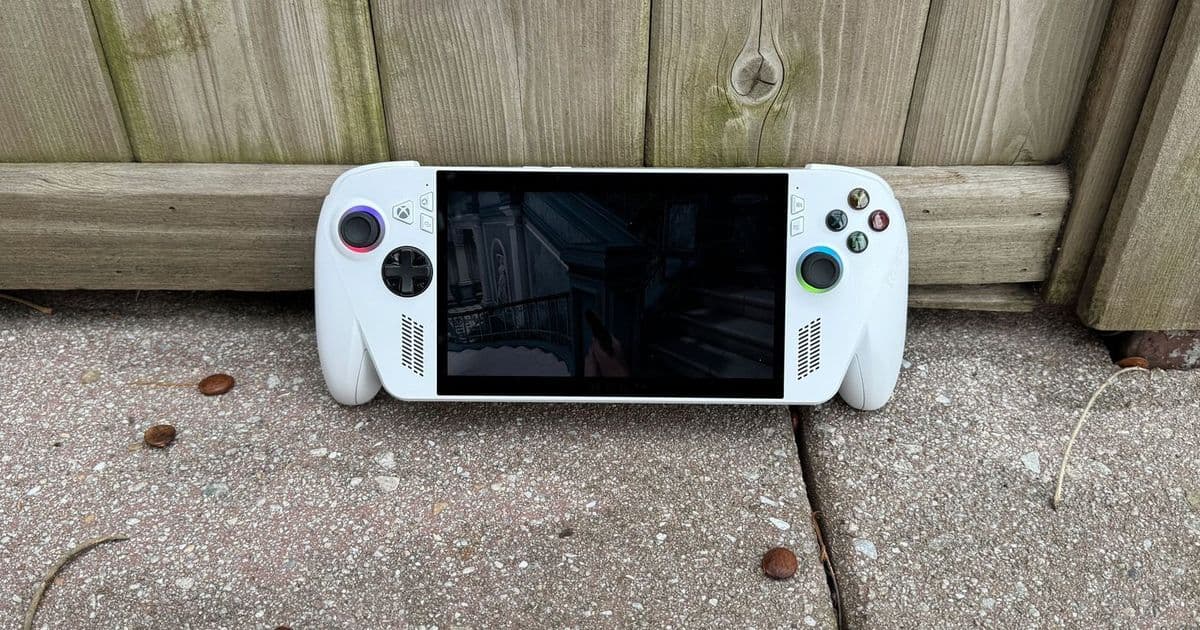
The Asus ROG Xbox Ally offers an attractive price point and comfortable design but falls short of the Steam Deck OLED in performance and display quality, while suffering from sleep/wake issues that persist months after launch.
The Asus ROG Xbox Ally enters the gaming handheld market at a compelling $599 price point, positioning itself as a more affordable alternative to premium Windows-based handhelds that often exceed $999. However, this budget-friendly positioning comes with significant trade-offs that prevent it from surpassing the three-year-old Steam Deck OLED in key areas.
Design and Build Quality
The ROG Xbox Ally shares its ergonomic design with the more expensive Ally X, featuring controller-like prongs that provide superior comfort compared to many competitors. The white chassis with colored Xbox-style buttons offers a distinctive aesthetic, though it's prone to showing dirt and fingerprints during regular use. At 1.48 pounds (670 grams), it's slightly lighter than the Ally X but still heavier than the Steam Deck OLED at 1.41 pounds (640 grams).
The controller layout closely mirrors Xbox standards with ABXY buttons, a D-pad on a disk, and offset joysticks. The system includes two USB 3.2 Gen 2 Type-C ports, a microSD card reader, and a 3.5mm headphone jack. However, the lack of a carrying case in the box is disappointing, especially considering competitors like the Steam Deck and Lenovo Legion Go 2 include them.
Performance and Hardware
Powering the Ally is the AMD Ryzen Z2 A processor with an 8-core GPU using integrated Radeon RDNA 2 graphics. This configuration is notably similar to the Steam Deck OLED's hardware, though the Ally runs at higher power levels (15W default, 20W turbo mode). The system includes 16GB of LPDDR5-6400 RAM and a 512GB M.2 2280 SSD.
Gaming performance reveals the system's limitations. Despite the 1080p screen, the Ally performs best at 720p resolution, struggling to maintain playable frame rates at higher resolutions. In testing with games like Resident Evil Requiem, Borderlands 3, and Shadow of the Tomb Raider, the Ally only meaningfully outperformed the Steam Deck OLED when plugged in or running in turbo mode. Even then, performance gains were modest, and in some cases like Red Dead Redemption 2, the Steam Deck actually performed better.
Display Quality
The 7-inch, 1920 x 1080, 120Hz IPS touchscreen delivers decent performance for an LCD panel, covering 85.4% of DCI-P3 and 120.6% of sRGB color gamuts. However, it falls significantly short of the Steam Deck OLED's superior color accuracy and brightness, maxing out at 488.8 nits compared to the OLED's 597.2 nits. The difference in display quality is particularly noticeable in games with dark scenes or vibrant colors.
Software and User Experience
The Xbox Full Screen Experience represents a significant improvement over standard Windows 11 for gaming handhelds, booting directly into the Xbox app and bypassing unnecessary Windows components. This approach should theoretically improve performance and reduce memory usage. However, the experience still suffers from Windows-related issues, including User Account Control pop-ups and launcher compatibility problems.
Armoury Crate SE software provides system customization options, though most settings are more accessible through the Xbox interface. The most significant software issue remains the sleep/wake functionality, which continues to cause crashes and system instability months after launch. Asus acknowledges these issues and is working with Microsoft and AMD to address them, but a permanent solution remains elusive.
Battery Life and Thermals
The 60WHr battery provides approximately 2.5 hours of gameplay under conservative settings, which is reasonable for a gaming handheld but not exceptional. During stress testing, the system maintained comfortable temperatures, with the hottest point (at the exhaust vent) reaching 104.5°F. The AMD Ryzen Z2 A SoC averaged 67.7°C during intensive gaming sessions.
Upgradeability and Maintenance
While the M.2 2280 SSD is user-upgradeable, accessing it requires removing eight screws and carefully separating the device's casing. The process is complicated enough that most users would be better served by using the microSD card reader for additional storage. The system uses modular potentiometer-based thumbsticks, which are prone to drift over time but can be replaced with third-party alternatives.
Value Proposition and Market Position
At its regular $599 price point, the ROG Xbox Ally offers decent value, especially when compared to $999+ premium handhelds. However, the Steam Deck OLED's $549 starting price and superior performance make it the better choice for most users, assuming it's in stock. The Ally's main advantage is availability - while the Steam Deck has faced ongoing stock shortages, the Ally remains readily available.
Conclusion
The Asus ROG Xbox Ally succeeds in offering an affordable Windows gaming handheld with comfortable ergonomics and decent performance. However, its similarities to the Steam Deck OLED in hardware, combined with inferior display quality and persistent software issues, prevent it from being the clear recommendation. For users who prioritize Windows compatibility and immediate availability over peak performance and display quality, the Ally represents a viable option. Others would be better served waiting for the Steam Deck OLED to return to stock or considering more premium alternatives.
Bottom Line: The ROG Xbox Ally fills a necessary price gap in the gaming handheld market but doesn't significantly outperform the older Steam Deck OLED. Its main selling points are Windows compatibility and availability, but these come with compromises in display quality, performance consistency, and software stability that may frustrate users expecting a console-like experience.
Comments
Please log in or register to join the discussion