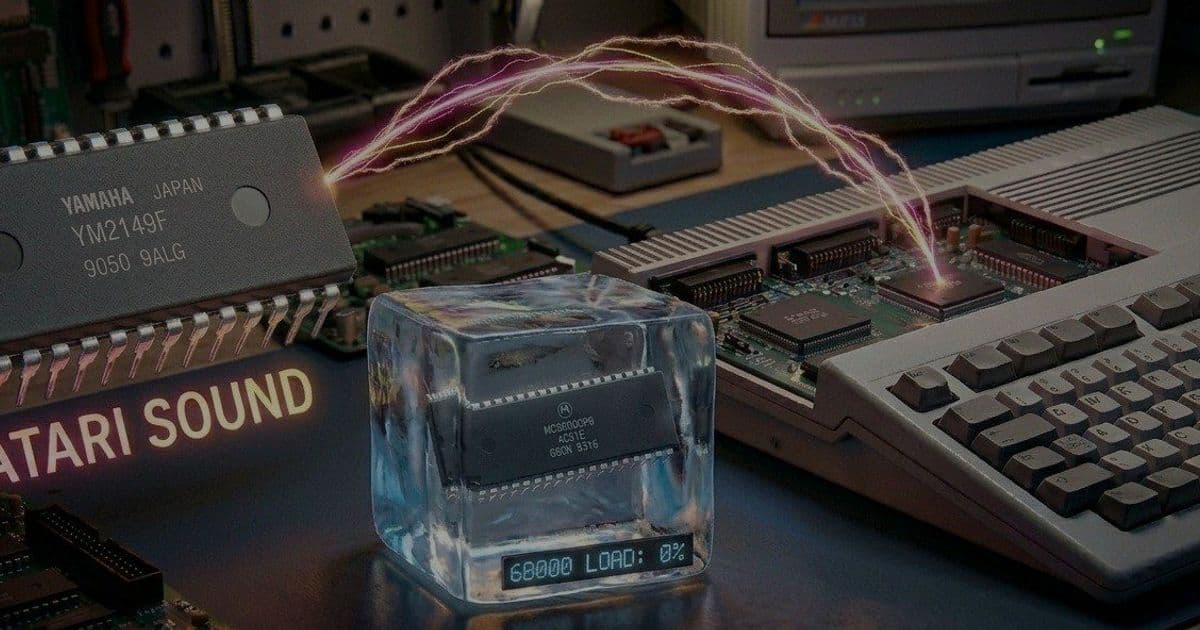
A deep dive into how a demo scene developer achieved the impossible: playing authentic Atari music on an Amiga without consuming any CPU resources, all while breaking a graphics rendering record.
The demoscene has always been a playground for technical one-upmanship, where programmers push hardware to its absolute limits. Recently, this competitive spirit manifested in an intriguing challenge between two scene legends: Leonard and Hannibal. After Hannibal surpassed Leonard's sin-dots record (6682 dots compared to Leonard's previous 6405), he couldn't resist a playful jab: "Hi Leonard, you optimized your dots well for an Atari programmer. But there were hundreds of dots left if you optimize like an Amiga expert."
This wasn't just friendly banter; it was a technical challenge that demanded an innovative response. Leonard's solution was both technically audacious and thematically perfect: he would not only break Hannibal's record but do so while playing authentic Atari music on the Amiga hardware.
The Sound Chip Challenge
At the heart of this technical puzzle lies two fundamentally different approaches to audio generation:
- The Atari YM2149 (a modified Yamaha AY-3-8910) featuring three square wave voices, a noise generator, and a shared hardware envelope
- The Amiga's PAULA chip, a sophisticated PCM sample playback system with four independent channels
Most Atari music relies heavily on square waves, making initial emulation seem straightforward. Leonard's first attempt involved storing a single cycle of a square wave as 8-bit samples and looping them. The result, however, was disappointingly bland, lacking the richness expected from classic Atari soundtracks.
The MadMax Buzzer Revelation
The breakthrough came from understanding how innovative Atari musicians like Jochen Hippel (MadMax of TEX) had pushed the YM2149 beyond its intended capabilities. These pioneers discovered that the YM's shared envelope hardware, rather than being used as a traditional ADSR substitute, could be repurposed as an audio source itself.
The technique, now known as the "MadMax Buzzer," involves:
- Configuring the envelope with a triangle shape at an audible frequency
- Enabling the square wave on the same voice with a slightly detuned frequency
- The result: when the square wave is high, the output follows the envelope shape; when low, the output is zero
This creates complex, sweeping waveforms that became the signature sound of many classic Atari tracks, particularly those from Thalion Software.
PAULA's Hidden Potential
The Amiga's PAULA chip, while seemingly incompatible with the YM2149's architecture, possessed a little-known feature: "attached voice" mode. This allowed one PAULA channel to modulate the period or volume of another channel—a feature largely ignored by both Amiga game developers and demo sceners.
Leonard's initial approach was to use three PAULA voices for square waves and the fourth as a volume modulator. However, this produced a coarse, chunky sound due to the low resolution of the modulation data (one volume value for every two audio samples).
The Eureka Moment
The breakthrough came during a moment of inspiration—often experienced by developers at the threshold of sleep. Instead of storing the triangle envelope as modulation data, Leonard reversed the approach:
- Store the triangle envelope as high-resolution 8-bit PCM samples
- Use a simple square wave as the modulation data (alternating between maximum and minimum volume)
This approach worked because the square wave's binary nature didn't require the high resolution that the triangle envelope needed. The result was a faithful reproduction of the MadMax buzzer effect with minimal CPU overhead.
Zero-CPU Audio via COPPER Lists
With the audio emulation working efficiently, Leonard still faced one challenge: the CPU was still being used to update PAULA registers each frame. This was unacceptable when trying to maximize sin-dots rendering performance.
The solution lay in another Amiga custom chip: the COPPER. This simple yet powerful coprocessor runs in parallel with the 68000 CPU and can:
- Write values to any Amiga custom chip register
- Wait for specific screen positions
Leonard's final innovation was to pregenerate hundreds of tiny COPPER lists, each containing all necessary PAULA register updates for a music frame. The COPPER could then execute these lists automatically, even chaining to the next list without CPU intervention. The result was true zero-CPU audio playback.
The Achievement
With this technique, Leonard didn't just match Hannibal's record—he surpassed it, achieving 7210 sin-dots while playing authentic Atari music. The accomplishment represents several significant technical contributions:
- A novel method for emulating the YM2149's distinctive envelope effects on PAULA
- Creative repurposing of PAULA's "attached voice" feature
- Complete COPPER-based audio processing, freeing the CPU for graphics
The demoscene has always been about finding novel solutions within hardware constraints. This achievement stands as a prime example, demonstrating how deep understanding of legacy hardware can lead to unexpected innovations. The competitive nature of the scene continues to drive technical boundaries, with each new record building upon the innovations of predecessors.
For those interested in exploring this work further, the source code and demo are available through the author's channels. The techniques developed here may find applications beyond demoscene, particularly in systems where CPU resources are at a premium.
The exchange between Leonard and Hannibal exemplifies the collaborative yet competitive spirit that defines the demoscene. It's not just about technical prowess; it's about the shared language of innovation that connects developers across generations, pushing each other to explore the outer limits of what's possible with the hardware we love.
Comments
Please log in or register to join the discussion