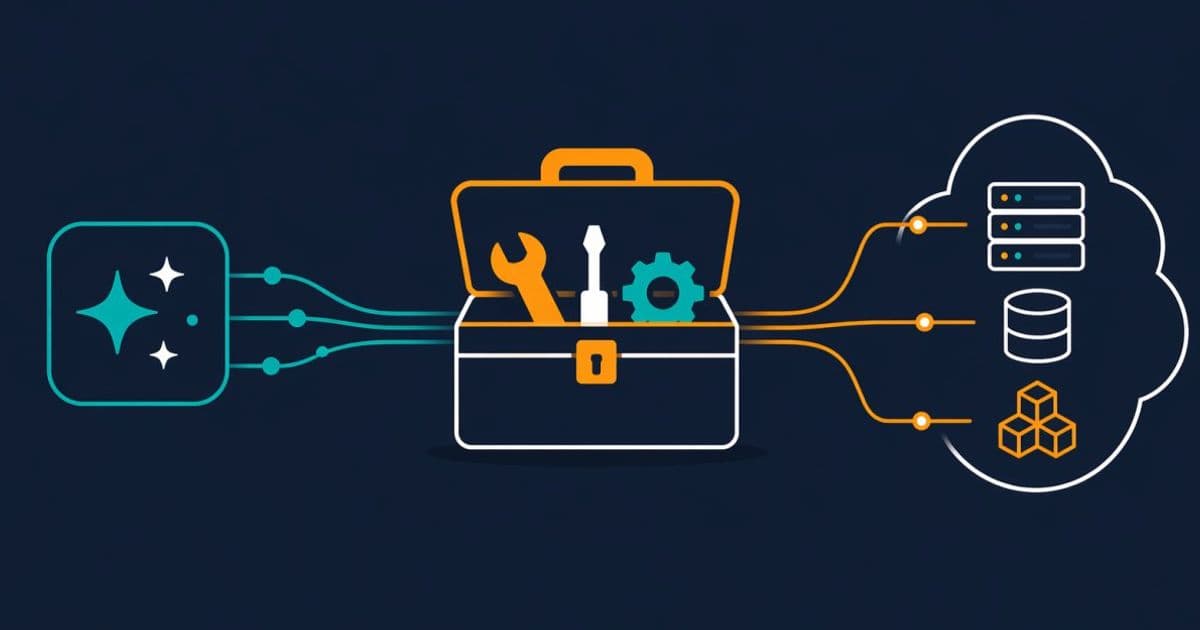
AWS launches generally available MCP Server, providing secure, authenticated access to all AWS services through a compact set of tools, addressing critical limitations in AI agent capabilities for cloud infrastructure development.
The AWS MCP Server has reached general availability, marking a significant advancement in how AI agents interact with cloud infrastructure. This managed remote Model Context Protocol (MCP) server addresses a fundamental challenge in cloud-native AI development: providing agents with secure, authenticated access to AWS services without compromising security or exposing unnecessary permissions.
What Changed: From Limited Knowledge to Real-Time AWS Integration
The AWS MCP Server represents a paradigm shift in how AI coding assistants engage with cloud services. Previously, AI agents operated with significant limitations when working with AWS infrastructure. These agents relied on training data that could be months out of date, lacked knowledge of newer AWS services like Amazon S3 Vectors or Amazon Aurora DSQL, and produced suboptimal infrastructure code.
The new MCP Server resolves these limitations through three primary tools:
call_aws: Executes any of the 15,000+ AWS API operations using existing IAM credentials. This tool eliminates the need for agents to use the AWS CLI directly and enables programmatic access to all AWS services.
search_documentation and read_documentation: Retrieve current AWS documentation and best practices at query time. This ensures agents always work with the most up-to-date information rather than relying on potentially outdated training data.
run_script: Allows agents to write and execute short Python scripts in a sandboxed environment. This capability enables agents to chain API calls, filter responses, and compute results in a single round-trip, improving both speed and context efficiency.
With general availability, the AWS MCP Server introduces several enhancements including IAM context keys support, eliminating the need for separate IAM permissions to use the server. Documentation retrieval no longer requires authentication, and token consumption has been reduced for complex workflows.
Provider Comparison: AWS MCP Server vs. Alternative Approaches
When evaluating the AWS MCP Server against alternative approaches for AI agent-cloud integration, several differentiators emerge:
Traditional AWS CLI Access: While the AWS CLI provides comprehensive access to AWS services, it requires agents to handle complex command structures and authentication mechanisms. The MCP Server abstracts this complexity through a unified interface that doesn't consume the model's context window.
Direct API Access: Direct API access would require agents to handle authentication, request formatting, and response parsing for each service. The MCP Server consolidates these operations into a single, streamlined interface.
Third-party MCP Implementations: Unlike third-party implementations that might focus on specific AWS services or subsets of functionality, the AWS MCP Server provides comprehensive access to all AWS services with official AWS support and integration.
The transition from Agent SOPs (Standard Operating Procedures) to Skills represents another significant differentiator. Skills provide curated guidance and best practices maintained by AWS service teams, reducing hallucination and keeping agents focused on validated approaches.
Business Impact: Security, Efficiency, and Development Velocity
The AWS MCP Server delivers substantial business value across multiple dimensions:
Security Enhancements: The server provides clear separation between human and agent permissions. Organizations can use IAM policies or Service Control Policies to specify that users perform mutating operations while the MCP server remains restricted to read-only actions. This granular control reduces the risk of unintended infrastructure changes.
Operational Visibility: Amazon CloudWatch metrics published under the AWS-MCP namespace allow organizations to observe MCP server calls separately from direct human calls. Combined with Amazon CloudTrail's comprehensive API call logging, this creates the audit trails required by compliance teams.
Development Efficiency: By providing agents with current documentation and authenticated API access, the MCP Server reduces the time required to develop and deploy cloud infrastructure. The run_script tool's ability to chain multiple API calls in a single round-trip significantly improves performance for complex workflows.
Cost Optimization: The server reduces token consumption per interaction, which translates to lower costs when using AI services. Additionally, by following best practices through Skills, agents produce more efficient infrastructure that optimizes resource utilization.
Implementation Considerations
Organizations adopting the AWS MCP Server should consider several implementation factors:
Regional Availability: Currently available in US East (N. Virginia) and Europe (Frankfurt) AWS Regions, with API calls possible to any Region. Organizations should select the region closest to their user base for optimal performance.
Authentication Configuration: The server uses IAM and IAM SigV4 authentication. For local AWS credentials configuration over MCP (which only supports OAuth 2.1), organizations need to configure an MCP proxy like the open-source MCP Proxy for AWS.
Client Compatibility: The AWS MCP Server works with Claude Code, Kiro, Cursor, and any MCP-compatible client. Organizations should evaluate their preferred development environments and ensure compatibility.
Cost Structure: There is no additional charge for the AWS MCP Server itself. Organizations pay only for the AWS resources created and any applicable data transfer costs, making it a cost-effective solution for enhancing AI agent capabilities.
Future Implications
The general availability of the AWS MCP Server signals AWS's commitment to advancing AI-cloud integration. As AI agents become more sophisticated in their ability to develop and manage cloud infrastructure, tools like the MCP Server will become essential components of cloud-native development workflows.
The introduction of Skills suggests a future where AWS service teams provide increasingly specialized guidance for complex cloud operations. This evolution could further reduce the learning curve for cloud development and improve the quality of infrastructure generated by AI agents.
For organizations evaluating AI agent adoption for cloud development, the AWS MCP Server provides a secure, efficient pathway to leverage these technologies while maintaining the control and visibility required for production environments.
The AWS MCP Server is available today, with documentation and setup instructions available in the AWS MCP Server User Guide. Organizations interested in exploring this technology can begin with the Agent Toolkit for AWS, which includes the MCP Server, skills, and plugins designed to enhance AI agent development on AWS.
The MCP Proxy for AWS, required for local credential configuration, is available as an open-source project and can be installed via the command line as described in the AWS blog post. This proxy bridges the gap between IAM authentication and OAuth, enabling seamless integration with local development environments.
For organizations seeking to enhance their AI agent capabilities while maintaining security and compliance, the AWS MCP Server represents a significant advancement in cloud-native AI development. By addressing the fundamental limitations of AI agents when working with cloud infrastructure, this tool enables more efficient, secure, and effective cloud development workflows.
Comments
Please log in or register to join the discussion