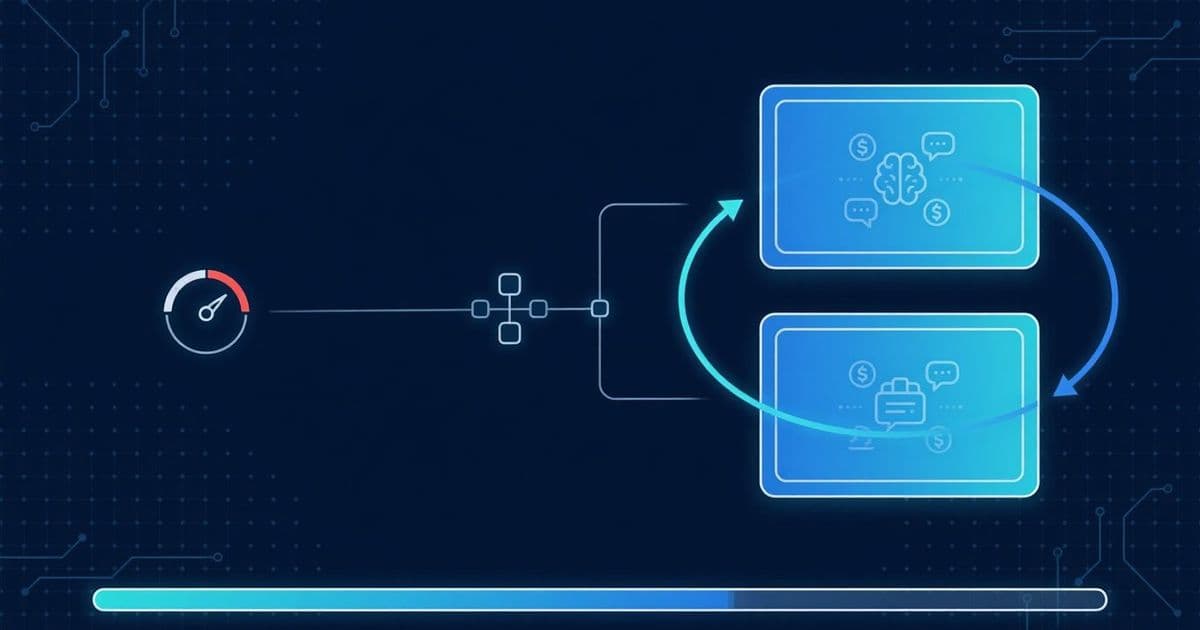
Microsoft introduces a comprehensive LLMOps solution for Azure App Service that transforms traditional web apps into self-healing AI agents, addressing unique operational challenges like unbounded costs, silent failures, and prompt-driven quality regressions.
The operational landscape for AI agents presents fundamentally different challenges compared to traditional web applications. When you ship an LLM agent that works perfectly in demos but encounters new problems in production—such as burning through 50,000 tokens on malformed tool responses or silently failing due to model rate limits—standard web app monitoring proves inadequate. Microsoft has addressed this gap with a comprehensive LLMOps solution built specifically for Azure App Service, creating a self-healing architecture that maintains reliability and cost control in production environments.
The Fundamental Shift: From Web Apps to LLM Agents
Traditional web applications operate with bounded workloads where each request maps to predictable operations like SQL queries or templated responses. Their reliability model focuses on HTTP 5xx errors, p95 latency, and dependency failures. LLM agents break this model in four critical ways:
- Unbounded cost per request: An agent stuck in a loop on a flaky tool can spend $5 on a single user prompt while returning a 200 OK response
- Silent failures: Models can hallucinate confident JSON or return malformed arguments without raising exceptions
- Non-deterministic latency: A prompt that normally completes in 2 seconds can expand to 30 seconds when the model selects an expensive execution plan
- Quality regression from prompt changes: A prompt tweak shipped in seconds can crater tool-call accuracy by 30%, undetected by CI/CD pipelines
These differences necessitate agent-specific Service Level Indicators (SLIs) rather than relying solely on web-app SLOs. The reference implementation focuses on four critical metrics:
- Task success rate: Percentage of /chat requests self-classified as completed
- Cost per task: Real-dollar expenditure per request calculated from model rate cards
- Tool success rate: Percentage of tool invocations without errors
- Repair retries: Count of model re-prompting after schema validation failures
Azure App Service's LLMOps Advantage
Azure App Service provides several unique advantages for building production-grade LLM agents that would require significantly more complex implementation on other platforms:
Deployment Slots for Instant Rollback
The most compelling differentiator is App Service's deployment slots, which provide a pre-warmed, known-good previous version just one ARM API call away from production traffic. This enables automatic rollbacks when SLIs breach thresholds—a process that would require substantial infrastructure setup on Kubernetes platforms.
Managed Identity Simplification
The sample implementation leverages managed identity to authenticate with Azure OpenAI, eliminating key rotation complexities. By setting disableLocalAuth: true on the Azure OpenAI account, the system removes the entire key management burden.
Integrated Observability
App Service comes with App Insights automatically configured, allowing custom metrics to flow directly to customMetrics without additional instrumentation. The reference implementation uses OpenTelemetry to emit eleven custom metrics that visualize as SLO compliance tiles, cost burn-down charts, tool failure breakdowns, and latency percentiles.
Self-Healing Patterns for Production Reliability
The reference sample implements three complementary patterns that address different failure classes:
1. Budget Circuit Breaker
A middleware component in llmops_middleware/budget.py maintains per-tenant counters and enforces spending limits. When a tenant approaches 80% of their monthly budget, the system automatically downshifts from GPT-4o to GPT-4o-mini (a 16× cost reduction). At 100%, requests are blocked entirely. This prevents runaway costs while maintaining service availability.
2. Prompt-Repair Retry Loop
The most common agent failure isn't tool exceptions but models returning malformed JSON that fails schema validation. The solution implemented in llmops_middleware/repair.py feeds validation errors back to the model and requests repair. This pattern recovers 50-70% of "agent returned garbage" cases without escalation.
3. Tool Fallback Chains
When primary tools timeout or fail, the system attempts cheaper or simpler alternatives. Lookup tools particularly benefit from this pattern: web search → cached snapshot → static knowledge base. The implementation in llmops_middleware/repair.py creates a chain of tool calls that gracefully degrade when failures occur.
Implementation and Testing
The complete solution is available in the GitHub repository and can be deployed in under 10 minutes using the Azure Developer CLI (azd). The implementation includes:
- A chaos testing framework with four failure modes (off, throttle, malformed, outage)
- KQL queries for monitoring all critical SLIs
- A deployable workbook in App Insights that visualizes system health
- Bicep infrastructure as code for the entire stack
The chaos testing reliably demonstrates the self-healing capabilities by driving failure scenarios that trigger the budget breaker, prompt-repair mechanism, and ultimately the slot-swap rollback when SLIs breach thresholds.
Business Impact and Operational Efficiency
Organizations implementing this LLMOps approach realize several key business benefits:
- Cost predictability: The budget circuit breaker provides cost assurance even with unbounded agent behavior
- Reduced operational overhead: Automated rollbacks eliminate manual intervention during incidents
- Improved user experience: Silent failures are caught and repaired before reaching users
- Faster incident response: The complete stack deploys in minutes rather than weeks
- Enhanced observability: Agent-specific metrics provide visibility into actual system health
Microsoft is considering baking these capabilities into App Service as first-class platform features, potentially including an "Agent Observatory" sidecar that captures reasoning traces with zero code changes, an "AI Cost Guardian" for cross-provider spend management, and a "Policy Guard" for governance and compliance.
For organizations building LLM agents on Azure, this reference implementation provides a production-ready foundation that addresses the unique operational challenges of AI systems while leveraging the simplicity and reliability of Azure App Service. The combination of agent-specific SLIs, cost guardrails, and automated healing creates a robust operational model that traditional web app monitoring cannot provide.
Comments
Please log in or register to join the discussion