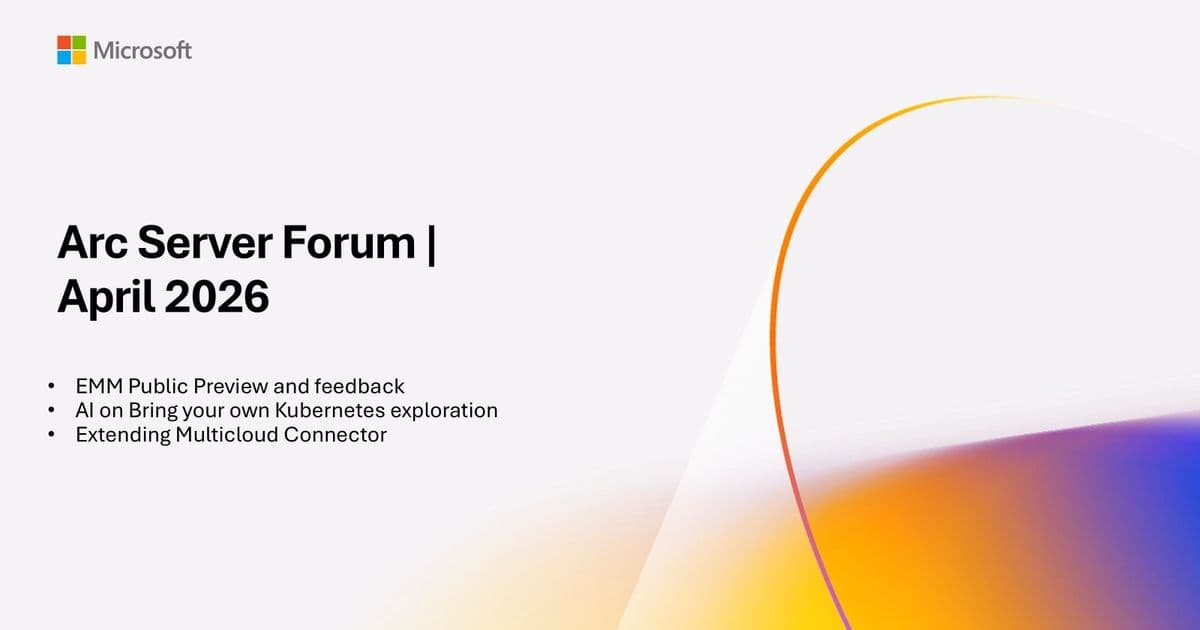
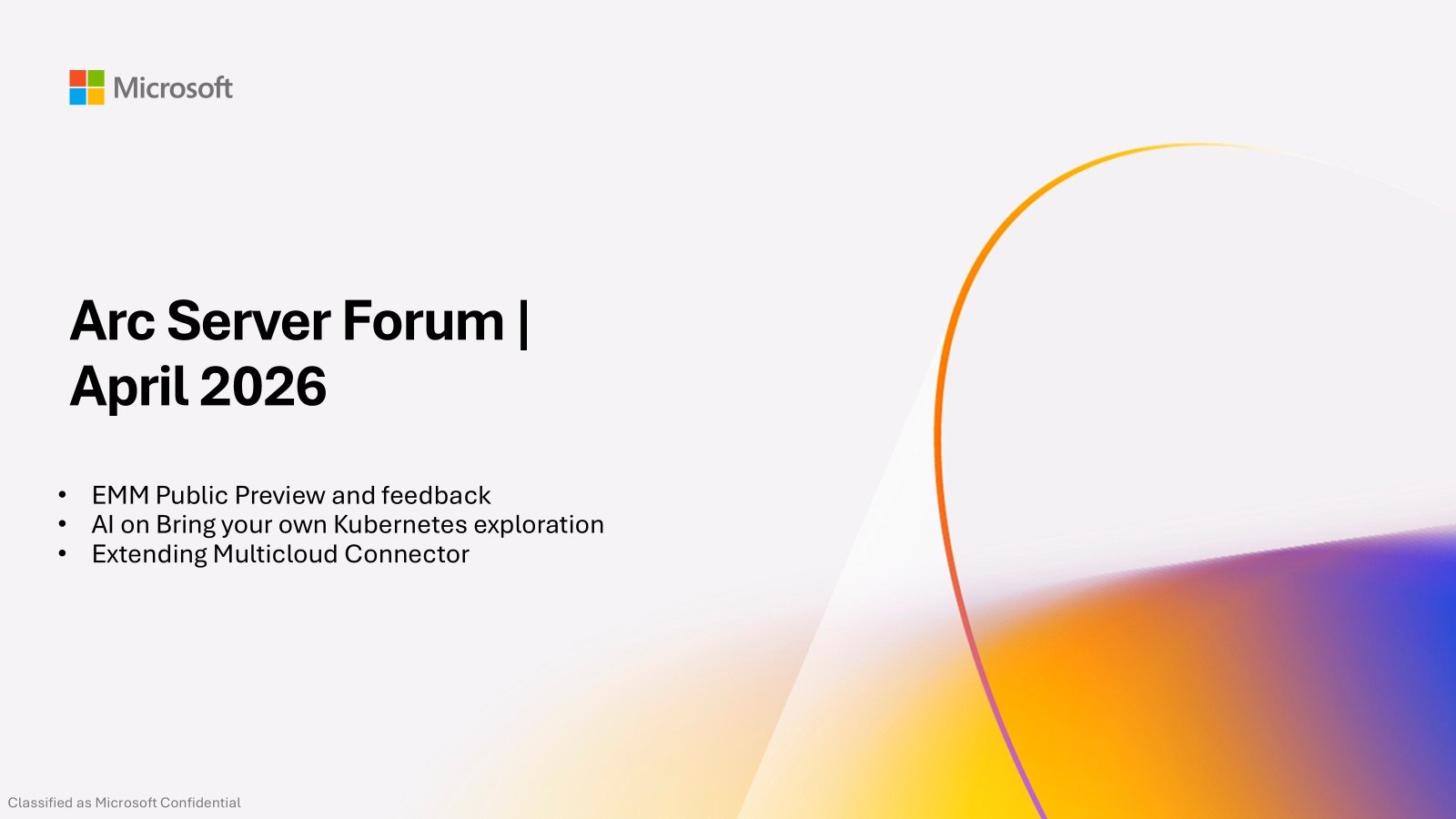
The April 2026 Azure Arc Server Forum introduced the Essential Machine Management preview, outlined plans for AI‑driven bring‑your‑own‑Kubernetes (BYOK) workloads, and announced broader support for the Multi‑Cloud Connector. This article breaks down what changed, compares Azure Arc’s emerging capabilities with competing hybrid solutions, and explains the business impact for enterprises planning multi‑cloud migrations.
What changed at the Azure Arc Server Forum (April 2026)
During the live session on May 19, Microsoft unveiled three strategic updates that reshape how organizations manage on‑premises, edge, and multi‑cloud workloads:
- Essential Machine Management (EMM) – Public Preview – A lightweight, agent‑based service that adds inventory, patching, and compliance reporting to any Windows or Linux server without requiring full Azure Arc onboarding. Read the preview blog and sign up for feedback.
- AI‑enabled BYOK Kubernetes – A survey‑driven initiative to embed generative‑AI assistants into customers’ self‑managed Kubernetes clusters, delivering proactive diagnostics, workload‑placement recommendations, and cost‑optimisation hints. Join the survey.
- Extended Multi‑Cloud Connector – The connector now supports Microsoft Endpoint Configuration Manager (MECM) environments, allowing inventory, monitoring, and policy enforcement to flow from on‑prem MECM into Azure Arc’s unified view.
The session also reminded attendees of the latest Azure Connected Machine agent release notes (What’s new?) and announced the next forum on May 21, 2026.
Provider comparison: Azure Arc vs. AWS Outposts & Google Anthos
| Feature | Azure Arc (April 2026) | AWS Outposts | Google Anthos |
|---|---|---|---|
| Management scope | Any server (Windows/Linux) via lightweight agent; optional full Arc onboarding | Bare‑metal racks in data‑center; limited to AWS services | Kubernetes‑centric; manages GKE, on‑prem, and other clusters |
| Essential Machine Management | Public preview adds inventory, patching, compliance without full Arc | No comparable lightweight tier; requires full Outposts stack | No direct equivalent; relies on Anthos Config Management |
| AI assistance for BYOK | Survey‑driven AI layer for diagnostics and cost advice | No native AI for self‑managed clusters (requires SageMaker integration) | Anthos Config Management provides policy‑as‑code, but AI‑driven ops are still experimental |
| Multi‑cloud connector | Now ingests MECM data, exposing it in Azure Monitor & Defender | Outposts integrates with AWS Systems Manager; no MECM bridge | Anthos integrates with Google Cloud Operations, but lacks a dedicated MECM bridge |
| Pricing model | Pay‑as‑you‑go per connected machine (≈ $5 / month) + optional EMM preview (free during preview) | Capital expense for hardware + hourly compute charges; higher upfront cost | Subscription per vCPU‑hour; Anthos licensing adds ~ $0.10 / vCPU‑hour |
| Migration friction | Minimal – agents install via PowerShell/SSH; can be rolled back easily | Requires physical rack delivery, network provisioning, and OS imaging | Requires cluster‑level configuration; may need re‑architecting workloads |
Key takeaways
- Azure Arc’s new EMM preview lowers the entry barrier for organizations that only need basic inventory and patching, a niche where Outposts and Anthos currently demand full‑stack deployment.
- AI‑enabled BYOK positions Azure Arc as the first major cloud provider to embed generative‑AI directly into the management plane of customer‑owned clusters.
- Extending the Multi‑Cloud Connector to MECM gives Microsoft a unique advantage for enterprises heavily invested in legacy Windows management tools.
Business impact and migration considerations
1. Faster onboarding for legacy assets
The EMM preview means a Windows Server 2012 R2 box in a remote factory can now report compliance data to Azure without the overhead of full Arc registration. For a typical 5,000‑machine estate, this reduces onboarding time from weeks (full Arc) to days, translating into lower labor costs and earlier visibility into security posture.
2. Cost‑optimisation through AI insights
Enterprises that already run self‑managed Kubernetes clusters (e.g., on‑prem VMware or third‑party clouds) can opt‑in to the AI survey. Early participants will receive a custom dashboard that suggests node‑size adjustments, spot‑instance replacements, and container‑image slimming. The projected ROI, based on pilot data, ranges from 5‑12 % lower compute spend per quarter.
3. Consolidated monitoring for mixed‑environment shops
By feeding MECM inventory into Azure Monitor, IT teams can create unified dashboards that correlate patch compliance with Azure Sentinel alerts. This eliminates the need for separate SCCM and Azure monitoring pipelines, simplifying both licensing and operational overhead.
4. Migration risk mitigation
Because the EMM agent is optional, organizations can adopt a phased approach:
- Deploy EMM on a pilot subset to validate inventory accuracy.
- Gradually enable full Arc onboarding for workloads that need advanced governance (e.g., Azure Policy, Defender for Cloud).
- Use the Multi‑Cloud Connector to synchronize existing MECM baselines, ensuring no loss of historical compliance data.
5. Pricing implications
Assuming a 10,000‑machine deployment, the baseline Arc cost would be roughly $50,000 / month. Adding the EMM preview incurs no extra charge during the preview period, and the AI BYOK feature is billed as a per‑cluster subscription (estimated $200 / cluster / month). Compared with Outposts, which could exceed $150,000 / month when accounting for hardware amortisation, Azure Arc presents a clear cost advantage for distributed workloads.
Strategic recommendations for hybrid‑cloud planners
- Start with Essential Machine Management – Deploy the free preview on any server that only needs inventory and patching. Capture baseline compliance data before committing to full Arc.
- Evaluate AI‑BYOK suitability – If your organization already runs multiple self‑managed clusters, sign up for the survey. The AI layer can be a differentiator when negotiating cloud spend with finance.
- Integrate MECM through the Multi‑Cloud Connector – Map existing device collections to Azure tags; this enables policy inheritance across Azure Policy and Microsoft Defender for Cloud.
- Run a cost‑benefit model – Compare per‑machine Azure Arc pricing against the total cost of ownership for Outposts or Anthos, factoring in hardware, staffing, and migration timelines.
- Plan for the next forum – The May 21 session will likely surface early feedback on EMM and AI‑BYOK. Prepare questions around licensing, SLA guarantees, and roadmap alignment.
By treating Azure Arc’s April 2026 announcements as incremental building blocks rather than a wholesale shift, enterprises can modernise legacy assets, gain AI‑driven operational insight, and keep multi‑cloud governance under a single pane of glass.
Resources
Comments
Please log in or register to join the discussion