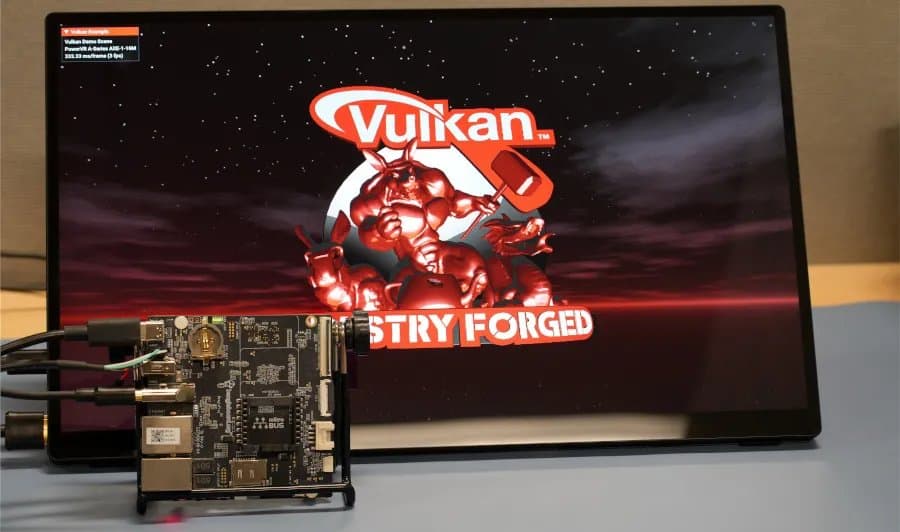
Texas Instruments confirms the BeaglePlay single board computer achieves complete upstream support for PowerVR Rogue graphics, marking a milestone for open-source GPU drivers on embedded hardware.
The BeaglePlay single board computer has demonstrated fully functional, upstream open-source PowerVR graphics drivers, running on a $99 hardware platform that Texas Instruments claims requires no proprietary code branches or patches.
This development represents a significant shift for Imagination Technologies' PowerVR graphics IP, which historically earned criticism from Linux enthusiasts for its closed-source driver approach. The PowerVR Rogue AXE-1-16M GPU integrated into the TI AM625 processor now operates entirely through open-source components within the Linux kernel and Mesa graphics stack.
Hardware Specifications
The BeaglePlay uses the TI AM625 SoC, which combines four ARM Cortex-A53 CPU cores with a 400MHz Cortex-M4F microcontroller. While the CPU configuration is modest, the integrated PowerVR Rogue AXE-1-16M GPU benefits from years of driver development work.
The complete software stack includes:
- Linux 6.18 LTS kernel with PowerVR DRM driver
- Mesa 25.3 with PowerVR Vulkan driver
- Yocto-based distribution with 100% open-source components
- Zink (OpenGL over Vulkan) for additional API coverage
Driver Architecture and Capabilities
The upstream PowerVR driver stack consists of two main components working in concert. The kernel-side DRM (Direct Rendering Manager) driver handles low-level hardware interaction, memory management, and display output. This lives in the mainline Linux kernel, ensuring long-term maintenance and compatibility with kernel updates.
The Mesa driver provides Vulkan 1.2 support through the PowerVR-specific implementation. Vulkan serves as the primary 3D API, while Zink enables OpenGL applications by translating GL calls to Vulkan. This approach mirrors strategies used for other modern GPU drivers where Vulkan represents the foundation for graphics acceleration.
Texas Instruments emphasizes that four-plus years of development work went into achieving this upstream status. The company confirms no private code trees or out-of-tree patches are necessary for full functionality.
Performance Considerations
While specific benchmark numbers weren't provided in the announcement, the PowerVR Rogue AXE-1-16M is an entry-level GPU designed for embedded applications. Users should expect performance suitable for lightweight desktop compositing, basic 3D applications, and media player acceleration rather than demanding gaming workloads.
The open-source nature of the driver enables several advantages:
- Direct kernel integration means automatic support for new kernel features
- Mesa updates provide ongoing API improvements
- Community can contribute fixes and optimizations
- Debugging and troubleshooting are significantly easier
Real-World Implications
For homelab builders and embedded system developers, this opens new possibilities. The BeaglePlay becomes a viable platform for projects requiring GPU acceleration without licensing restrictions or binary blob dependencies.
Potential use cases include:
- Headless systems with GPU-accelerated compute tasks
- Lightweight display systems for monitoring dashboards
- Development platforms for PowerVR-specific optimization
- Educational tools for studying modern GPU driver architecture
The upstream nature also means the driver will automatically benefit from future kernel and Mesa improvements without requiring TI-specific intervention.
Comparison to Historical PowerVR Situation
Previous PowerVR hardware required proprietary binary drivers that were often outdated, incompatible with newer kernels, and lacked community support. This created a barrier for Linux adoption and frustrated users who valued open-source principles.
The current upstream driver represents a complete reversal of that approach. Imagination Technologies has been contributing directly to mainline Linux and Mesa, suggesting a long-term commitment to open-source support for their graphics IP.
Getting Started
Developers interested in testing this stack can obtain a BeaglePlay board through BeagleBoard.org for $99. The standard Yocto-based distribution includes all necessary drivers, though users can compile their own kernel and Mesa packages for bleeding-edge testing.
Documentation and community resources are available through the BeagleBoard.org community forums and the official BeaglePlay documentation. The upstream PowerVR driver code is part of the standard Linux kernel and Mesa releases, accessible through their respective repositories.
This milestone demonstrates how embedded GPU drivers can successfully transition from proprietary silos to community-maintained upstream code, benefiting both hardware vendors through reduced maintenance overhead and users through improved compatibility and transparency.
Comments
Please log in or register to join the discussion