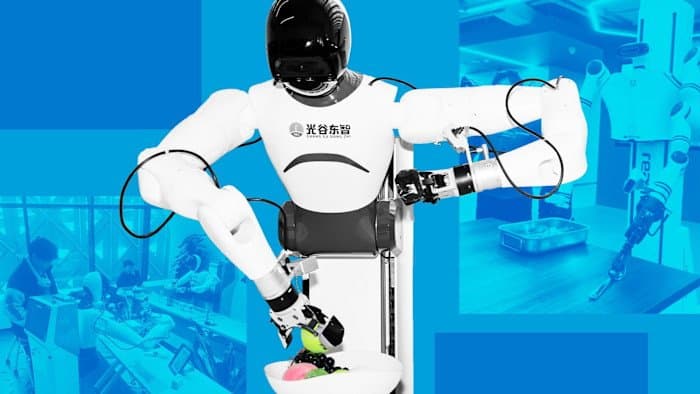
Bernstein's analysis reveals China's humanoid robot market is dominated by learning and R&D applications, with a new network of training farms emerging to supply the data needed for AI development.
Bernstein's latest research on China's humanoid robot market reveals a striking pattern: 42% of the country's 20,000+ humanoid robot shipments in 2025 were dedicated to learning and R&D purposes, while data collection and human-robot interaction services each accounted for 19% of deployments.
The findings point to a fundamental shift in how China is approaching humanoid robotics development. Rather than focusing primarily on commercial deployment, the market appears to be building an extensive infrastructure for training AI systems that will power future generations of robots.
At the center of this strategy is a new 12,000 square meter facility in Wuhan that represents a broader network of "training farms" being established across China. These facilities are designed to generate the vast amounts of data needed to train the "brains" of humanoid robots - the AI systems that will eventually enable them to perform complex tasks autonomously.
This approach mirrors strategies seen in other AI domains, where massive data collection and iterative learning have proven essential for developing sophisticated models. The emphasis on R&D and data collection suggests Chinese companies are prioritizing long-term capability development over immediate commercial returns.
The 19% allocation to human-robot interaction services indicates parallel efforts to refine how robots engage with people - a critical factor for eventual widespread adoption. This dual focus on technical capability and user experience represents a comprehensive approach to humanoid robotics development.
What makes this particularly noteworthy is the scale of investment relative to current commercial applications. With nearly half of all shipments going to R&D and another 38% split between data collection and interaction services, only about 20% of humanoid robots appear to be deployed for direct commercial use.
This data-heavy, learning-focused strategy could position China to accelerate its progress in humanoid robotics, potentially creating a competitive advantage as the technology matures. The training farm network may become the foundation for a new generation of AI-powered robots capable of handling increasingly complex tasks.
The research highlights how China's approach to humanoid robotics differs from other markets, with a greater emphasis on building the underlying AI infrastructure before scaling commercial deployments. Whether this strategy will yield faster progress remains to be seen, but the investment in foundational capabilities is substantial and growing.
As the global race for humanoid robotics intensifies, China's focus on learning and data infrastructure may prove to be a defining factor in determining which companies and countries emerge as leaders in this transformative technology.
Comments
Please log in or register to join the discussion