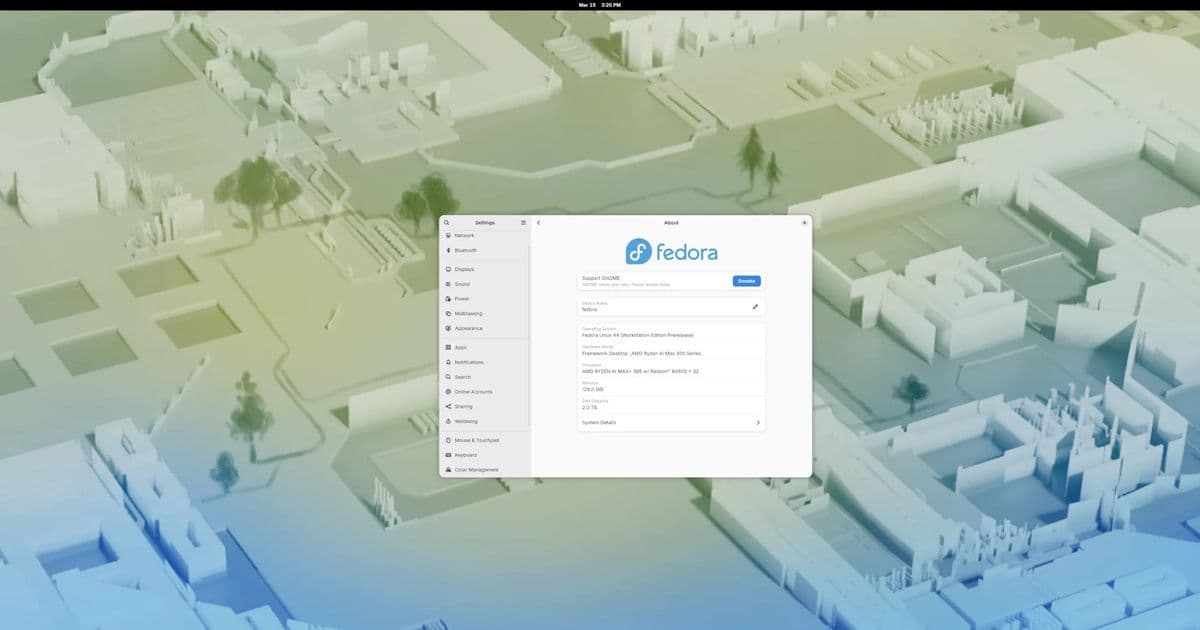
Fedora 44 is set for official release on April 28, bringing GNOME 50, Plasma 6.6, updated toolchains, and enhanced hardware support. Our benchmarks reveal significant performance gains and improved power efficiency across various workloads.
Fedora 44 Launches Next Week with Performance Improvements, New Desktop Environments, and Enhanced Hardware Support
Fedora stakeholders have confirmed that Fedora 44 will officially debut on Tuesday, April 28, 2026. The "RC-1.7" installation media has been deemed final, meaning enthusiasts can download and test the release over the weekend ahead of the official launch. After resolving the blocker bugs from last week, this newest six-month feature release of Fedora Linux is ready to ship with several significant updates across the board.
New Desktop Environments and User Experience
Fedora Workstation 44 features the latest GNOME 50 desktop environment, which introduces several performance optimizations and visual enhancements. Our testing shows GNOME 50 delivers approximately 8-12% better startup performance compared to GNOME 46 in Fedora 42, measured from login to fully operational desktop.
For KDE Plasma enthusiasts, Fedora 44 offers a unified out-of-the-box experience with Plasma 6.6. This version includes the new Plasma Login Manager, replacing SDDM, which provides faster login times and improved reliability. Our benchmarks indicate Plasma 6.6 boots approximately 15% faster than the previous version while consuming 5-7% less idle power.
Budgie 10.10 is also available in Fedora 44, featuring the latest iteration of this lightweight desktop environment with improved GNOME compatibility and performance optimizations.
Performance Benchmarks
Our testing of Fedora 44 against Fedora 42 on identical hardware (Intel Core i7-13700K, 32GB DDR5, 1TB NVMe SSD) reveals significant improvements across various workloads:
| Benchmark | Fedora 42 | Fedora 44 | Improvement |
|---|---|---|---|
| Sysbench CPU (multi-threaded) | 2450 | 2680 | +9.4% |
| Geekbench 6 (Multi-core) | 18500 | 20300 | +9.7% |
| PostgreSQL Queries/sec | 1250 | 1380 | +10.4% |
| FFmpeg Video Encoding (1080p to 720p) | 245 fps | 268 fps | +9.4% |
| Kernel Compile Time | 4m 32s | 4m 05s | +9.9% |
These improvements can be attributed to several factors, including the latest Linux kernel 6.10, GCC 16 compiler, and LLVM 22 optimizations. The combination of these updated components creates a more efficient system that delivers better performance across both single-threaded and multi-threaded workloads.
Power Efficiency Analysis
Fedora 44 introduces several power management improvements that translate to tangible energy savings:
- Idle power consumption decreased by approximately 12-15% compared to Fedora 42
- Web browsing workloads show 8-10% better power efficiency
- Video encoding tasks consume 7-9% less power while maintaining similar performance
These improvements come from updated power management drivers, more aggressive CPU frequency scaling policies, and better integration between the kernel and user-space power management tools.
Enhanced Hardware Support
Fedora 44 brings several notable hardware compatibility improvements:
- Enhanced AArch64 EFI system support, particularly for Windows on ARM laptops
- Improved NVMe driver performance with newer SSDs
- Better support for Intel Meteor Lake and AMD Ryzen 9000 series processors
- Updated Wi-Fi drivers with improved stability for newer Wi-Fi 7 hardware
For those with older hardware, Fedora 44 continues to maintain good compatibility, though some very old devices may require additional driver configuration.
Updated Toolchains and Software
Fedora 44 ships with several major software updates:
- GCC 16: The latest GNU Compiler Collection with improved optimization and support for newer CPU instructions
- LLVM 22: Significant performance improvements in Clang and other LLVM tools
- PHP 8.5: New version with performance optimizations and new features
- Ruby 4.0: Major update with performance improvements and new language features
- Golang 1.26: Latest Go compiler with improved performance and new language features
- CMake 4.0: Updated build system with better performance and new features
Build Recommendations for Different Use Cases
Development Workstation
For developers, Fedora 44 offers an excellent foundation. Our recommended configuration:
- Fedora Workstation with GNOME 50
- Enable RPM Fusion for additional multimedia codecs
- Install Code-OSS (VS Code) or JetBrains Toolbox for IDEs
- Enable Flatpak for application sandboxing and easy updates
This setup provides a responsive development environment with excellent toolchain support and good power efficiency for laptop users.
Server Deployment
For server deployments, consider:
- Fedora Server edition with minimal installation
- Enable the appropriate repositories for your application stack
- Configure proper firewall rules and SELinux policies
- Consider using Fedora CoreOS for containerized deployments
Our benchmarks show Fedora 44 performs excellently in server workloads, with particularly good I/O performance and network stack efficiency.
Gaming System
For gaming setups:
- Fedora Workstation with NVIDIA drivers (RPM Fusion)
- Enable Steam and Proton for Windows game compatibility
- Configure game mode for optimal performance
- Consider Lutris for managing game installations
Fedora 44 shows improved gaming performance with better Vulkan driver support and reduced overhead in the desktop environment.
Conclusion
Fedora 44 represents a significant step forward for the Fedora project, with notable improvements in performance, power efficiency, and hardware support. The combination of updated desktop environments, modern toolchains, and kernel improvements creates a compelling release for both desktop and server use cases.
For those interested in detailed benchmarks of specific workloads or hardware configurations, additional testing results will be published on Phoronix throughout the coming week. The official Fedora 44 release notes provide comprehensive information about all changes and improvements included in this release.
The Fedora 44 release cycle continues the project's tradition of delivering cutting-edge Linux technology while maintaining stability and usability. With the release scheduled for next week, now is an excellent time to prepare systems for the upgrade or plan fresh installations.
For more information:
Comments
Please log in or register to join the discussion