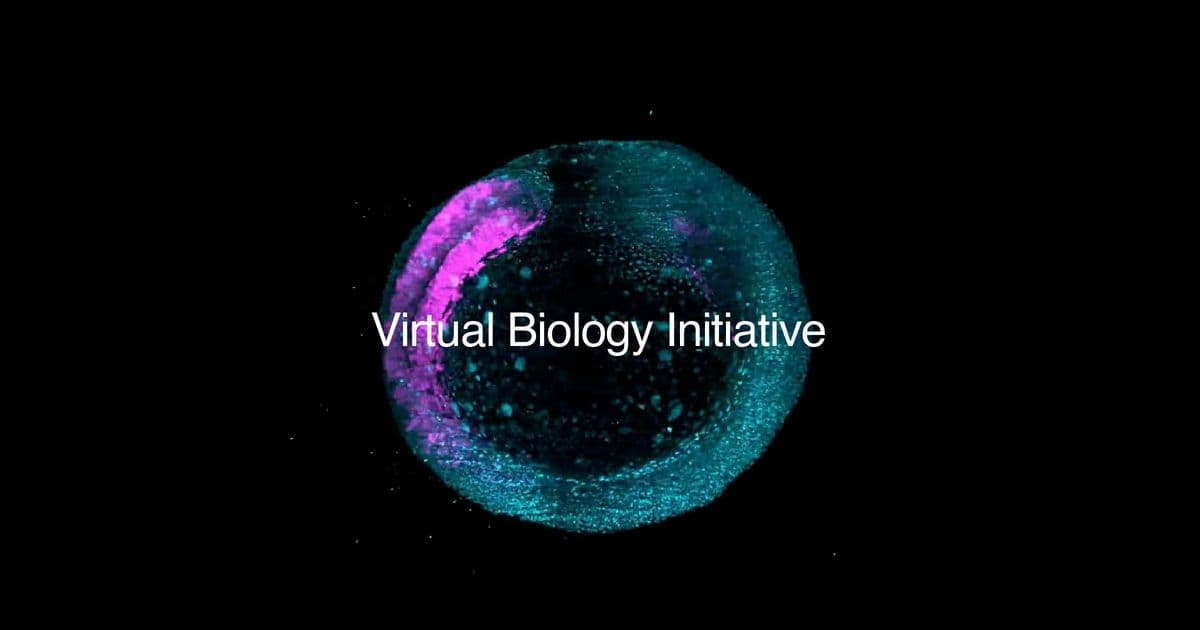
Biohub has launched the Virtual Biology Initiative, committing $500 million to create an open data foundation for AI-accelerated biology. The five-year global effort aims to build predictive models of human cells to accelerate disease cure and prevention, with contributions from leading research institutions and technology partners including NVIDIA.
Biohub today announced the Virtual Biology Initiative, a landmark five-year effort to galvanize a global scientific community in creating predictive models of human cells. The initiative represents a $500 million commitment to develop the technologies and multi-modal datasets needed to understand cellular complexity at an unprecedented scale, potentially accelerating the cure and prevention of all diseases.
Building the Foundation for Biological AI
The Virtual Biology Initiative addresses a fundamental challenge in modern biology: the need for vast amounts of high-quality data to train artificial intelligence systems that can accurately model the complexity of human cells. While the scientific and technological foundations for such models now exist, achieving meaningful predictive capabilities requires orders of magnitude more data than is currently available.
"To build artificial intelligence that can accurately represent the full complexity of biology and accelerate scientific research, we need orders of magnitude more data than exists today. We need new technologies to observe the cell, from the molecular to the tissue level, and in the context of health and disease. At Biohub, we're committing our resources to solve this problem," said Alex Rives, Biohub Head of Science.
Funding Structure and Global Collaboration
Biohub's $500 million commitment is split strategically: $100 million will support a coordinated, worldwide data-generation effort beyond what any individual institution could undertake alone, while $400 million will fund data generation at scale and development of next-generation technologies for measuring, imaging, and engineering biology. All data generated will be made openly available to the global scientific community.
The initiative has already attracted significant participation from leading research institutions and international consortia, including:
- Allen Institute
- Arc Institute
- Broad Institute
- Wellcome Sanger Institute
- Human Cell Atlas consortium
- Human Protein Atlas
NVIDIA will serve as a key technology partner, providing accelerated computing infrastructure, domain-specific software, and technical expertise to enable processing and analysis of large-scale datasets. Renaissance Philanthropy is joining to catalyze additional funding for data generation.
Technological Frontiers
The initiative will advance several technological frontiers in biological research:
- Next-generation imaging: Development of cryo-electron tomography to resolve atomic-level details in cells, and microscopy capable of observing millions to billions of cells in living tissues and organisms
- Molecular engineering: Technologies enabling better experiments and measurement of more parameters across cellular biology
- Data infrastructure: Building the computational frameworks necessary to integrate and analyze multi-modal biological datasets
These technologies will allow researchers to observe and measure biological systems at unprecedented resolution and scale, providing the raw material needed to train sophisticated AI models.
From Data to Discovery
Accurate predictive models of cellular complexity could fundamentally transform biological research and medicine. Such models would allow scientists to:
- Understand fundamental biological mechanisms that maintain health or cause disease
- Test hypotheses digitally at a scale and rate impossible in physical laboratories
- Identify potential therapeutic targets and predict drug responses
- Develop new approaches to complex diseases that have resisted traditional treatments
"Achieving a predictive understanding of cellular behavior will require coordination and data at a truly global scale. The Human Cell Atlas brings together a global community, data, capabilities, and expertise needed to help make this possible—and efforts like this, where leading partners including Biohub come together, have the potential to accelerate progress in ways no single organization and consortium could achieve alone," says Muzz Haniffa, co-Vice-Chair of the HCA Organising Committee.
Building on Existing Successes
The Virtual Biology Initiative extends Biohub's decade-long commitment to advancing biological measurement technologies. The organization has previously supported major projects including:
- The Human Cell Atlas
- The Billion Cells Project
- The Tabula Sapiens multi-organ cell atlas
- Various integrated grant programs across imaging, instrumentation, spatial molecular biology, and synthetic biology
"Biohub has been an extraordinary partner to the field for a decade, and the Billion Cells Project is a terrific example of why. It brought together and supported groups and turned their efforts into a shared resource the whole community can build on. Expanding that model to the full measurement set needed to train an AI model of the cell and to understand how cells function together in communities is ambitious in the best sense. It's the kind of coordinated, openly shared infrastructure that can genuinely change what's possible in biology," said Jonathan Weissman, Landon T. Clay Professor of Biology at Whitehead Institute and MIT.
The Challenge of Scale
Creating predictive models of human biology represents one of the most ambitious scientific challenges of our time. The human cell contains approximately 20,000 proteins, 30,000 genes, and countless molecular interactions—all organized in complex spatial and temporal arrangements. Modeling this system requires not just vast amounts of data, but also sophisticated algorithms that can capture multi-scale relationships.
The initiative's approach emphasizes open science and collaborative data generation, drawing inspiration from successful large-scale scientific projects like the Human Genome Project and the Protein Data Bank. These projects succeeded because researchers worldwide aligned around shared goals and contributed to common resources.
"The biomedical community has a long tradition of coming together around ambitious projects to assemble, analyze and freely share large-scale data, dating all the way back to the Human Genome Project. Fully deciphering the logic of cells is a huge challenge, but it has the potential to transform medicine. And, it's a challenge that will again take many groups and perspectives collaborating together," said Eric S. Lander, Founding Director of the Broad Institute.
Future Implications
If successful, the Virtual Biology Initiative could accelerate biological discovery dramatically. Instead of testing one hypothesis at a time in the laboratory, researchers could use predictive models to rapidly screen thousands of potential interventions, identify promising candidates, and understand their likely effects before conducting expensive wet-lab experiments.
The initiative could also democratize access to cutting-edge biological research. By making data and computational tools openly available, researchers at institutions with limited resources could contribute to and benefit from the most advanced biological research.
"While AI presents novel powerful opportunities to model biology, we are still greatly limited by data. A global coordinated data foundation for modern AI-powered biology is exactly what we need to break siloes and accelerate progress towards high-fidelity simulators of biology. The HPA has always been advocates for open science, and are delighted to support this initiative," stated Emma Lundberg, co-Director Human Protein Atlas.
The Virtual Biology Initiative represents a significant step toward realizing the potential of AI in biology. By combining ambitious data generation with cutting-edge measurement technologies and fostering global collaboration, Biohub and its partners aim to create the foundation for a new era of biological discovery and medical innovation.
For more information about the Virtual Biology Initiative, visit Biohub's website or contact [email protected].
Comments
Please log in or register to join the discussion