
Brave Software has launched 'Ask Brave,' a privacy-first subsystem that seamlessly integrates generative AI with traditional search results. The feature offers chat-style interactions and deep research modes while guaranteeing encrypted conversations and zero data retention—directly challenging conventional AI search data practices.
Brave Software has redefined the search experience with its new Ask Brave subsystem, merging traditional web results with generative AI capabilities in a unified interface. Accessible at search.brave.com/ask from any browser, the feature targets users frustrated by juggling between conventional "ten blue links" and standalone AI chatbots.
Blending Search Paradigms
Ask Brave isn't a replacement for Brave's existing "AI Answers" summarization tool but rather an evolution. While AI Answers generates over 15 million daily summaries, Brave identified a gap between static summaries and interactive exploration. Ask Brave solves this by:
- Combining outputs: Displaying AI-generated responses alongside classic search results
- Enabling dialogue: Allowing follow-up questions in a chat interface
- Offering two modes:
- Standard for quick queries
- Deep Research for multi-round web dives to eliminate blind spots
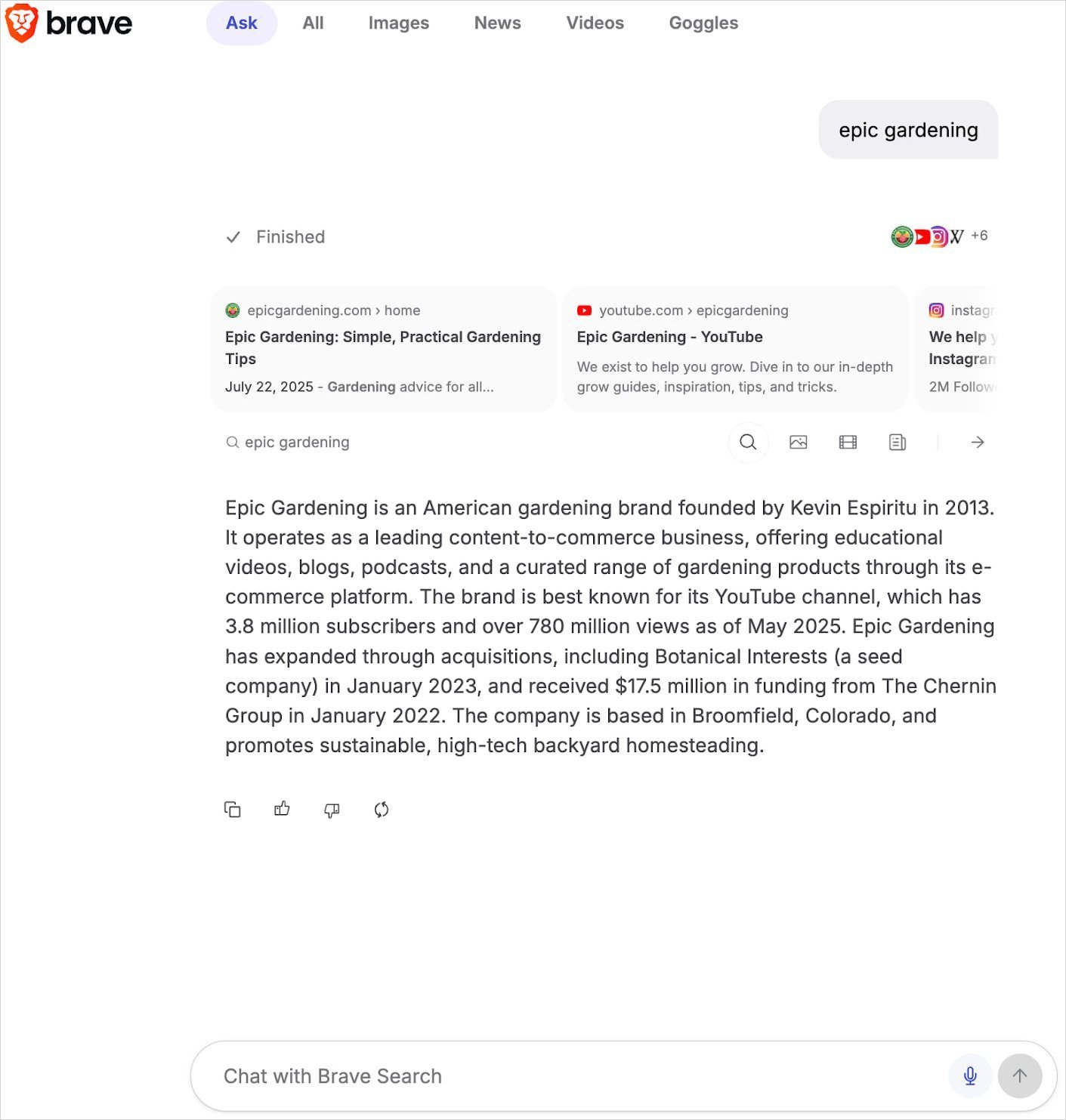 Ask Brave's interface blends chat and search results (Source: Brave)
Privacy by Design
In stark contrast to competitors, Brave enforces stringent privacy safeguards:
- End-to-end encryption for all chats
- Zero training data usage: Conversations never train AI models
- Automatic deletion: Chats expire after 24 hours of inactivity
- No IP logging: Prevents user tracing via search queries
This approach directly challenges industry norms where queries are typically logged for training unless users opt out—a significant differentiator for privacy-conscious developers.
Technical Execution
Users activate Ask Brave by:
- Appending "??" to Brave Search queries
- Clicking the "Ask" button on Brave Search
- Selecting the "Ask" tab on results pages
The Deep Research mode leverages Brave's independent index to execute iterative searches, cross-referencing sources to minimize hallucinations—a critical improvement over black-box AI systems.
{{IMAGE:3}} Deep Research mode provides multi-source synthesis (Source: Brave)
Implications for Developers
Brave's architecture demonstrates how retrieval-augmented generation (RAG) can evolve beyond chatbots into unified search experiences. By decoupling data retention from AI utility, it establishes a privacy benchmark other platforms may struggle to match—especially as regulations tighten around AI data usage. The feature also hints at future API integrations that could let developers leverage Brave's privacy-centric AI stack.
While giants like Google and OpenAI refine their AI search hybrids, Brave's uncompromising stance on data handling could attract users prioritizing transparency. As search paradigms fracture between traditional, AI-summarized, and conversational interfaces, Brave bets that fusion—not fragmentation—will define the next era of information retrieval.
Source: BleepingComputer
Comments
Please log in or register to join the discussion