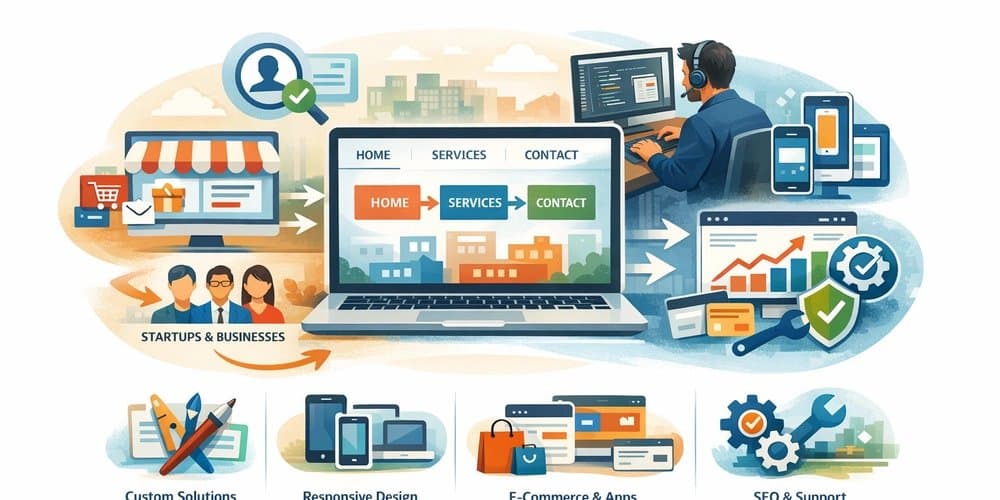
A pragmatic look at how modern website development companies in India are shifting from visual-first approaches to building scalable, maintainable digital platforms that serve actual business outcomes.
When I look at most website development projects, I see the same pattern: teams optimize for visual appeal first, then try to retrofit scalability and maintainability later. This approach creates technical debt that accumulates faster than the business can pay it down.
As a distributed systems engineer, I've watched countless platforms struggle because their foundational architecture couldn't support growth. The same principles apply to websites, just at a different scale. The difference between a brochure site and a growth platform isn't just features—it's architectural thinking.
The Problem with Template-First Thinking
Many businesses approach website development by selecting a template, customizing colors, and calling it done. This works for simple informational sites, but creates problems when requirements evolve. Template constraints force business logic to conform to design patterns, not the other way around.
Consider an e-commerce site built on a rigid template. When the business needs to add a subscription model, integrate with a new payment processor, or implement custom inventory logic, they hit walls. The template's architecture wasn't designed for these extensions, so they either hack around limitations or rebuild entirely.
This is where the systems thinking approach matters. A well-architected website treats business logic as separate from presentation layer. Changes in one shouldn't require rewrites in the other.
Scalability Implications in Web Architecture
Scalability isn't just about handling traffic spikes. It's about how easily the system can adapt to new requirements. In website development, this translates to:
Modular Design Patterns: Each feature (user authentication, content management, e-commerce, analytics) should exist as an independent module that can be updated or replaced without affecting others.
API-First Thinking: Even for traditional websites, thinking in terms of data contracts and service boundaries creates flexibility. When you need to add a mobile app later, the backend already exposes clean APIs.
Stateless Architecture: Where possible, keep business logic stateless and push state to databases or caches. This makes horizontal scaling straightforward and reduces complexity.
Consistency Models for Content and Data
Websites often deal with multiple consistency requirements:
User-Facing Content: Needs eventual consistency. A user might see slightly stale content for seconds, which is acceptable.
Transactional Data: E-commerce orders, payments, inventory—these need strong consistency. You can't sell the same item twice.
Analytics and Reporting: Often need read-after-write consistency for business decisions.
The challenge is implementing these different models within the same application. Modern frameworks and databases offer solutions:
- MongoDB Atlas provides flexible document modeling that can handle mixed consistency requirements. Its native vector search capabilities are particularly useful for content discovery and recommendation features.
- PostgreSQL with appropriate transaction isolation levels works well for financial operations.
- Redis for caching provides eventual consistency for content that changes infrequently.
The key is recognizing that different parts of your website have different consistency needs, and designing accordingly.
API Patterns for Modern Websites
Even traditional websites benefit from thinking about their internal APIs. Consider a content management system:
RESTful endpoints for CRUD operations on pages and posts GraphQL for complex queries that need specific data shapes (useful for component-driven frontends) Webhooks for integrations with external services (email marketing, analytics, CRM)
The pattern I've seen work best is to build the website as a client of its own APIs. This forces clean separation and makes it easier to add other clients (mobile apps, third-party integrations) later.
Practical Implementation Strategy
Here's how I approach website development from a systems perspective:
1. Requirements Analysis as System Design
Instead of asking "what pages do you need?" ask "what business processes need to be supported?" This shifts thinking from static pages to dynamic systems.
For an e-commerce site, the requirements might be:
- Product discovery with search and filters
- Shopping cart state management across sessions
- Order processing with inventory validation
- Payment integration with error handling
- Post-purchase communication
Each requirement maps to a system component with specific data flows and failure modes.
2. Data Modeling Before Design
Start with the data structures, not the UI. What data needs to be stored? How does it relate? What are the access patterns?
For a service business website, you might have:
- Service definitions with pricing and descriptions
- Client records with contact information
- Appointment bookings with time slots
- Invoice generation and payment tracking
Modeling this in a document database like MongoDB allows for flexible schema evolution as the business grows.
3. Choose the Right Technology Stack
The stack should match the requirements, not trends:
For content-heavy sites: Static site generators (Hugo, Next.js) with CDN distribution for performance and security.
For interactive applications: Full-stack frameworks (Next.js, Remix) that handle both server and client rendering.
For complex business logic: Backend services (Node.js, Python, Go) with proper database architecture.
For e-commerce: Consider specialized platforms (Shopify, WooCommerce) for standard features, but be prepared to customize for unique requirements.
4. Build for Maintainability
Code that's easy to maintain is code that's easy to change:
- Consistent naming conventions across all layers
- Clear separation of concerns (business logic, data access, presentation)
- Comprehensive testing for critical flows (not just unit tests, but integration and end-to-end)
- Documentation of architecture decisions and data flows
Trade-offs in Website Development
Every decision involves trade-offs:
Custom vs. Template: Custom development costs more upfront but provides flexibility. Templates are faster but constrain future growth.
Monolith vs. Microservices: For most websites, a well-structured monolith is simpler and more maintainable. Microservices add complexity that's only justified at scale.
Server-Side vs. Client-Side Rendering: SSR provides better SEO and initial load performance. CSR provides smoother interactions. Modern frameworks offer hybrid approaches.
Database Choice: Relational databases enforce data integrity but can be rigid. Document databases offer flexibility but require careful schema design. The choice depends on your data access patterns.
Real-World Example: Service Business Website
Consider a consulting business that needs:
- Service pages with case studies
- Contact forms with lead qualification
- Appointment scheduling
- Client portal for project updates
A systems approach would:
- Design data models for services, clients, appointments, and projects
- Create API endpoints for each entity with proper validation
- Implement authentication for client portal access
- Build admin interface for managing content and appointments
- Integrate with external services (calendar for scheduling, email for notifications)
- Implement monitoring to track form submissions and appointment bookings
Each component can be developed and tested independently, then integrated.
Performance Considerations
Performance isn't just about speed—it's about resource efficiency:
Frontend: Optimize images, lazy load content, minimize JavaScript bundles. Use modern formats like WebP for images.
Backend: Implement caching strategies, database query optimization, and connection pooling. Monitor response times and error rates.
Infrastructure: Choose hosting that matches traffic patterns. Static sites work well on CDN. Dynamic sites need appropriate compute resources.
Database: Index frequently queried fields, use connection pooling, and consider read replicas for high-traffic sites.
Security as a Foundation
Security shouldn't be an afterthought:
- Input validation at every layer (client, server, database)
- Authentication and authorization with proper session management
- HTTPS everywhere with proper certificate management
- Regular dependency updates to patch vulnerabilities
- Backup and recovery procedures tested regularly
For e-commerce, PCI compliance is non-negotiable. Consider using established payment processors rather than handling card data directly.
The Maintenance Reality
A website is never "done." It requires:
Regular updates: Security patches, dependency updates, performance monitoring Content updates: Keeping information current and relevant Feature additions: Responding to business needs and user feedback Technical debt management: Refactoring code as requirements evolve
This is why maintainable architecture matters. A well-structured site can evolve gracefully. A poorly structured one becomes a liability.
Measuring Success
Success metrics should align with business goals:
- Conversion rates for e-commerce or lead generation
- User engagement (time on site, pages per session)
- Technical performance (load times, error rates)
- Business outcomes (revenue, qualified leads, customer satisfaction)
Use analytics tools to track these metrics, but focus on actionable insights rather than vanity metrics.
Conclusion
Building a website that supports growth requires thinking beyond visual design. It demands architectural decisions that balance current needs with future flexibility. The most successful websites are those that can evolve with the business, not those that look impressive on day one but become technical debt within months.
The systems thinking approach—considering scalability, consistency, and maintainability from the start—creates digital platforms that serve as true business assets rather than temporary marketing tools.
For businesses looking to build or rebuild their online presence, the question isn't just "what should it look like?" but "what should it do, and how can we build it to do more tomorrow?"
For more details on practical website development approaches, visit Deep Javiya's website development services.
For technical discussions on distributed systems and architecture, connect on LinkedIn or GitHub.
Comments
Please log in or register to join the discussion