
Ben Werdmuller's FediForum keynote delivers a stark warning: centralized social platforms are complicit in rising authoritarianism. He argues the open, federated social web, built with encryption and focused on concrete community needs, offers a vital refuge for vulnerable groups and a foundation for resistance. Werdmuller provides developers a crucial three-question framework to build tools that matter.
The open, federated social web isn't just a technical curiosity or an ideological preference – it's rapidly becoming essential infrastructure for vulnerable communities operating under the threat of state surveillance and authoritarian crackdowns. That's the urgent message delivered by Ben Werdmuller, Senior Director of Technology at ProPublica and veteran builder of open social platforms (Elgg, Known), in his opening keynote at FediForum.
Drawing on his unique perspective spanning platform creation, venture investment (Matter Ventures), and leading technology for mission-driven newsrooms (ProPublica, The 19th), Werdmuller painted a chilling picture of the current landscape:
- The Capitulation of Social Media: Major platforms (Twitter/X, Meta/Threads, LinkedIn, TikTok) are increasingly aligned with or controlled by actors promoting authoritarian agendas. "Every major commercial social network is complicit. They’re collaborators," Werdmuller stated, highlighting financial ties between platform owners and figures driving restrictive policies.
- The Weaponization of Surveillance: Legislation like the CLOUD Act forces US-based services to hand over user data globally, regardless of local privacy laws. This is compounded by policies profiling left-leaning opinions, anti-capitalist sentiment, or simply belonging to vulnerable groups (like the trans community) as potential "terrorist" indicators, making encrypted communication a necessity, not a luxury.
- The Erosion of Journalism: Traditional news, a vital check on power, is being starved. Tech platforms siphon traffic and revenue via AI summaries and answer boxes, while government defunding accelerates the closure of public service outlets. The result is less accountability and more space for corruption to flourish.
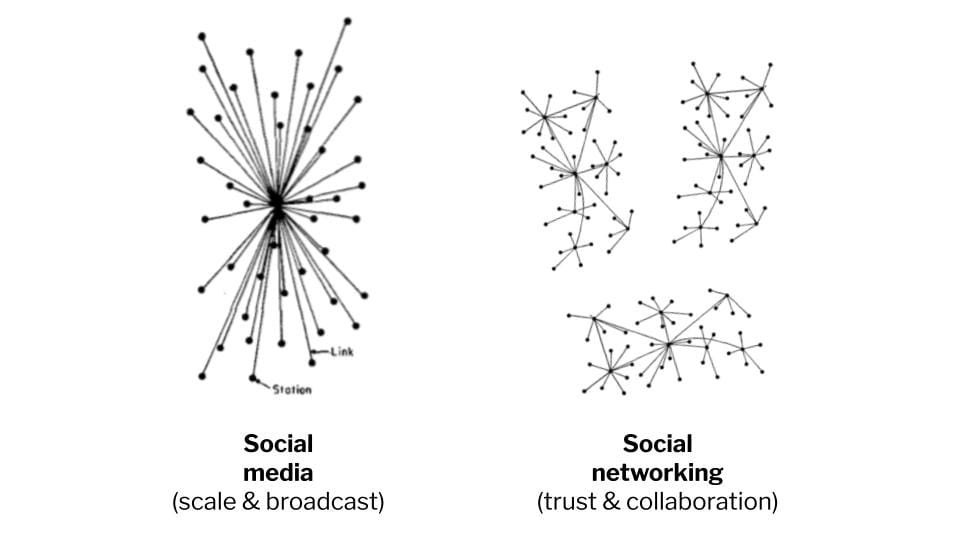
Alt text: Social media (scale & broadcast) vs social networking (trust & collaboration) - illustrating Werdmuller's key distinction.
Beyond the Town Square: The Critical Need for Encrypted Community Networking
Werdmuller drew a vital technical and philosophical distinction often lost in the "fediverse" conversation:
- Social Media = The Town Square: Focused on broadcast, scale, and audience-building. Inherently prone to centralization.
- Social Networking = Trusted Communities: Focused on coordination, relationship-building, and secure collaboration within and between groups. Inherently aligned with decentralization.
He illustrated this with a concrete, high-stakes use case: a rapid-response network protecting immigrants from deportation without due process.
- The Core Trusted Circle: Requires absolute security (end-to-end encryption) for sensitive coordination (resources, trained observers, fund movements). A breach could mean deportation.
- The Archipelago of Trust: This core group federates with other trusted communities (mutual aid networks, faith groups, rights orgs) for wider coordination during actions. Communication between these groups must also be end-to-end encrypted.
- The Public Fediverse: Only after secure coordination is the action broadcast publicly to rally support and build power at scale.
"Federation makes us stronger. If one community is compromised... the others remain online. Just like the web itself," Werdmuller argued. However, he cautioned: "The fediverse is not inherently safer because it’s federated: an open, permissionless protocol can be exploited just as easily to surveil." Encryption within trusted archipelagos is non-negotiable for vulnerable groups. The emerging spec for Messaging Layer Security (MLS) over ActivityPub provides a crucial building block, though most current fediverse platforms lack this capability.
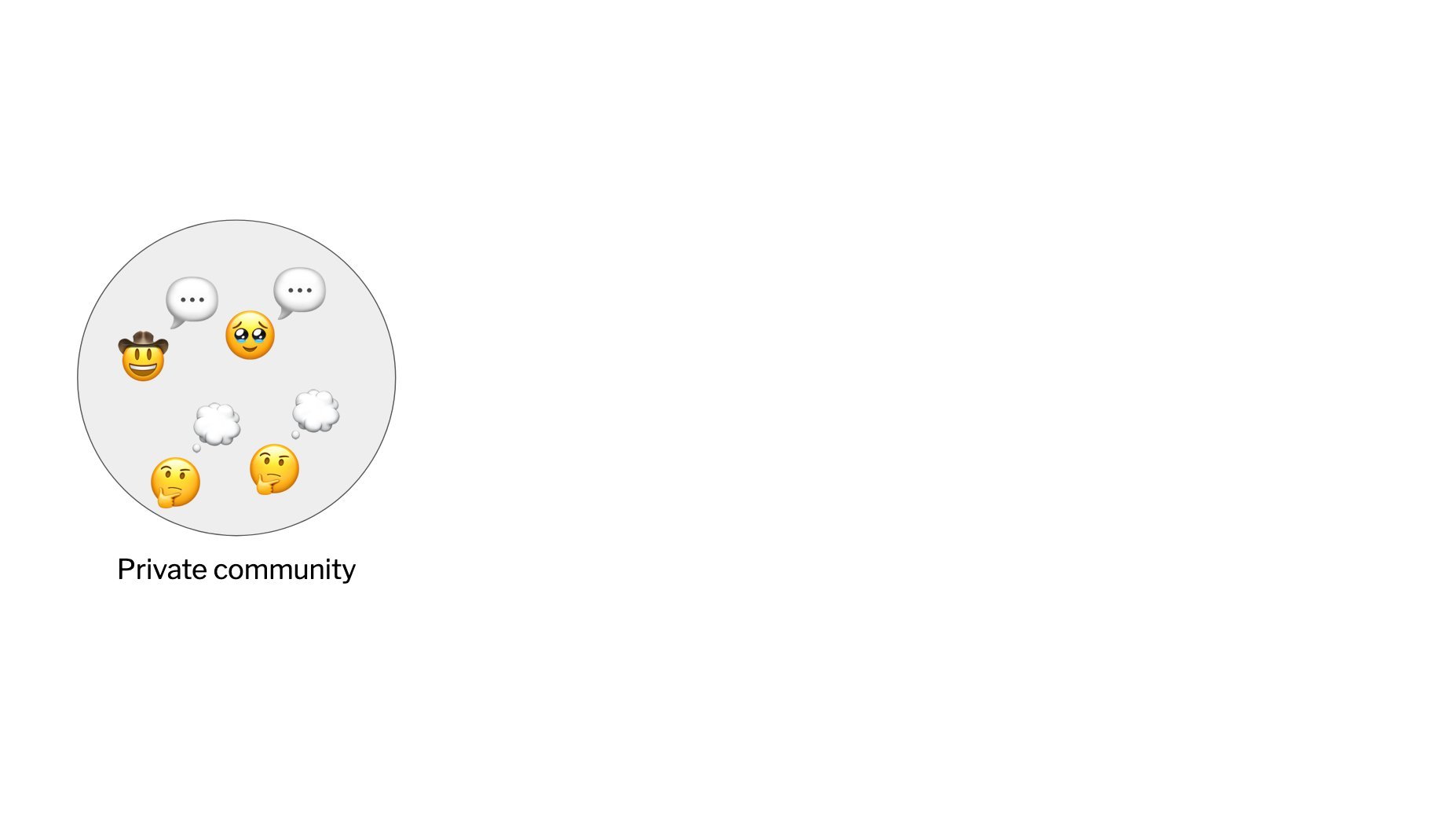
Alt text: A single core community - representing the foundational trusted group needing encryption.
Building Tools That Matter: The Three Essential Questions for Developers
Werdmuller challenged developers and platform builders to move beyond ideology and focus ruthlessly on solving concrete problems for specific, vulnerable communities. He distilled lessons from successful (Elgg) and struggling (Known) projects, and his experience funding mission-driven startups at Matter, into three survival questions:
- Who specifically do we want to help? "Not 'activists' or 'journalists' in the abstract. Which organizers? Which newsrooms? Which communities?... Have you sat with them? Marched with them? Watched them work?" Deep, empathetic understanding is paramount.
- Why are we the right team to help them? "Is it lived experience... Deep domain knowledge? A unique technical capability they need? Or are you building what you find intellectually interesting?" If your team isn't representative, you might not be the right people yet.
- How can we address their needs better than anything else that exists today? "I don’t mean ideology. Open source or federation are not solutions in themselves... What specific pain point are you solving that keeps people on WhatsApp despite the surveillance risk, or on X despite the white supremacy?... Concepts like 'credible exit' are hypothetical... What’s making their lives better right now?"
The history of TXTmob, an SMS tool for activists coordinating protests in 2004, which directly inspired the creation of Twitter at Odeo, exemplifies this approach: solving a specific, urgent need led to widely impactful technology.
The Stakes Demand Sustainable Solutions
Werdmuller emphasized that getting this right isn't just about technical elegance; it's about providing sustainable infrastructure for resistance and community building under threat. Newsrooms won't adopt federated tools because they are "decentralized"; they need demonstrably better engagement or donation pathways. Communities won't risk insecure platforms. Solving real needs deeply creates value, which in turn fosters sustainability for the open social web ecosystem – allowing developers to work full-time without burnout on these critical tools.
"The threats are real," Werdmuller concluded, pointing to escalating raids and repression. "But so is the community in this room. You have the skills, the values, and now hopefully a framework to build what's needed... The opportunity right now... is to build infrastructure that vulnerable people can actually use to organize, to communicate safely, and to build community. But we can only do that if we're building with those communities from day one."
Source: Why the Open Social Web Matters Now - Ben Werdmuller
Comments
Please log in or register to join the discussion