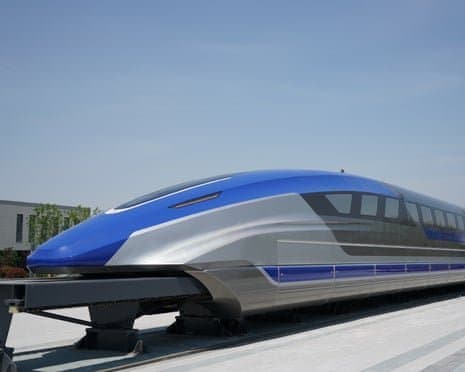
Chinese researchers appear to have solved the critical 'tunnel boom' problem plaguing ultra-high-speed maglev trains capable of 600km/h (370mph). By implementing innovative porous soundproofing buffers at tunnel entrances, shock waves causing structural damage and noise pollution are reduced by up to 96%, paving the way for practical implementation of next-generation magnetic levitation networks. This breakthrough addresses a fundamental physics challenge that threatened to derail maglev's poten
The dream of ultra-high-speed maglev trains, capable of whisking passengers at 600km/h (370mph), has long been hampered by a formidable physics problem: the deafening and destructive 'tunnel boom'. Now, researchers in China, developing the country's latest maglev prototype, believe they have cracked it using innovative acoustic engineering, potentially unlocking a new era of high-speed ground transportation.
{{IMAGE:3}}
At the heart of the problem is fluid dynamics. When a high-speed train enters a tunnel, it acts like a piston, violently compressing the air in front of it. This compressed air rushes towards the tunnel exit, coalescing into powerful, low-frequency shock waves that erupt from the tunnel mouth – the infamous 'tunnel boom'. These booms pose significant risks: disturbing or harming nearby humans and wildlife, causing structural damage, and severely impacting passenger comfort. While a known issue for conventional high-speed rail (topping ~350km/h), the problem intensifies dramatically at maglev speeds. A train travelling 600km/h generates a boom in tunnels as short as 2km (1.2 miles), a length where conventional high-speed trains wouldn't produce the effect until around 6km.
The Engineering Solution: Porous Buffers as Sonic Silencers
The breakthrough comes from deploying specialized 100-meter-long porous buffers at tunnel entrances, combined with porous coatings on the tunnel body itself. This design functions much like a firearm silencer. As the high-pressure air wave generated by the approaching train travels down the tunnel, the porous structure allows the trapped air to gradually escape and dissipate before it reaches the tunnel mouth and coalesces into a destructive boom. Early results are dramatic, showing shock wave reductions of up to 96%. This tackles the core issues of operational safety, noise pollution, and ride quality, while also mitigating environmental impact on surrounding areas.
Levitating Beyond Friction: The Maglev Advantage
Magnetic levitation (maglev) eliminates the fundamental speed limitation of wheel-on-rail systems: friction. By using magnetic forces – either electromagnetic suspension (EMS) attracting the train upwards to a rail or electrodynamic suspension (EDS) repelling it upwards within a guideway – the train floats mere millimeters above its track. Propulsion is also electromagnetic, allowing for vastly higher speeds and smoother rides with no mechanical noise beyond the quiet hum of electromagnets. China pioneered commercial high-speed maglev in 2004 with the Shanghai Transrapid line (460km/h), though subsequent national expansion focused on conventional high-speed rail, building the world's largest network.
The Maglev Resurgence and Future Lines
State-owned manufacturer CRRC reignited China's maglev ambitions with its 600km/h prototype launch in 2021. While no specific lines are officially confirmed, industry expectations point strongly towards a future Beijing-Shanghai maglev link. Such a line could slash the current 4.5-hour high-speed rail journey to just 2.5 hours – comparable to flight times but offering significant advantages. In China, high-speed rail is substantially cheaper than airfare (approximately ¥600 vs ¥1,200), and critically, emits roughly seven times less CO2 per passenger kilometer traveled. This represents a massive potential carbon saving for intercity travel.
China isn't alone in pursuing ultra-high-speed maglev. Japan's Chuo Shinkansen project, aiming to connect Tokyo and Osaka via Nagoya at 505km/h (314mph), promises to reduce the journey from 2.5 hours to just 67 minutes. However, the project has faced significant delays, underscoring the immense technical and logistical challenges inherent in deploying such cutting-edge infrastructure.
The successful mitigation of the tunnel boom is more than just an acoustic fix; it removes a critical barrier to the practical deployment of maglev technology at its theoretical speed limits. By mastering the complex interplay of aerodynamics and high-velocity travel within confined spaces, engineers are bringing the silent, frictionless glide of 600km/h maglev significantly closer to reality, promising faster, cleaner, and potentially transformative connections between major urban centers.
Source: The Guardian - 'Maglev train researchers may have solved ‘tunnel boom’ shock waves' (August 2025)
Comments
Please log in or register to join the discussion