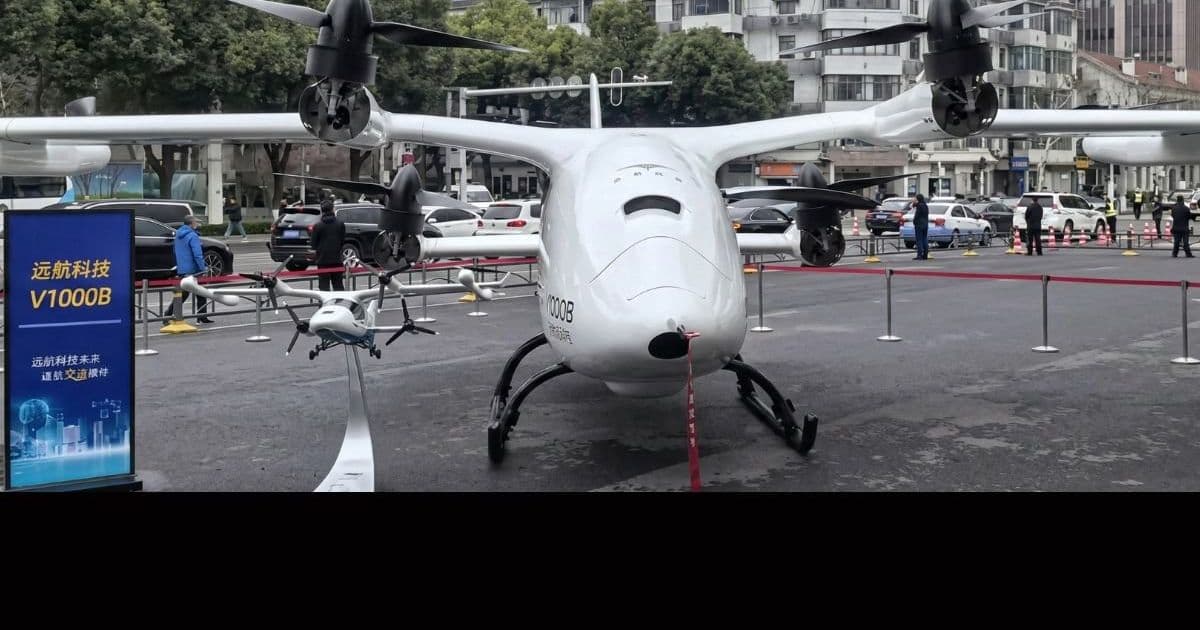
Four groundbreaking electric vertical takeoff and landing vehicles debuted in Wuhan, showcasing China's rapid advancement in aerial mobility with ranges up to 1,000 km and applications from urban commuting to emergency medical services.
On February 24, four distinct electric vertical takeoff and landing vehicles took center stage outside the Hongshan Auditorium in Wuhan, Hubei province. This display during the first provincial meeting following the Spring Festival signals a major acceleration in the low-altitude economy of the nation.
The eVTOL sector is rapidly transitioning from a conceptual blueprint into a commercial reality, supported by deep integration with existing new energy vehicle supply chains. With industry leaders viewing 2026 as a pivotal year for mass production, domestic developers are racing to secure certification and launch commercial passenger operations.
The showcased aircraft highlight the robust aviation manufacturing heritage of Hubei, a province that generated 27.9 billion yuan in aviation revenue in 2025. Among the innovations is the E-Hawk, a ton-class vehicle featuring fully enclosed rotors capable of carrying four passengers for short-haul urban commuting.
Addressing range anxiety, Wuhan Xunqi Technology presented the V1000, which uses a hybrid tilt-rotor system to achieve a flight range exceeding 1,000 kilometers. This model has already received formal design acceptance from the Civil Aviation Administration of China. Meanwhile, Shi Yun Aviation presented the SW-one, an aircraft controlled via a traditional steering wheel designed for personal water sports and future tourism applications.
Beyond commuter and recreational models, the industry is pioneering critical emergency applications. Fusheng General Aviation introduced the Sparrow-X2, an airborne intensive care unit designed to accommodate a stretcher and medical monitoring equipment. This pure-electric craft reduces hourly emergency rescue costs to approximately 2,200 yuan, significantly undercutting the expenses associated with traditional helicopters.
With 547 related companies nationwide and a surge in aviation patent filings, the domestic sector is leveraging high levels of investment capital to establish a dominant global footprint in next-generation aerial mobility.
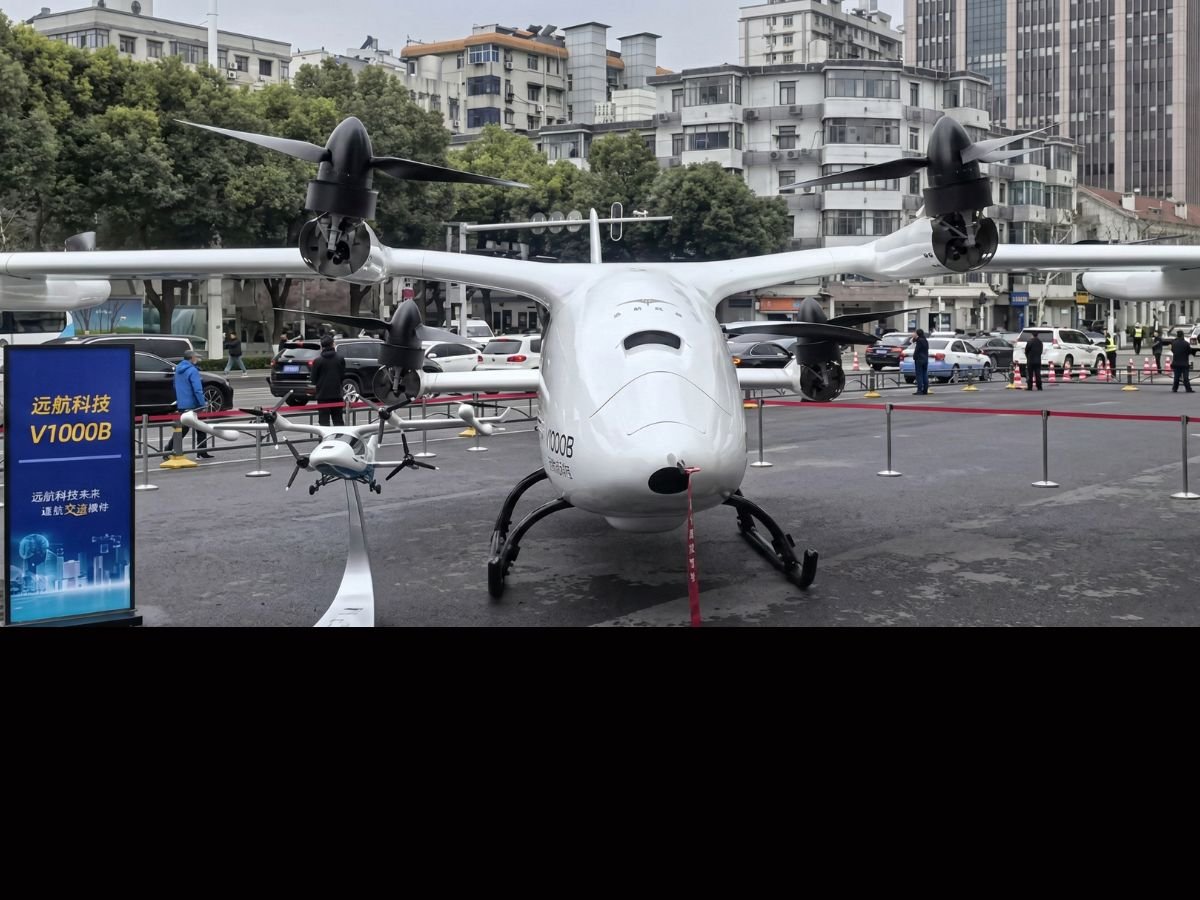
The V1000 electric air taxi represents a significant leap forward in electric aviation technology. Its hybrid tilt-rotor system addresses one of the most critical challenges facing electric aircraft: range limitations. While many electric aircraft struggle to exceed 200-300 kilometers on a single charge, the V1000's 1,000+ kilometer range opens up possibilities for regional air mobility that were previously impossible with pure electric propulsion.
This extended range is achieved through a sophisticated hybrid system that combines electric motors with a range-extending generator. The tilt-rotor configuration allows the aircraft to take off and land vertically like a helicopter while transitioning to efficient forward flight like a conventional airplane. This versatility makes it suitable for both urban air mobility applications and longer regional routes.
The formal design acceptance from the Civil Aviation Administration of China represents a crucial milestone in the aircraft's development. This certification process ensures the aircraft meets stringent safety and performance standards before entering commercial service. With this approval secured, Wuhan Xunqi Technology can now focus on final testing and preparation for mass production.
China's aggressive push into the eVTOL market reflects broader strategic objectives in the low-altitude economy. The government has identified aerial mobility as a key growth sector, with projections suggesting the market could reach hundreds of billions of yuan in value over the next decade. The concentration of 547 companies in this space indicates both the scale of investment and the competitive intensity driving innovation.
The emergency medical applications demonstrated by the Sparrow-X2 highlight how eVTOL technology extends beyond transportation to address critical infrastructure needs. Traditional helicopter emergency medical services face limitations in urban environments due to noise restrictions, landing space requirements, and high operational costs. The Sparrow-X2's electric propulsion system addresses these challenges while providing dedicated medical capabilities.
The cost reduction to approximately 2,200 yuan per hour represents a significant improvement over conventional helicopter emergency services, which typically cost several times more to operate. This price point makes emergency medical aviation accessible to a broader population and enables more frequent deployment for non-critical medical transfers.
The E-Hawk's design for urban commuting reflects the most immediate commercial application for eVTOL technology. With four-passenger capacity and fully enclosed rotors for safety, this aircraft is optimized for short urban routes where ground traffic congestion makes traditional transportation inefficient. The ton-class designation indicates a substantial aircraft capable of carrying meaningful payloads while maintaining the maneuverability required for urban operations.
Hubei province's 27.9 billion yuan aviation revenue in 2025 demonstrates the existing industrial base supporting this expansion into electric aviation. The province's established aerospace manufacturing capabilities provide the technical expertise and supply chain infrastructure necessary for large-scale eVTOL production. This industrial foundation gives Chinese manufacturers a competitive advantage as they scale up production to meet anticipated demand.
The integration with new energy vehicle supply chains represents a strategic approach to leveraging existing manufacturing capabilities. Components such as batteries, electric motors, and power electronics developed for electric vehicles can be adapted for aviation applications, reducing development costs and accelerating production timelines. This cross-industry synergy accelerates the commercialization of eVTOL technology.
As 2026 approaches as the targeted year for mass production, the competitive dynamics among Chinese manufacturers will likely intensify. Companies are not only racing to achieve certification but also to establish brand recognition and secure early market share in what promises to be a transformative transportation sector. The diversity of designs showcased in Wuhan—from urban commuters to emergency medical aircraft—demonstrates the breadth of applications being pursued simultaneously.
The surge in aviation patent filings indicates the rapid pace of innovation occurring across multiple technical domains. These patents cover everything from battery management systems and electric motor designs to flight control software and safety systems. This intellectual property development creates barriers to entry for international competitors while establishing China's position as a leader in next-generation aviation technology.
Looking forward, the successful commercialization of these aircraft will depend on several factors beyond technical performance. Public acceptance of electric air taxis, the development of charging and maintenance infrastructure, integration with existing air traffic control systems, and the establishment of operational regulations will all play crucial roles in determining the pace and scale of market adoption. The demonstration in Wuhan represents not just a technological achievement but a statement of intent about China's ambitions in the emerging aerial mobility sector.
Comments
Please log in or register to join the discussion