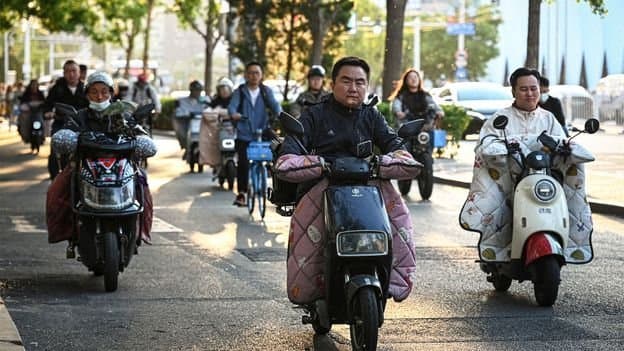
China is leveraging its massive electric scooter market to pioneer sodium-ion battery technology, aiming for mass adoption to reduce lithium dependency and dominate future energy storage. With rapid deployment in two-wheelers and grid infrastructure, Chinese firms are outpacing global competitors in commercializing this abundant, safer alternative. This strategic push could redefine clean energy supply chains and accelerate the global transition away from critical mineral constraints.
On a bustling street in Hangzhou, rows of sleek electric mopeds glisten under the sun—not as mere vehicles, but as harbingers of a battery revolution. These scooters, priced between $400 and $660, are powered not by conventional lithium-ion cells but by sodium-ion batteries derived from sea salt. For Chinese manufacturer Yadea, this is more than a product launch; it’s a calculated bid to scale an emerging technology through the world’s largest electric two-wheeler market. According to a BBC report, China is racing ahead in commercializing sodium-ion batteries, using scooters as a springboard to achieve economies of scale and outpace global rivals in a critical clean-energy arena.
The Sodium Surge: From Chemistry to Commercial Reality
Sodium-ion batteries function similarly to lithium-ion counterparts, shuttling ions between electrodes to store energy. But sodium’s abundance—400 times more plentiful than lithium—offers a compelling advantage. Extracted from salt, it sidesteps supply chain bottlenecks tied to lithium, which is largely processed in China and mined in Australia, Chile, and elsewhere. As Cory Combs of Trivium China notes, "Chinese companies' multi-pronged strategy in driving sodium-ion batteries will put it in a leading position of a global race."
The technology isn’t new; research dates back decades, but a lithium price surge in 2021 reignited interest. When battery-grade lithium prices quadrupled, giants like CATL accelerated sodium-ion development. Though lithium costs have since plummeted due to expanded Chinese refining capacity, sodium’s other benefits endure:
- Enhanced Safety: Sodium-ion batteries are less prone to overheating, a critical edge after 2024’s wave of lithium scooter fires in China and incidents like the California energy storage blaze in early 2025.
- Cold-Weather Resilience: They retain over 80% capacity at -40°C, thanks to sodium ions moving more easily through electrolytes, as highlighted by Xi’an Jiaotong University’s Tang Wei.
- Environmental Upside: They avoid cobalt and nickel mining, reducing ecological harm, though production emissions currently mirror lithium-ion cells.
Why Scooters Are the Perfect Testbed
China’s 55 million annual electric two-wheeler sales—six times its electric car volume—provide an ideal launchpad. Dubbed "little electric donkeys," these vehicles dominate Asian transit for short, low-speed trips, minimizing the impact of sodium-ion’s lower energy density. For now, they primarily compete with lead-acid batteries, which are cheaper but less efficient and durable.
Yadea is spearheading the charge. After selling 13 million e-bikes globally in 2024, it launched three sodium-ion scooter models and a supporting ecosystem:
- Fast-Charging Pillars: Replenish 0–80% power in 15 minutes.
- Battery-Swapping Stations: QR-code-activated exchanges take 30 seconds, piloted with 150,000 delivery riders in Shenzhen. The city aims to become a "battery-swapping city," deploying 50,000 stations by 2027. Meanwhile, rivals like Tailg and BYD’s FinDreams are investing in production, with sodium scooter market share projected to leap from 0.04% in 2023 to 15% by 2030.
Beyond Two Wheels: Grid Storage and Global Ambitions
While scooters build scale, energy storage is sodium-ion’s endgame. Fixed installations negate weight and range limitations, making them ideal for absorbing renewable energy. As Ilaria Mazzocco of CSIS explains, "You can just make a slightly bigger energy storage plant. It’s not moving anywhere. The weight doesn’t matter." With global grid storage needing 35-fold growth by 2030 for net-zero goals, China is already deploying:
- A 10 MWh sodium-ion station in Guangxi (powering 1,500 homes daily).
- Projects in Hubei and others constituting 20% of state-backed storage plans.
China’s manufacturing muscle is pivotal. Firms invested $7.6 billion in sodium R&D in 2023 alone, dwarfing global efforts. Factories with 180 GWh capacity are underway, and CATL’s Naxtra brand aims for mass car and truck batteries this year. Though sodium-ion cells currently cost 60% more than lithium for storage, analysts expect price parity as scale grows. While Western players like Natron Energy innovate, China’s 90% share of planned global capacity by 2033 seems unassailable. As Yadea expands into Southeast Asia and Africa, its vision—enabling "hundreds of millions to enjoy green transport"—could position sodium-ion as the backbone of a resilient, post-lithium energy future.
Source: Adapted from BBC Future's "How electric scooters are driving China's salt battery push" (May 2025).
Comments
Please log in or register to join the discussion