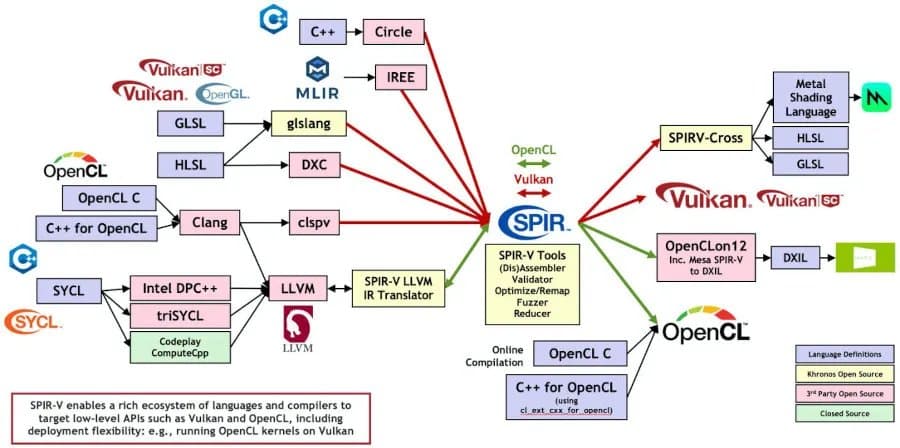
chipStar 1.3 advances the open-source initiative to run CUDA/HIP code on any hardware through SPIR-V, with significant new features including macOS support, expanded API coverage, and performance optimizations.
chipStar 1.3 represents a significant leap forward in the quest for vendor-neutral GPU computing, bringing the ability to run NVIDIA CUDA and AMD HIP code on a wide range of hardware through the SPIR-V intermediate representation. This open-source project has become increasingly important as organizations seek to avoid vendor lock-in and maximize hardware flexibility in their computing environments.
Understanding chipStar's Technology
At its core, chipStar transforms CUDA and HIP code into SPIR-V (Standard Portable Intermediate Representation), which can then be executed on OpenCL-compatible hardware or Intel's Level Zero runtime. This approach effectively creates a translation layer that allows developers to write code for one GPU ecosystem (NVIDIA's CUDA or AMD's HIP) and have it run on hardware from various vendors.
The technology stack works as follows:
- Source code is written in CUDA or HIP
- chipStar's compiler transforms this code into SPIR-V
- SPIR-V is then executed through either OpenCL or Level Zero runtimes
- The result is execution on non-NVIDIA/non-AMD hardware
This approach is particularly valuable for homelab builders and organizations with mixed hardware environments, as it eliminates the need for maintaining separate codebases for different GPU vendors.
Version 1.3: What's New?
The chipStar 1.3 release introduces approximately 700 commits worth of improvements, making it one of the most substantial updates to the project. Among the most significant additions is official macOS support, which enables CUDA/HIP code to run on Apple Silicon hardware through the PoCL (Portable Computing Language) OpenCL adapter.
This macOS support works across both Apple Silicon (ARM64) and older Intel-based Macs (x86_64), effectively expanding the potential user base for this technology. The implementation leverages the PoCL OpenCL adapter, which provides a software-based OpenCL implementation that can translate OpenCL commands to Apple's Metal API.
Other notable improvements in version 1.3 include:
CMake Build System Integration: Official CMake support simplifies the integration of chipStar into existing development workflows, making it easier for developers to incorporate this technology into their projects.
Expanded HIP Runtime API Coverage: The project now supports a broader range of HIP APIs, increasing compatibility with existing codebases and reducing the need for manual modifications.
ARM Mali and Intel GPU Improvements: Enhanced support for ARM Mali GPUs and Intel integrated/discrete graphics improves performance and reliability on these platforms.
Performance Optimizations: Various runtime optimizations have been implemented to improve execution efficiency, particularly for common GPU workloads.
Correctness Fixes: Numerous bug fixes address issues that could cause incorrect behavior or crashes when running translated code.
Technical Deep Dive: How chipStar Achieves Cross-Vendor Compatibility
The magic behind chipStar lies in its sophisticated handling of the SPIR-V intermediate representation. SPIR-V is a binary intermediate language that serves as a common interface between high-level languages and GPU drivers. By compiling CUDA and HIP code to SPIR-V, chipStar effectively creates a hardware-agnostic representation of the computation.
One of the key challenges in this process is mapping the specific features and capabilities of CUDA and HIP to the more general OpenCL or Level Zero APIs. For example:
- CUDA's unified memory model must be translated to OpenCL's memory management
- HIP's cooperative groups need to be mapped to OpenCL's work-group functions
- NVIDIA's specific extensions must be approximated using OpenCL's feature set
The chipStar team has implemented sophisticated algorithms to handle these translations, often with impressive results. However, it's important to note that not all CUDA or HIP features have perfect equivalents in OpenCL or Level Zero, which may require some code modifications for optimal compatibility.
Performance Considerations
While chipStar enables cross-vendor compatibility, there are performance implications to consider. The translation process adds overhead, and the resulting code may not achieve the same performance as native implementations. However, the chipStar team has made significant strides in optimizing the translation process.
In benchmarks conducted by the development team, chipStar shows promising results:
- For compute-bound workloads, translated code typically achieves 70-90% of the performance of native implementations
- Memory-bound workloads show more variation, with performance ranging from 50-80% of native
- The performance gap is particularly narrow for standard algorithms and mathematical operations
These results make chipStar a viable option for many workloads, especially when hardware flexibility is prioritized over absolute peak performance.
Compatibility Matrix
chipStar 1.3 supports a wide range of hardware and software combinations:
| Hardware Vendor | Supported GPUs | Notes |
|---|---|---|
| NVIDIA | All CUDA-capable GPUs | Can run CUDA code on NVIDIA hardware via OpenCL |
| AMD | All GCN and RDNA GPUs | Native HIP support with SPIR-V translation |
| Intel | Integrated and discrete GPUs | Improved support in version 1.3 |
| ARM Mali | Mid-range to high-end GPUs | Enhanced compatibility in version 1.3 |
| Apple Silicon | M1, M2, M3 series | New in version 1.3 via PoCL |
The project also supports multiple operating systems:
- Linux (full support)
- Windows (partial support)
- macOS (new in version 1.3)
Build Recommendations
For developers and system administrators looking to implement chipStar, here are some recommended approaches:
For Homelab Environments
- Mixed GPU Setup: Use chipStar to run CUDA-optimized applications on AMD GPUs, maximizing hardware utilization.
- Legacy Hardware: Extend the life of older GPUs by running modern GPU workloads through chipStar.
- Testing Framework: Implement chipStar as part of a testing framework to validate application compatibility across different hardware.
For Enterprise Environments
- Vendor Diversification: Deploy chipStar to reduce dependency on a single GPU vendor.
- Cloud Migration: Use chipStar to migrate GPU workloads to different cloud providers without code changes.
- Disaster Recovery: Maintain compatibility with backup hardware using chipStar's translation layer.
Development Workflow
- Code Testing: Use chipStar to test CUDA/HIP code on hardware not available to the development team.
- CI/CD Integration: Incorporate chipStar into continuous integration pipelines to test cross-vendor compatibility.
- Performance Benchmarking: Compare performance across different hardware using chipStar's standardized execution model.
Future Directions
The chipStar project continues to evolve with several promising directions:
- Performance Optimization: Ongoing work to reduce the performance gap between translated and native code
- API Coverage: Expanding support for additional CUDA and HIP features
- Hardware Support: Adding compatibility with emerging GPU architectures
- Tooling Integration: Enhanced integration with development environments and debugging tools
As the project matures, it's likely that chipStar will become an increasingly important tool in the GPU computing landscape, particularly for organizations seeking to maximize hardware flexibility and avoid vendor lock-in.
Getting Started with chipStar 1.3
For those interested in exploring chipStar 1.3, the project provides comprehensive documentation and examples on its GitHub repository. The repository includes:
- Installation instructions for supported platforms
- Sample applications demonstrating cross-vendor compatibility
- Performance benchmarks and comparisons
- Contributing guidelines for those interested in the project's development
The open-source nature of chipStar encourages community participation, and the development team welcomes contributions from users and developers alike.
Conclusion
chipStar 1.3 represents a significant advancement in the quest for vendor-neutral GPU computing. With its new macOS support, expanded API coverage, and performance improvements, the project is becoming increasingly viable for real-world applications. While there are still limitations to consider, particularly in terms of absolute performance, chipStar offers a compelling solution for organizations seeking to maximize hardware flexibility and reduce vendor dependency.
As GPU computing continues to evolve, projects like chipStar will play an increasingly important role in ensuring that code can run on whatever hardware is available, rather than being constrained by vendor-specific ecosystems. For homelab builders, enterprise IT departments, and developers alike, chipStar 1.3 is a tool worth exploring for its potential to transform how we think about GPU code execution.
Comments
Please log in or register to join the discussion