Anthropic’s Claude Code gains a lightweight, reflection‑driven diary system that captures session insights, synthesizes general rules, and updates its own instruction file. The new plugin demonstrates how generative agents can evolve from static prompts to adaptive behavior without external training data.
Claude Diary: Turning Claude Code Sessions into Self‑Learning Agent Memory
Anthropic’s Claude Code, the AI‑powered coding companion, traditionally relies on static system instructions stored in a CLAUDE.md file. A new plugin, Claude Diary, augments that architecture with a reflection‑based learning loop that turns raw session logs into actionable, persistent rules. The result is an agent that can refine its own behavior over time, a capability that has long been a missing piece in generative AI tooling.
The Memory Problem in Generative Agents
Research papers such as CoALA (2023) and Generative Agents (2023) formalize two key memory types for agents:
- Procedural memory – the set of instructions and templates that guide an agent’s actions.
- Episodic memory – a record of past interactions that can inform future decisions.
Claude Code already stores its system prompts in CLAUDE.md and logs sessions under ~/.claude/projects/. However, turning those logs into new procedural rules is non‑trivial. The Claude Diary plugin addresses this gap by letting the agent itself reflect on its past sessions and update its own instruction file.
“Claude Code stores its system instructions in CLAUDE.md files and session logs are saved to ~/.claude/projects/. But, how can we transform past actions from logs into persistent, general rules that can be added to instructions?” – Source
Building the Reflection Loop
The plugin introduces three core slash commands:
| Command | Purpose |
|---|---|
/diary |
Captures key details from a session (accomplishments, design decisions, challenges, user preferences, PR feedback) and writes a diary entry to ~/.claude/memory/diary/. |
/reflect |
Reads the diary entries, analyzes them against the current CLAUDE.md, identifies rule violations, strengthens weak rules, and proposes one‑line bullet updates. |
PreCompact hook |
Optionally auto‑generates diary entries for longer sessions that use compaction, giving the agent a hybrid manual/automatic capture strategy. |
The diary entries are stored as Markdown files named by date and session number, e.g., 2025-12-01-session-3.md. Reflections are similarly archived, with a processed.log file preventing duplicate analysis.
The reflection process works as follows:
- Load the current
CLAUDE.mdinto memory. - Scan all unprocessed diary entries.
- Detect rule violations and recurring patterns.
- Generate concise bullet updates that can be added directly to
CLAUDE.md. - Save the reflection output and mark entries as processed.
“The reflection command reads the CLAUDE.md file, checks for rule violations in the diary entries, and strengthens weak rules. It also looks across diary entries to identify recurring patterns.” – Source
Visualizing the Flow
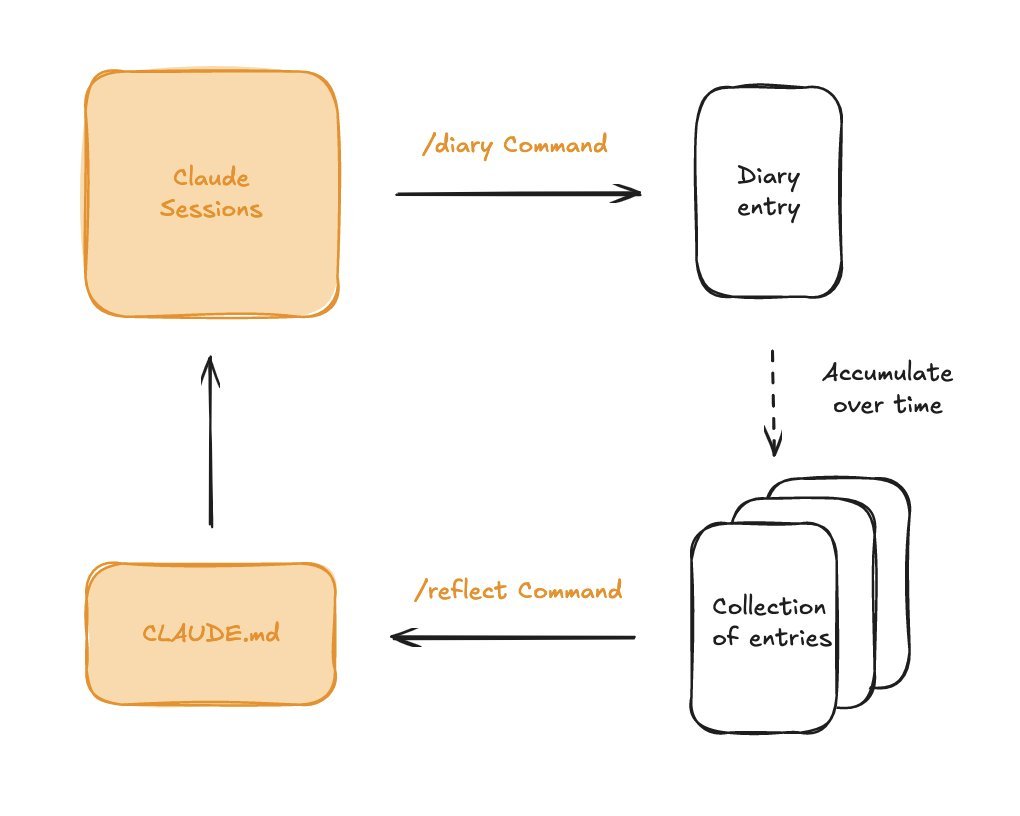
The diagram above illustrates the end‑to‑end pipeline: from raw session logs to diary entries, reflection, and updated system instructions. The modular design means each step can be tweaked or replaced without breaking the overall workflow.
Practical Gains: What Claude Diary Learned
Over a month of use, the plugin surfaced several concrete improvements:
- PR Review Feedback – By ingesting comments from the
pr-commentscommand, the agent learned to adapt its code style to team conventions. - Git Workflow – The diary captured atomic commits, branch naming conventions, and commit‑message formatting, reinforcing best practices.
- Testing Practices – Reflection identified a pattern of running targeted tests first for rapid feedback, followed by comprehensive suites, and the use of specialized test libraries.
- Code Quality – The agent avoided anti‑patterns such as naming conflicts, stale directories after refactoring, and verbose code.
- Agent Design – For generative‑agent projects, the system learned to favor single‑agent delegation over premature parallelization and to use the filesystem for context offloading.
- Self‑Correction – When the agent deviated from its own instructions, reflections reinforced the relevant rules.
These insights demonstrate how a lightweight reflection loop can turn a static AI assistant into a continuously improving partner.
Extensibility and Future Work
Claude Diary’s architecture is intentionally minimalistic: the commands are essentially prompts that can be edited or extended. Automation can be added via hooks, and the reflection logic could be replaced with a more sophisticated learning algorithm. The plugin also opens the door to research on how generative agents can evolve without external fine‑tuning.
“Claude Diary is just a simple attempt to convert raw Claude Sessions into memory updates in CLAUDE.md. The commands are just prompts, making them easy to modify.” – Source
Conclusion
Claude Diary showcases a practical pathway for generative agents to acquire a form of continual learning. By embedding a reflection loop directly into Claude Code, the agent can transform its own experiences into procedural knowledge, closing the loop between episodic memory and actionable instruction updates. As the field pushes toward more autonomous AI, such lightweight, prompt‑driven learning mechanisms may become a cornerstone of next‑generation developer tools.
Source: https://rlancemartin.github.io/2025/12/01/claude_diary/
Comments
Please log in or register to join the discussion