
Cloudflare introduces Moltworker, an open-source implementation that enables running Moltbot—a self-hosted personal AI agent—on Cloudflare's Developer Platform, removing the need for dedicated local hardware.
Cloudflare has introduced Moltworker, an open-source implementation that enables running Moltbot—a self-hosted personal AI agent—on Cloudflare's Developer Platform, removing the need for dedicated local hardware. Moltbot, recently renamed from Clawdbot, is designed to operate as a personal assistant through chat applications, integrating with AI models, browsers, and third-party tools while remaining user-controlled.
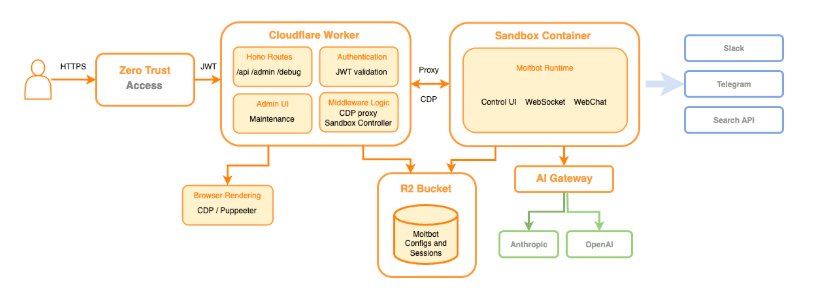
Source: Cloudflare Blog
The implementation leverages recent enhancements in Node.js compatibility within Cloudflare Workers. Cloudflare notes that improved native support for Node APIs reduces the need for workarounds, allowing more npm packages to run unmodified. While Moltbot mainly operates in containers, Cloudflare believes that this greater compatibility will enable more agent logic to move closer to the edge in future designs.
Moltworker adapts Moltbot to Cloudflare Workers by combining an entrypoint Worker with isolated Sandbox containers. The Worker acts as an API router and administration layer, while the Moltbot runtime and its integrations execute inside Sandboxes. Persistent state, including conversation memory and session data, is stored in Cloudflare R2, addressing the ephemeral nature of containers.
Moltworker Architecture
The project has drawn mixed reactions from early users. Some see the Cloudflare-hosted approach as lowering the barrier to entry. Commenting on the announcement, Peter Choi noted that running Moltbot on Cloudflare could significantly broaden adoption, but questioned whether the shift alters the project's original appeal, which emphasized full local control.
Others highlighted operational benefits. One user wrote: "I've been self-hosting on a VPS, which works fine, but managing the box is a chore. This looks like the 'set it and forget it' version. Curious how state persistence works across worker invocations."
Cloudflare has open-sourced Moltworker on GitHub and positions it as a proof of concept rather than a supported product. The company describes the project as a demonstration of how its Developer Platform—combining Workers, Sandboxes, AI Gateway, Browser Rendering, and storage services—can be used to run AI agents securely and at scale on the edge.
Key Technical Components
- Cloudflare Workers: Entrypoint Worker acts as API router and administration layer
- Sandbox Containers: Isolated execution environment for Moltbot runtime and integrations
- Cloudflare R2: Persistent storage for conversation memory and session data
- AI Gateway: Routes AI requests through multiple model providers with centralized observability
- Browser Rendering: Handles headless Chromium instances for browser automation tasks
- Zero Trust Access: Enforces authentication for APIs and Admin UI
Cloudflare Services Integration
Moltworker integrates several Cloudflare services to replicate and extend the local Moltbot experience. AI requests are routed through Cloudflare AI Gateway, which supports multiple model providers, centralized observability, and options. Browser automation tasks are handled via Cloudflare Browser Rendering, allowing Moltbot to control headless Chromium instances for navigation, form filling, and content capture without running a browser directly in the container.
Authentication for APIs and the Admin UI is enforced using Cloudflare Zero Trust Access, ensuring secure access to the AI agent's capabilities.
The Edge Computing Opportunity
Cloudflare's approach represents a significant shift in how personal AI agents can be deployed. By leveraging edge computing infrastructure, Moltworker eliminates the need for users to maintain dedicated hardware or manage complex server configurations. This "set it and forget it" model could dramatically lower the barrier to entry for self-hosted AI assistants.
The use of Cloudflare's global edge network also means that Moltbot can operate with low latency from virtually anywhere, while still maintaining the privacy and control benefits of a self-hosted solution. The persistent state storage in R2 ensures that conversation history and user preferences are maintained across container invocations, addressing a key challenge in serverless architectures.
Technical Innovation
The implementation demonstrates several technical innovations in running AI agents on edge platforms:
- Node.js Compatibility: Recent improvements in Cloudflare Workers' Node.js support enable more npm packages to run unmodified
- Container Isolation: Sandbox containers provide secure isolation for the Moltbot runtime
- State Persistence: R2 storage solves the ephemeral nature of serverless containers
- Service Integration: Seamless integration with Cloudflare's AI Gateway and Browser Rendering services
Community Response
The mixed reactions from the community highlight the tension between accessibility and control in AI agent deployment. While some users welcome the simplified deployment model, others express concern about moving away from fully local control.
This debate reflects broader discussions in the AI community about the trade-offs between convenience and privacy, and the evolving definition of "self-hosted" in an increasingly cloud-centric world.
Future Implications
Cloudflare's demonstration suggests a future where AI agents can be deployed across a spectrum of hosting options, from fully local to fully cloud-based, with varying degrees of control and convenience. The improved Node.js compatibility in Workers could enable more complex AI agent architectures to run at the edge, potentially shifting more AI processing closer to users.
As edge computing platforms continue to evolve, we may see more sophisticated AI agents that can leverage the global distribution and low latency of edge networks while maintaining user privacy and control.
About the Author

Robert Krzaczyński is a software engineer with solid experience in developing web applications. Passionate about applying artificial intelligence algorithms in medicine and the broader healthcare sector, he continuously expands his expertise in ML and AI. He holds a BSc Eng degree in Control Engineering and Robotics, as well as an MSc Eng degree in Computer Science.
Related Content
- Microsoft Adds Custom Copilot Agents for .NET Developers with C# and WinForms
- Astro Announces Version 6 Beta with Redesigned Development Server and First-Class Cloudflare Workers
- Cloudflare's Matrix Homeserver Demo Sparks Debate over AI-Generated Code Claims
- How CyberArk Protects AI Agents with Instruction Detectors and History-Aware Validation
- Docker's Cagent Brings Deterministic Testing to AI Agents
Technical Resources
- Moltworker GitHub Repository
- Moltbot GitHub Repository
- Cloudflare Workers Documentation
- Cloudflare R2 Documentation
- Cloudflare AI Gateway Documentation
This content is in the AI, ML & Data Engineering topic FOLLOW TOPIC
Comments
Please log in or register to join the discussion