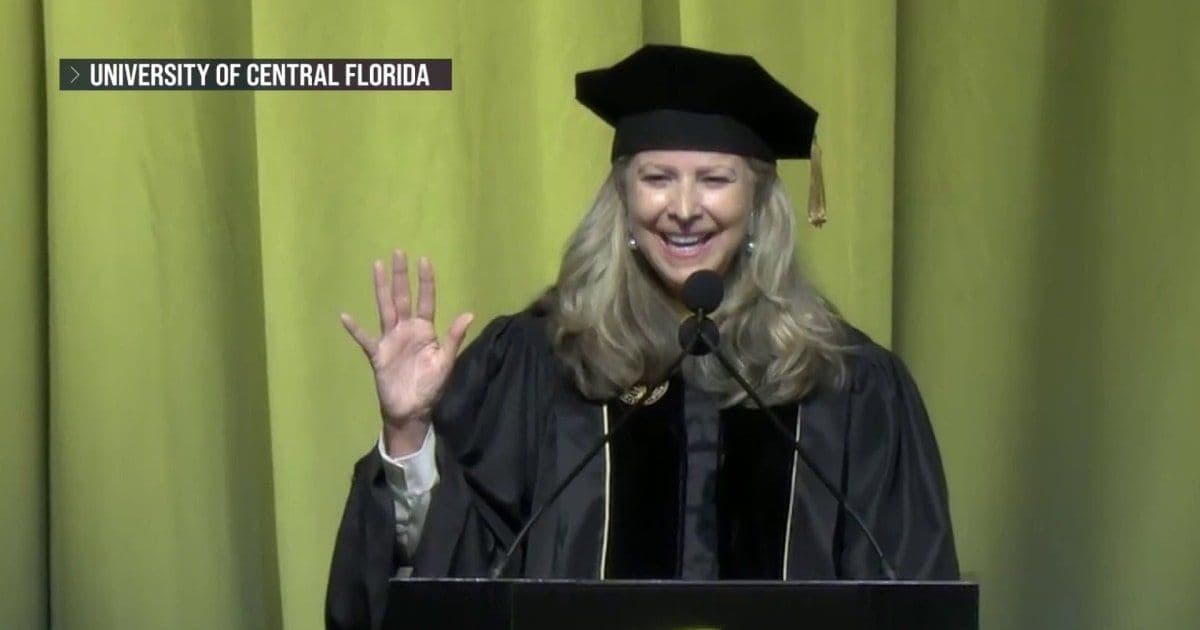
During graduation ceremonies at the University of Arizona and other campuses, several speakers were jeered after warning that AI could exacerbate a tight job market. The incidents highlight growing fatigue with AI hype and underscore genuine concerns about automation, talent pipelines, and the need for concrete policy rather than buzzwords.
 )
)
When former Google CEO Eric Schmidt took the podium at the University of Arizona’s spring commencement, his remarks about “the coming wave of AI‑driven automation” were met with a chorus of boos. He was not alone: two other invited speakers at the same ceremony, a venture‑capital partner and a state education official, faced similar reactions after warning that recent graduates would be competing with increasingly capable language models for entry‑level roles.
What the speakers claimed
- Schmidt warned that “large language models will soon be able to write code, draft contracts, and even generate news stories without human supervision.”
- Venture partner Maya Patel (a partner at Accel) argued that “the hiring market for software engineers is already flattening because AI can handle routine tasks that used to be entry‑level work.”
- Arizona’s Secretary of Higher Education, Dr. Luis Ortega, cautioned that “universities must redesign curricula to focus on prompt engineering, model interpretability, and ethical AI deployment if graduates are to remain relevant.”
What’s actually new?
The core ideas are not novel. Academic papers and industry roadmaps have been flagging the automation of routine software tasks for years. A 2023 study from Microsoft Research showed that GitHub Copilot could reduce the time to write a typical function by about 30 %, and a 2024 OpenAI internal memo estimated that 35 % of junior‑level tickets could be resolved automatically with current models.
What is new is the public visibility of the backlash. Graduation ceremonies are rarely the stage for technical debate, so the boos turned a routine warning into a media moment. The incident also coincided with two concrete developments that make the speakers’ concerns more tangible:
- Enterprise adoption of code‑generation models has accelerated. According to the Stack Overflow Developer Survey 2025, 42 % of respondents reported that their companies now use AI assistants for at least half of their coding tasks.
- Policy proposals: The U.S. Department of Labor released a draft “AI‑Impact Assessment” framework in March 2026, aiming to require large employers to report on how generative AI affects staffing levels. This is the first federal attempt to quantify the displacement risk that speakers were alluding to.
Limitations and missing context
While the speakers highlighted a genuine risk, several nuances were omitted:
- Task substitution vs. task augmentation – Most current models excel at repetitive coding patterns but still struggle with system design, debugging complex integration issues, or understanding legacy codebases. A 2025 benchmark from MLCommons showed that state‑of‑the‑art models achieved 71 % accuracy on synthetic coding problems but only 49 % on real‑world debugging tasks.
- Economic elasticity – Historical data suggests that automation often creates new roles faster than it destroys them. The World Bank’s 2024 report on AI and employment predicts a net 0.3 % increase in global jobs per year, driven largely by AI‑enabled services and maintenance positions.
- Geographic variance – The impact will be uneven. In regions with strong tech ecosystems (e.g., Silicon Valley, Bangalore), AI may shift the skill ceiling upward, whereas in areas with limited upskilling infrastructure, displacement could be more pronounced.
Practical takeaways for graduates
- Invest in model‑centric skills – Understanding prompt engineering, model fine‑tuning, and interpretability is becoming as essential as traditional software engineering fundamentals.
- Emphasize soft‑skill domains – Communication, product sense, and stakeholder management remain hard for AI to replicate.
- Leverage AI as a productivity tool – Early‑career developers who can integrate AI assistants into their workflow tend to deliver features faster, which can translate into higher early‑career earnings.
Broader implications
The booing episode underscores a growing tension: AI hype fatigue versus real, measurable change. As more companies adopt generative models, the narrative will shift from “AI will replace you” to “AI will reshape the type of work you do.” Policymakers, educators, and industry leaders need to move beyond alarmist soundbites and provide concrete pathways for upskilling.
For those interested in the technical details behind the claims, the following resources are useful:
- GitHub Copilot performance study (2023) – quantifies productivity gains.
- MLCommons Coding Benchmark 2025 – provides a realistic assessment of model capabilities on real‑world tasks.
- U.S. Department of Labor AI‑Impact Assessment draft – outlines upcoming reporting requirements for large employers.
The incident may have been noisy, but it serves as a reminder that substance, not hype, should drive the conversation about AI’s role in the future of work.
Image credit: NBC News
Comments
Please log in or register to join the discussion