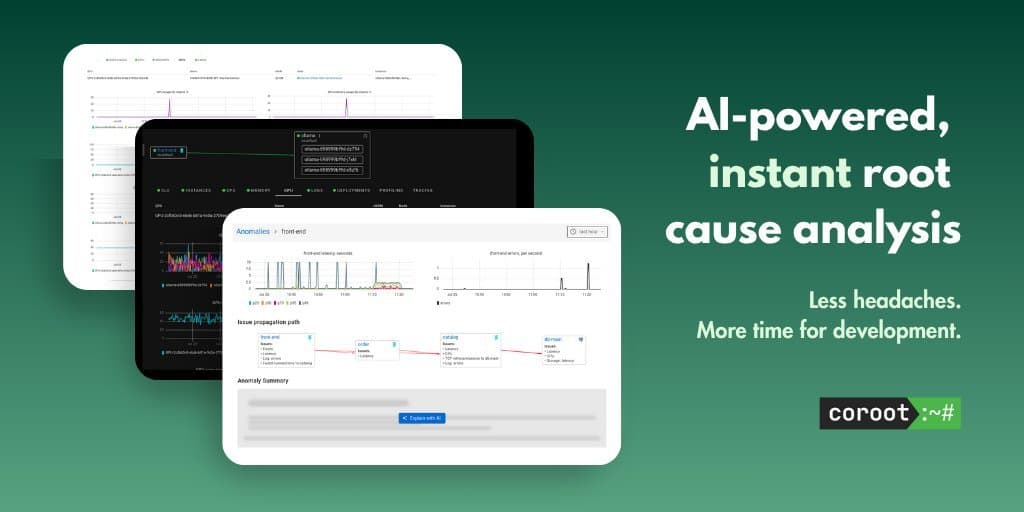
Coroot's eBPF-powered observability platform eliminates manual debugging by automatically pinpointing failures across entire stacks—including third-party and legacy services—with AI-driven explanations. Offering frictionless deployment and predictable core-based pricing, it delivers actionable insights in plain English within minutes.
The Root Cause Revolution: Ending the Debugging Black Hole
Every engineer knows the frustration: alerts blaring, dashboards flashing red, and hours lost sifting through fragmented metrics, logs, and traces while users rage. Traditional observability tools often drown teams in data but leave the critical "why" unanswered—especially when failures span Kubernetes clusters, cloud services, or legacy systems.
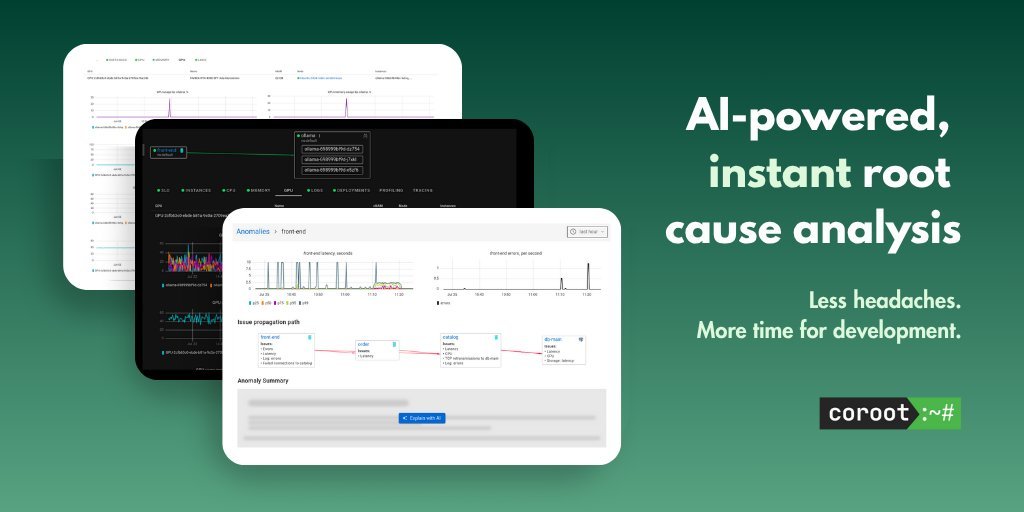
Coroot confronts this chaos head-on with a radical approach. By leveraging eBPF (extended Berkeley Packet Filter) at the kernel level, its lightweight agent automatically captures metrics, traces, logs, profiles, and events across all layers—applications, infrastructure, third-party services, and even black-box components—without a single code change. Within minutes of deployment, it constructs a real-time map of service dependencies and performance bottlenecks.
How Coroot’s AI Cuts Through Noise to Answers
Coroot’s true innovation lies in its AI engine, which analyzes captured telemetry to instantly:
- Identify critical issues that actually impact users (e.g., "Front-end latency spike due to CPU saturation on Node 3")
- Uncover hidden dependencies (e.g., "Network chaos experiment throttling catalog-db-main requests")
- Deliver plain-English diagnostics with evidence-backed remediation steps
Unlike traditional APM tools, Coroot avoids alert fatigue by suppressing noise and highlighting only consequential anomalies. Its causal analysis connects infrastructure flaws (like resource contention) to service degradation, even tracing failures across complex interaction chains.
Self-Hosted Simplicity and Core-Based Economics
Coroot sidesteps two major industry pain points:
- Deployment: Runs entirely within your environment; no telemetry data leaves your infrastructure
- Pricing: Charges per monitored CPU core—not per data volume, user, or storage—with no long-term contracts
This model eliminates unpredictable "bill shock" from data ingestion fees while allowing unlimited retention. Teams scale costs linearly with infrastructure growth, paying only for compute resources monitored.
Why This Matters for Modern Engineering
As systems grow more distributed, manual root cause analysis becomes untenable. Coroot’s eBPF-driven automation offers:
- Speed: Resolve issues in minutes instead of hours
- Universal Visibility: Monitor legacy systems and cloud-native services equally
- Contextual Intelligence: AI explains failures in human terms with supporting evidence
For DevOps and platform teams drowning in tribal debugging knowledge, this isn’t just observability—it’s a force multiplier.
Source: Coroot
Comments
Please log in or register to join the discussion