
Charles Leifer's cysqlite emerges as a thoughtful alternative to existing SQLite drivers, addressing transaction handling complexities while maintaining DB-API compatibility and offering enhanced extension support.
cysqlite: A New SQLite Driver Bridging Functionality and Simplicity
In the evolving landscape of Python database drivers, Charles Leifer's cysqlite represents a deliberate attempt to create a middle path between the feature-rich but complex APSW and the standard library's sqlite3 with its transaction handling quirks. Born from practical experience and the challenges of maintaining pysqlite3, cysqlite offers a fresh perspective on SQLite integration in Python applications.
The Genesis of cysqlite
Leifer's journey with cysqlite began in 2019, motivated by the limitations of existing SQLite drivers. The project lay dormant for several years during which he focused on maintaining pysqlite3, a driver that allowed compiling against specific SQLite versions without depending on system installations. This flexibility proved crucial for leveraging SQLite's compile-time options, particularly for those using "SQLite in anger"—as Leifer puts it.
However, maintaining pysqlite3 became increasingly challenging as CPython evolved. The introduction of private APIs and the argument clinic preprocessor complicated synchronization efforts. Additionally, Leifer's Peewee ORM contained a "hacky C extension" that extracted sqlite3 pointers from Connection objects, an approach incompatible with self-contained pysqlite3 builds. These challenges led to the reactivation of cysqlite as a more sustainable solution.
Addressing SQLite's Transaction Handling Quirks
The most compelling aspect of cysqlite is its approach to transaction handling, which directly confronts the confusing and potentially problematic behavior in Python's standard library sqlite3 module. Leifer illustrates this with clear examples showing how the newer autocommit=True mode silently renders commit() methods ineffective, creating a dangerous situation where developers might believe they're committing transactions when they're not.
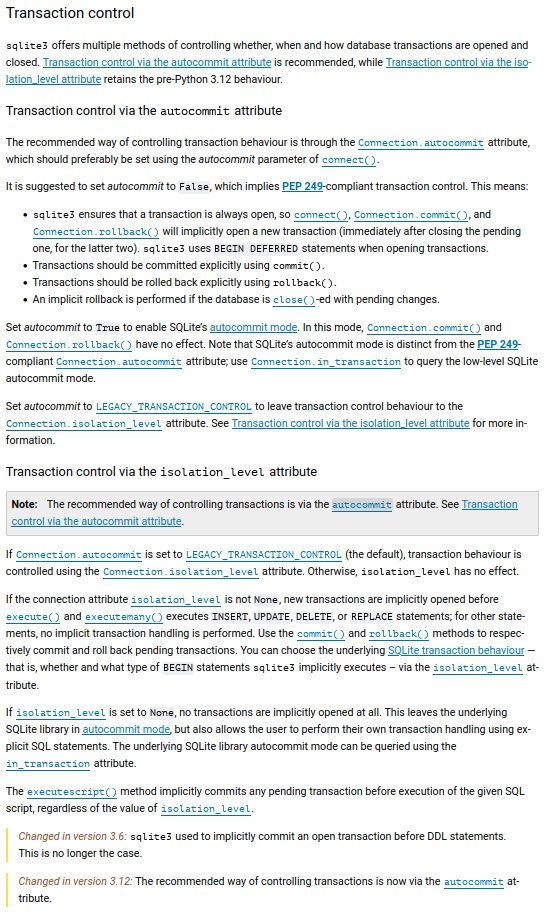
The standard library's transaction handling has evolved into two distinct worlds depending on Python version, with the legacy approach using isolation_level=None being replaced by autocommit=True. This transition has created inconsistent behavior that can lead to subtle bugs and confusion. More critically, both approaches can result in unnecessarily long-lived transactions that hold exclusive write locks, potentially causing "database is locked" errors in concurrent applications.
cysqlite addresses these issues by implementing a straightforward transaction model:
- No implicit transactions or commits
- No isolation level configuration or sentinel values
- No autocommit attributes
- Explicit transaction control only
- Minimal duration for write transactions
This approach aligns with SQLite's default behavior, where each statement runs in its own transaction unless explicitly wrapped in a transaction. The implementation provides convenient methods for begin(), commit(), and rollback(), along with a Peewee-style atomic() context manager that handles savepoints for nested operations.
Simplified Data Type Handling
Another significant improvement in cysqlite is its data type handling approach. The standard library sqlite3 uses a complex system of adapters and converters that Leifer describes as "pretty wild." This system requires registering custom functions for non-standard types, creating additional boilerplate for developers.
cysqlite adopts a more straightforward mapping between Python and SQLite types:
- Python None → SQLite NULL
- Python int, bool → SQLite INTEGER
- Python float → SQLite REAL
- Python str → SQLite TEXT
- Python bytes, buffers → SQLite BLOB
For other Python types, cysqlite applies sensible defaults: datetime objects become TEXT in ISO format, dates become TEXT in ISO format, Decimal and Fraction objects become REAL, and anything else becomes TEXT after conversion to string. This approach eliminates the need for extensive type registration while maintaining flexibility for custom handling when needed.
Extension Capabilities and Integration
Beyond core functionality, cysqlite incorporates several advanced features that Leifer had previously developed for Peewee:
- User-defined virtual tables
- BM25 result ranking algorithm for search applications
- Various SQLite hooks (commit, rollback, update, authorizer, trace, progress)
- Backup APIs
- Blob I/O capabilities
These features make cysqlite particularly attractive for applications requiring advanced SQLite functionality without the complexity of APSW. The driver also provides rich introspection helpers for database metadata, including methods to retrieve tables, views, indexes, columns, primary keys, and foreign keys.
Performance and Compatibility
Leifer reports that cysqlite's performance is comparable to the standard library, with slight advantages when iterating over result sets and minor disadvantages when constructing new cursors for many small queries. The overall performance tends to even out across typical usage patterns.
The driver maintains DB-API compatibility while adding several convenience methods:
- execute_one() for fetching a single row
- execute_scalar() for fetching a single value
- pragma() for runtime configuration
- value() for fetching a scalar from a cursor
These additions reduce common boilerplate code without breaking existing codebases.
Deployment Flexibility
A significant advantage of cysqlite is its ability to be built with statically-linked SQLite or SQLCipher. This capability offers deployment advantages in environments where specific SQLite versions are required or where encryption is necessary. The documentation includes instructions and helpers for creating custom builds, making it straightforward to integrate cysqlite into various deployment scenarios.
The Middle Path in SQLite Driver Landscape
cysqlite occupies an interesting position in the SQLite driver ecosystem. As Leifer acknowledges, most developers will likely choose between APSW for maximum SQLite feature exposure or the standard library for maximum compatibility and simplicity. cysqlite targets those who want more than the standard library but find APSW's deviations from the DB-API cumbersome.
The explicit transaction model, while preventing common locking issues, does require more code for simple operations compared to the standard library's implicit transactions. This represents a trade-off between safety and convenience that developers must evaluate based on their specific use cases.
Conclusion
cysqlite emerges as a thoughtful addition to Python's SQLite driver landscape, addressing real pain points in transaction handling while maintaining compatibility and adding useful features. Leifer's pragmatic approach—focusing on practical problems rather than revolutionary changes—results in a driver that fills a specific niche in the ecosystem.
For developers who have encountered the frustrations of SQLite's transaction behavior in Python or who need advanced SQLite features without APSW's complexity, cysqlite offers a compelling alternative. The project's integration with Peewee ORM and its use in Leifer's own websites demonstrate its practical viability.
As with any specialized tool, cysqlite may not be necessary for every Python application using SQLite. However, it represents an important contribution to the ecosystem, particularly for those who have outgrown the standard library's limitations but find APSW's approach misaligned with their preferences.
For those interested in exploring cysqlite further, the project documentation and GitHub repository provide comprehensive information about its features and capabilities. Peewee users can also try out the cysqlite integration for a seamless experience.
Comments
Please log in or register to join the discussion