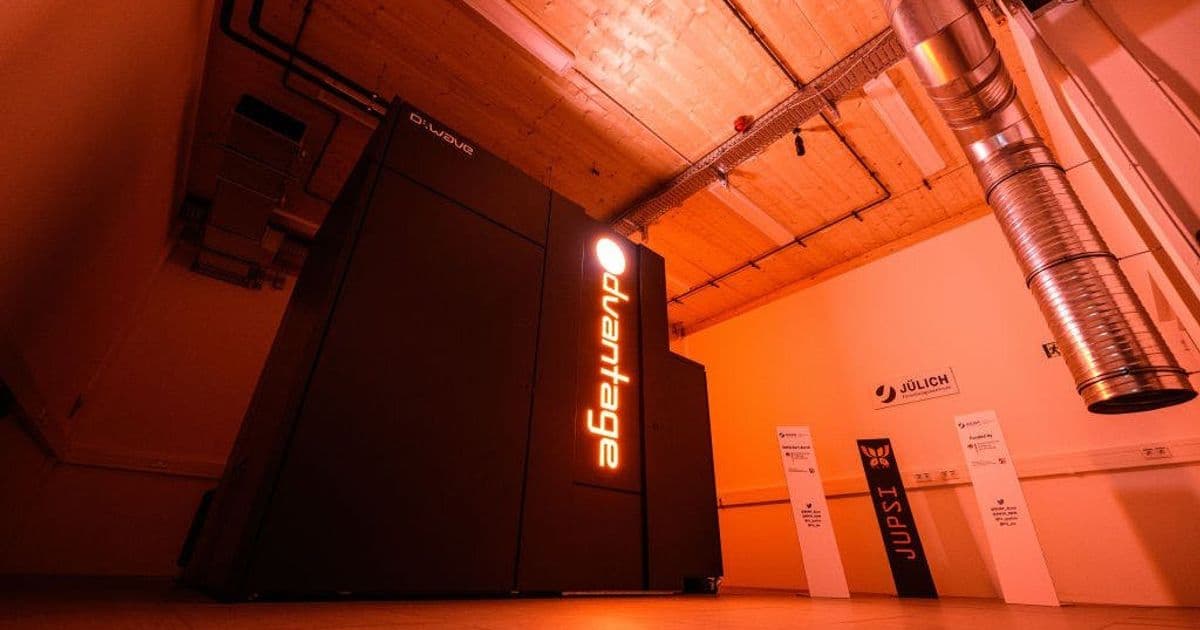
Quantum annealing specialist D-Wave purchases gate-model innovator Quantum Circuits, signaling strategic expansion beyond its core technology amid ongoing industry consolidation.

D-Wave Quantum DWAVE announced a definitive agreement to acquire Quantum Circuits, Inc. QCI for $550 million, comprising $300 million in stock and $250 million in cash. The deal represents a significant strategic pivot for D-Wave, whose quantum annealing processors have dominated commercial quantum computing for specialized optimization problems, but face limitations in universal computation tasks.
Divergent Approaches Converge
Quantum annealing and gate-model quantum computing constitute fundamentally different paradigms. D-Wave's processors excel at solving specific optimization problems by finding minimal energy states, deployed commercially through cloud services like Leap. In contrast, Quantum Circuits develops superconducting quantum processors implementing gate operations – the foundational approach pursued by IBM, Google, and Rigetti for universal quantum computation. QCI's core innovation lies in its error-correction architecture, using multi-dimensional qubit arrays to enhance coherence times and operational fidelity.
Technical Drivers Behind the Acquisition
Three factors make this acquisition noteworthy:
- Error Correction: QCI's hardware-embedded error suppression techniques claim 99.9% two-qubit gate fidelity in lab environments, nearing the threshold for practical error correction. Their approach uses custom resonator networks to stabilize qubits, differing from surface code methods dominant elsewhere.
- Complementary Strengths: D-Wave gains immediate gate-model capabilities via QCI's 24-qubit processors, while QCI accesses D-Wave's commercial infrastructure and annealing-specific expertise. The combined entity plans integrated systems offering both annealing and gate-model operations by 2027.
- Market Positioning: With annealing limited to optimization problems and gate-model systems years from practical advantage, this merger hedges against technological uncertainty. D-Wave CEO Alan Baratz stated the acquisition "creates a clear pathway to commercially relevant universal quantum computing."
Persistent Technical Hurdles
Despite optimistic projections, material constraints remain:
- Scalability: QCI's largest public demo involved 8 logical qubits. Scaling to hundreds of error-corrected qubits requires orders-of-magnitude improvement in error rates.
- Cooling Infrastructure: Both technologies operate near absolute zero, but gate-model systems demand more complex control wiring and lower noise environments than annealing architectures.
- Algorithmic Readiness: Few commercially valuable algorithms exist for near-term gate-model devices beyond niche quantum chemistry simulations.
Industry Context
This acquisition occurs amid aggressive consolidation in quantum computing. Rigetti acquired quantum CMOS developer Quantum Benchmark in 2025, while IBM and Quantinuum continue expanding software ecosystems. The $550 million valuation reflects investor confidence in QCI's 47 patents covering error correction methods and quantum bus architectures. However, D-Wave's stock-based payment structure ($300M in shares) signals caution – the final value depends heavily on post-merger performance.
Practical Implications
For enterprise users, the merger offers:
- Single-platform access to both annealing (optimization) and gate-model (simulation) workloads
- Potential hybrid algorithms combining annealing preprocessing with gate-model refinement
- Shared control systems reducing operational complexity
Yet meaningful advantage over classical HPC clusters remains confined to specialized use cases. As quantum error correction researcher Michelle Simmons noted: "Error-corrected universal quantum computing at scale remains a multi-decade endeavor. Acquisitions accelerate engineering resources, but don't alter fundamental physics constraints."
The combined entity faces integration challenges through 2026, with technology roadmaps due Q3 2026. Commercial availability of hybrid systems remains speculative pending further benchmarking against classical and quantum alternatives.
Comments
Please log in or register to join the discussion