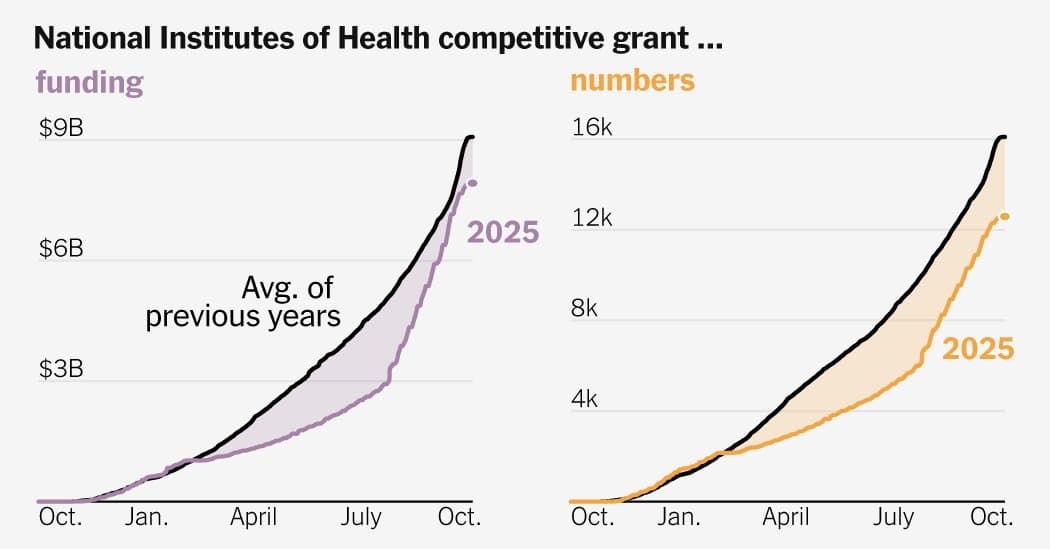
The Trump administration's $2 billion reduction in NIH competitive grants and 25% drop in NSF awards have slashed funding for computer science, AI, and STEM education research. This policy shift prioritizes upfront multi-year payments, reducing the number of funded projects and intensifying competition for critical tech research resources. The cuts risk undermining America's position as a global scientific leader and stifling innovation in high-impact fields.
A seismic shift in U.S. federal research funding is jeopardizing advancements in artificial intelligence, computer science, and technology infrastructure. Data from the National Institutes of Health (NIH) and National Science Foundation (NSF) reveals a $2 billion shortfall in NIH competitive grants this year—41% below the decade average—alongside a 25% reduction in new NSF awards. This contraction stems from a White House directive favoring upfront multi-year payments over annual disbursements, shrinking the pool of funded projects despite similar overall budgets.
Upfront Funding Model Reduces Research Opportunities
The NIH's new policy replaces its traditional five-year installment payments with four-year lump-sum grants, providing researchers less time and flexibility. While average grant sizes swelled to $830,000 in 2025, the agency funded 22% fewer projects—3,500 fewer competitive grants across all domains. Tech-critical fields suffered disproportionately:
- Computer Science: NSF grants down 28%
- Engineering: NSF grants down 17%
- STEM Education: NSF grants down 30%
- Human Genome Research: NIH grants down 47%
"Nobody believes that a fourth-percentile and a fifth-percentile grant are clearly of different quality. It's just not that precise a measurement," said Dr. Sarah Kobrin of the NIH's National Cancer Institute, highlighting intensified competition.
Tech Talent Pipeline at Risk
The NSF Graduate Research Fellowship Program, which cultivates future AI and computing experts, awarded 29% fewer fellowships in 2025. Critical fields faced even steeper declines:
| Field               | Change  |
|---------------------|---------|
| Computer Science    | +48%    |
| Life Sciences       | -59%    |
| Psychology          | -52%    |
| Social Sciences     | -50%    |
| STEM Education      | -52%    |
This selective funding aligns with administration priorities but sidelines foundational research. New eligibility rules barring second-year PhD students from applying further threaten early-career scientists—a demographic vital for tech industry talent.
Diversity Research Purged from Funding Portfolios
The NIH slashed grants mentioning diversity, equity, and inclusion (DEI) keywords by over 50% following White House mandates. The National Institute on Minority Health and Health Disparities saw a 61% grant reduction—the steepest of any NIH division. Researchers reported opaque vetting processes, with projects flagged without clear justification.
Long-Term Innovation Consequences
With proposed 2026 budget cuts of $18 billion for NIH and $5 billion for NSF, these trends signal systemic risks:
- Reduced R&D Output: Fewer grants mean diminished innovation in AI algorithms, cloud infrastructure, and cybersecurity tools.
- Brain Drain: Early-career scientists may abandon academia for industry or relocate abroad, as hinted by NSF insiders.
- Global Competitiveness: Vannevar Bush's 1945 vision of government-funded science leadership faces erosion, potentially ceding ground to international rivals.
As Theresa Kim of NIH's National Institute on Aging noted, agency staff "worked their butts off" to allocate funds amid constraints. Yet policy-driven scarcity now imperils the research ecosystem underpinning technological progress.
Source: Analysis of NIH and NSF grant data from 2015–2025 by The New York Times.
Comments
Please log in or register to join the discussion