Dell Technologies World 2026 showcased the company's comprehensive strategy for on-premises and sovereign AI deployments, featuring new hardware architectures, software partnerships, and integrated solutions designed to bring AI capabilities within enterprise data centers.
Dell Tech World 2026: Building the On-Premises AI Infrastructure Revolution
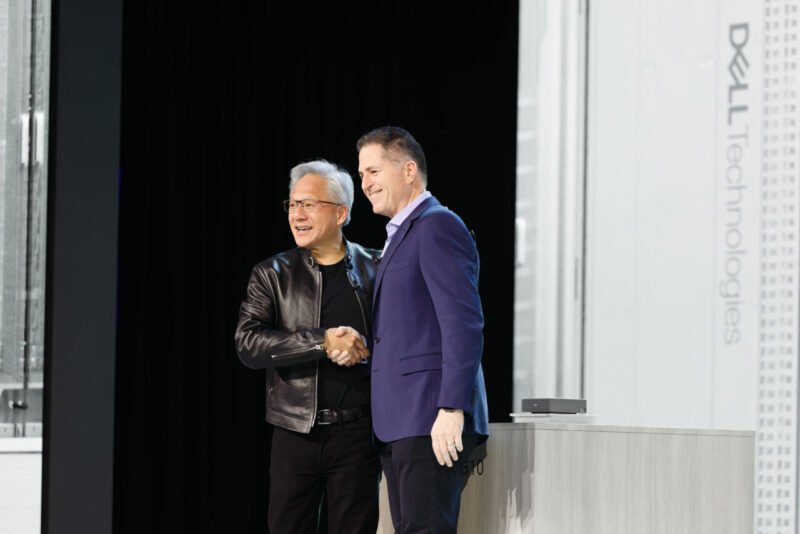
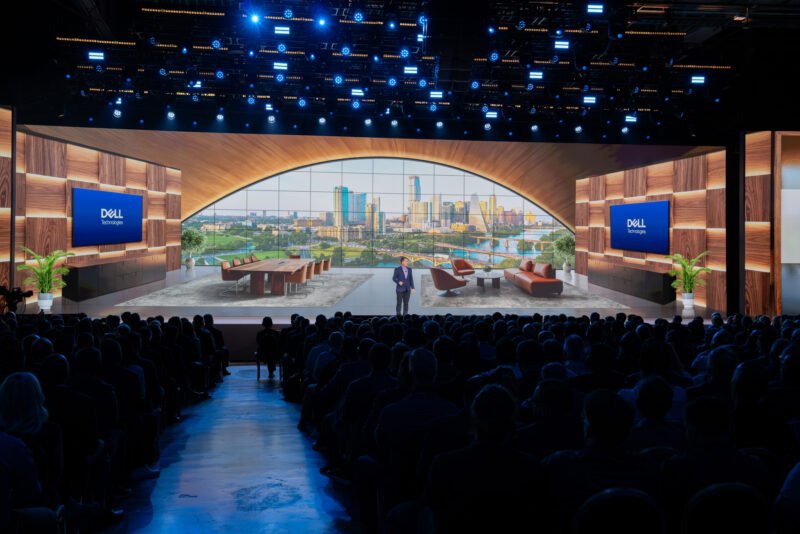
Dell Technologies kicked off its annual Dell Technologies World (DTW) conference this week with a clear strategic focus: positioning itself as the premier provider of on-premises and sovereign AI infrastructure. The conference's opening keynote established that Dell has moved beyond viewing AI as an experimental technology to positioning it as a core component of enterprise computing infrastructure. By leveraging NVIDIA's hardware and AI Factory model, Dell is creating a comprehensive ecosystem that addresses the technical, security, and operational challenges of deploying AI workloads within customer data centers.
The Sovereign AI Imperative
Dell's keynote emphasized that AI has transitioned from experimentation to production deployment, with customers now ready to integrate AI throughout their organizations. The company argues that many enterprises and even nations require on-premises AI capabilities for three primary reasons:
- Data Security: Protecting valuable intellectual property and sensitive data from potential exposure
- Autonomous Development: Maintaining control over AI model development and deployment
- Cost Predictability: Achieving more consistent and predictable operational costs compared to cloud-based AI services
This sovereign AI approach represents a fundamental shift in how organizations think about AI infrastructure, moving from cloud-centric models to hybrid and on-premises deployments that maintain control over data and operations.
Comprehensive Model Partnerships
A significant portion of Dell's announcement focused on expanding access to frontier AI models. During the keynote, Dell confirmed partnerships with virtually all major frontier model developers:
- OpenAI
- Palantir
- SpaceXAI
- Reflection
- Mistral AI
These partnerships enable customers to run state-of-the-art AI models on-premises without exposing their proprietary data to third-party model providers. According to Dell, this ecosystem provides "second-to-none" access to frontier models, though notable by its absence is Anthropic, which may represent a future opportunity for Dell.
The technical implementation of these partnerships involves model optimization and containerization to ensure compatibility with Dell's hardware stack, particularly NVIDIA-based GPU infrastructure. This requires significant engineering work to maintain performance parity with cloud-based deployments while addressing the unique challenges of on-premises environments.
Dell AI Ecosystem Program
To simplify the deployment of these AI models and software, Dell introduced the Dell AI Ecosystem Program. This program serves as a validation and blueprinting framework that addresses several key challenges in AI deployment:
- Hardware Compatibility Validation: Ensuring software stacks perform optimally on Dell's AI Factory hardware
- Security Best Practices: Implementing enterprise-grade security protocols for AI workloads
- Reliability Standards: Establishing benchmarks for AI system uptime and performance consistency
- Operational Simplicity: Providing pre-configured blueprints that reduce deployment complexity
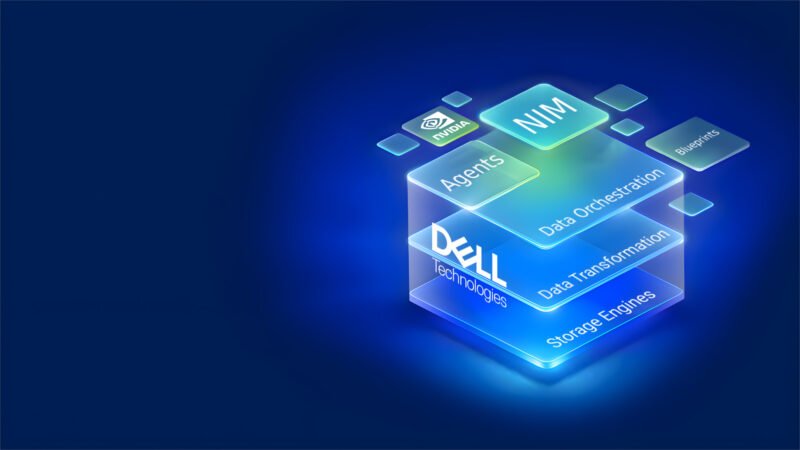
The program essentially creates a "plug-and-play" experience for enterprise customers looking to implement AI capabilities, addressing the common pain points of integration and optimization that typically consume significant engineering resources.
PowerRack: A New Approach to Rack-Scale Infrastructure
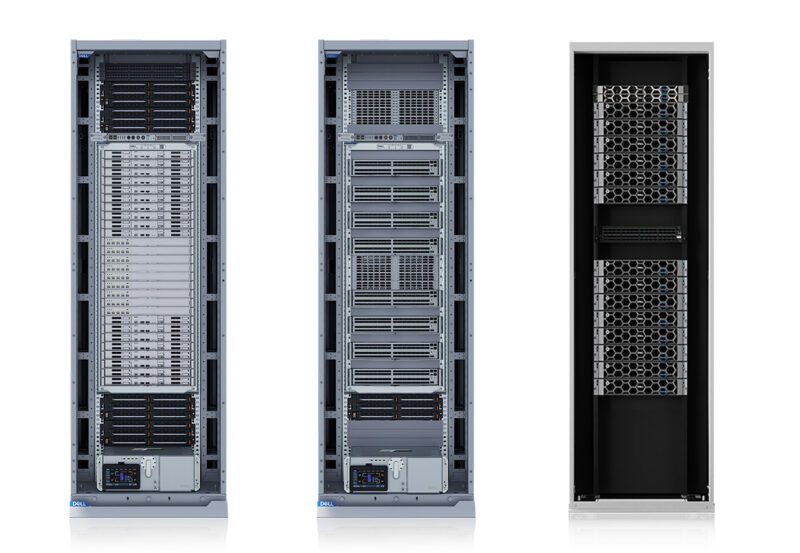
Dell's most significant hardware announcement was the introduction of the PowerRack family, a complete rack-scale solution designed specifically for AI workloads. The PowerRack represents a fundamental rethinking of how enterprises deploy AI infrastructure, offering several key innovations:
Physical Architecture
The PowerRack family supports both 19-inch and 21-inch rack configurations, with options for air cooling or liquid cooling based on density requirements. This flexibility allows customers to select the optimal configuration for their specific power and thermal constraints.
Modular Configurations
Dell offers multiple specialized rack configurations:
- Compute-Optimized: Maximum GPU density with optimized power delivery
- Network-Optimized: High-bandwidth networking with low-latency switching
- Storage-Optimized: High-capacity storage configurations for data-intensive AI workloads
- Hybrid: Balanced configurations combining compute, networking, and storage
Each configuration is engineered as a complete system rather than a collection of individual components, reducing integration complexity and improving overall system reliability.
Deployment Advantages
According to Dell, a PowerRack can be deployed in as little as 6 hours, compared to the days or weeks typically required for custom rack deployments. This dramatic reduction in deployment time comes from several factors:
- Pre-configured power and cooling systems
- Pre-tested networking and compute components
- Integrated management software
- Factory-installed cabling and connections
Networking Specifications
The PowerRack networking configuration represents a significant expansion of Dell's portfolio, incorporating eight PowerSwitch SN6600-LD switches (branded versions of NVIDIA's Spectrum SN6600-LD Ethernet switch). This configuration delivers:
- Over 800 Tb/sec of switching capacity for east-west traffic
- Support for NVIDIA's Quantum-2 InfiniBand technology
- Low-latency switching optimized for AI workloads
- RDMA (Remote Direct Memory Access) capabilities for efficient GPU-to-GPU communication
Storage Expansion: PowerFlex
Dell also expanded its storage capabilities with the introduction of PowerFlex, which adds block storage to the existing file storage (PowerScale) and object storage (ObjectScale) options. This comprehensive approach allows customers to:
- Store diverse data types within a single infrastructure
- Optimize storage for different AI workload patterns
- Simplify data management across the AI lifecycle
- Scale storage independently from compute resources
The Exascale Storage configuration can house SSDs as large as 245TB each, with a total capacity exceeding 10 PB per rack. This storage density is critical for large language model training and inference workloads that require high-speed access to massive datasets.
Thermal Management: PowerCool CDU C7000
To address the thermal challenges of increasingly dense AI racks, Dell introduced the PowerCool CDU C7000, a rackmount cooling distribution unit designed for liquid cooling systems. Key specifications include:
- 4U form factor
- Cooling capacity of up to 220kW of heat
- Support for warm water intake temperatures (up to 40C)
- Compatibility with NVIDIA's forthcoming Vera Rubin NVL72 platform
- Integration with Dell's PowerRack ecosystem
The CDU C7000 represents Dell's response to the increasing power density of AI systems, with some configurations now exceeding 50kW per rack. By supporting higher coolant temperatures, the system reduces the energy required for cooling, improving overall data center efficiency.
Client-Side AI: Dell Deskside Agentic AI
Dell didn't focus solely on data center infrastructure; the company also announced a comprehensive client-side AI platform called Dell Deskside Agentic AI. This platform targets the growing need for on-premises AI inference and execution at the edge, particularly for organizations with strict data privacy requirements.
Hardware Portfolio
Dell's client AI hardware spans multiple form factors and performance levels:
SFF GB10-based Systems: Compact form factor systems suitable for office environments
- Dell Pro Max with GB10
- Optimized for space-constrained deployments
- Support for professional GPU configurations
Precision Tower PCs: Versatile workstations with discrete NVIDIA GPUs
- Scalable configuration options
- Balance of performance and form factor
- Suitable for various professional AI workloads
Dell Pro Max with GB300: Flagship workstation-class system
- Dell's first GB300-based DGX Station system
- Peak performance within standard power constraints
- Optimized for complex AI model inference
The GB300 represents the upper limit of what Dell can deliver within standard North American power circuits (typically 15A at 120V), delivering approximately 3,500W of system power. This constraint shapes the design of high-end client AI systems, balancing performance with practical deployment considerations.
Software Stack
The client AI platform leverages NVIDIA's software stack, with Dell's implementation centered around:
- NVIDIA NemoClaw: OpenShell runtime coupled with Nemotron models
- NVIDIA CUDA libraries for GPU acceleration
- NVIDIA's Triton Inference Server for optimized model deployment
- Security frameworks for data protection at the edge
This software stack enables the execution of agentic AI systems locally, including both AI reasoning and agent execution. By keeping these workloads on-premises, organizations can maintain control over sensitive data while still accessing advanced AI capabilities.
Use Cases and Applications
Dell envisions the Deskside Agentic AI platform supporting several key enterprise functions:
- Code Development: AI-assisted programming with context-aware suggestions
- Research Analysis: Data processing and insight generation without cloud exposure
- Content Creation: AI-powered content generation with organization-specific knowledge
- Customer Support: On-premises AI assistants with access to proprietary customer data
These applications typically require a balance of computational power, data privacy, and user interaction capabilities that traditional cloud-based AI services struggle to provide.
Integration and Operational Considerations
The success of Dell's on-premises AI strategy depends not just on individual components but on their integration and operational management. Several key considerations emerge from Dell's announcements:
Management and Orchestration
Dell's approach emphasizes unified management across the AI infrastructure stack:
- Hardware monitoring and management through OpenManage
- Software deployment and lifecycle management
- Performance optimization tools for AI workloads
- Security policy enforcement across the stack
This integrated management approach reduces the operational complexity of AI deployments, which is a significant barrier for many organizations.
Security Framework
The sovereign AI approach requires comprehensive security measures:
- Hardware root of trust for system integrity
- Confidential computing capabilities for data protection
- Secure model deployment and execution environments
- Audit trails for AI system operations
These security features are particularly important for regulated industries and government agencies that must demonstrate compliance with strict data protection requirements.
Performance Optimization
Dell's hardware and software stack is designed to optimize AI performance through:
- GPU-to-GPU communication optimization
- Memory bandwidth utilization improvements
- Data locality optimizations
- I/O performance enhancements
These optimizations are critical for achieving the performance levels required for modern AI workloads, particularly large language model inference and training.
Real-World Implications and Market Impact
Dell's comprehensive on-premises AI strategy has several significant implications for the technology market:
Enterprise AI Adoption
By providing a complete hardware and software stack, Dell lowers the barrier to AI adoption for enterprises. This could accelerate the transition from experimental AI projects to production deployments, particularly in industries with strict data privacy requirements.
Competitive Landscape
Dell's focus on on-premises AI creates a clear differentiator from cloud providers and other OEMs. The company's partnerships with major AI model developers and comprehensive hardware portfolio position it as a leader in the emerging on-premises AI market.
Infrastructure Evolution
The PowerRack and related innovations represent a significant evolution in data center infrastructure design. The integration of compute, networking, storage, and cooling into optimized rack-scale systems reflects the changing requirements of AI workloads.
Operational Model Changes
Dell's emphasis on pre-configured, validated systems suggests a shift toward more standardized AI infrastructure deployment. This could reduce the need for specialized AI engineering expertise while still enabling sophisticated AI capabilities.
Conclusion
Dell Technologies World 2026 established the company's vision for the future of AI infrastructure: a comprehensive, on-premises ecosystem that enables sovereign AI capabilities while simplifying deployment and operations. Through partnerships with major AI model developers, innovative hardware designs like the PowerRack family, and integrated software stacks, Dell is positioning itself as a key enabler of the next phase of AI adoption.
The company's focus on addressing the practical challenges of AI deployment—from thermal management to security to operational complexity—suggests a mature understanding of what enterprises need to successfully implement AI workloads. As organizations increasingly seek to maintain control over their AI infrastructure while still accessing state-of-the-art capabilities, Dell's comprehensive approach may well define the next generation of enterprise AI systems.
The success of this strategy will ultimately depend on execution—both in product development and in addressing the real-world challenges of AI deployment. But with its comprehensive vision and broad ecosystem partnerships, Dell has established itself as a major player in the rapidly evolving on-premises AI market.
Comments
Please log in or register to join the discussion