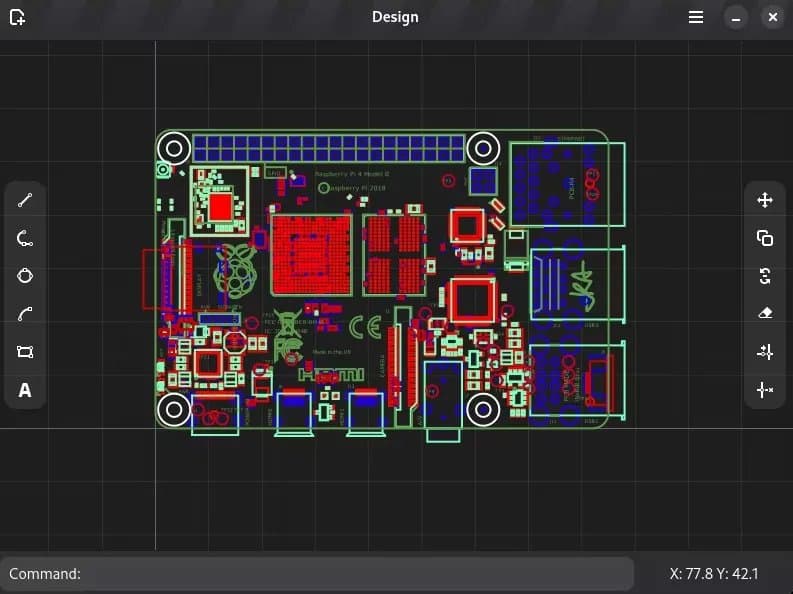
The GNOME-aligned 2D CAD tool Design has released version 50 Alpha 1 with new polyline editing features, performance improvements, and expanded command support, positioning itself as a lightweight alternative to heavier CAD solutions.
The GNOME desktop ecosystem continues to expand its creative toolkit with the release of Design 50 Alpha 1, a 2D CAD design tool that brings professional-grade drafting capabilities to Linux users. Following closely on the heels of FreeCAD 1.1 and SolveSpace 3.2 releases, Design 50 Alpha 1 introduces several significant features that enhance its position as a lightweight yet capable CAD solution for the GNOME desktop environment.
New CAD Commands and Enhanced Functionality
The latest release focuses heavily on expanding the core drafting capabilities that CAD users rely on daily. The addition of polyline trim and polyline extend commands addresses fundamental needs in technical drawing workflows, allowing users to modify existing geometry with precision and efficiency. These commands are essential for creating clean, professional designs where exact measurements and clean intersections matter.
The chamfer command and fillet command additions round out the basic geometric modification toolkit, enabling users to create beveled edges and rounded corners respectively. These features are particularly valuable for mechanical design, architectural drafting, and any application where smooth transitions between surfaces are required. The inclusion of these commands suggests that Design is maturing beyond basic drawing tools into a more comprehensive CAD solution.
Performance Improvements
Beyond new features, the release notes highlight "better performance when panning," which addresses a common pain point in CAD applications. Smooth navigation and real-time feedback during panning operations are crucial for maintaining workflow efficiency, especially when working with complex drawings containing numerous elements. This optimization likely involves improvements to the rendering pipeline or viewport management, though specific technical details weren't provided in the release announcement.
Technical Implementation and Availability
Design is written in part with JavaScript, which is an interesting choice for a CAD application. This implementation approach suggests that the tool leverages web technologies or utilizes JavaScript for its user interface layer, potentially making it more accessible to developers familiar with web development paradigms. The hybrid nature of the implementation could offer advantages in terms of cross-platform compatibility and rapid development cycles.
The availability of Flatpak builds through Flathub demonstrates a commitment to modern Linux packaging standards, ensuring that users can easily install and update the application regardless of their distribution. This approach also provides sandboxing benefits and simplifies dependency management. For users who prefer source-based installation or need to customize the build, GitHub hosts the project's source code, enabling community contributions and modifications.
GNOME Ecosystem Context
The Design release was featured in "This Week in GNOME," indicating its significance within the GNOME community. This timing is particularly noteworthy as it follows the recent GNOME 50 stable debut, suggesting a coordinated effort to enhance the GNOME desktop's creative and productivity capabilities. The GNOME 50 release likely provided underlying improvements that Design could leverage, such as enhanced GTK4 support or improved graphics acceleration.
Related GNOME Developments
The same week saw updates to other GNOME-aligned applications, including Serigy 2, an updated clipboard manager, and Fractal 14 Beta for Matrix messaging. This pattern of simultaneous improvements across the GNOME ecosystem suggests active development and a focus on creating a cohesive user experience. The diversity of applications being updated—from CAD tools to communication platforms—demonstrates GNOME's broad appeal and its ability to support various user workflows.
Comparison to Other Open-Source CAD Solutions
While FreeCAD and SolveSpace target more comprehensive 3D modeling and simulation capabilities, Design appears to be positioning itself as a specialized 2D CAD tool. This focus could be advantageous for users who need drafting capabilities without the complexity and resource requirements of full 3D CAD suites. The 2D focus also makes Design potentially more suitable for architectural drafting, technical illustration, and other applications where 3D modeling isn't necessary.
The JavaScript-based implementation might offer advantages in terms of development speed and cross-platform compatibility, though it may face challenges in matching the performance of natively compiled CAD applications for extremely complex drawings. However, for typical 2D drafting tasks, the performance improvements in panning suggest that Design is already competitive in terms of user experience.
Future Development Trajectory
The "Alpha" designation in Design 50 Alpha 1 indicates that the project is still in active development and may not yet be considered stable for production use. This early stage provides an opportunity for community feedback to shape the tool's evolution. Given the steady stream of feature additions and performance improvements, the development team appears committed to rapid iteration and responsiveness to user needs.
Future releases will likely expand the command set further, potentially adding more advanced features like dimensioning tools, layer management, and export capabilities to standard CAD formats. The foundation laid by the current release—with its focus on core geometric operations and performance—provides a solid base for these enhancements.
Installation and Community
Users interested in trying Design 50 Alpha 1 can access it through Flathub for easy installation on any Flatpak-compatible Linux distribution. The GitHub repository provides access to source code for those who want to build from scratch, contribute to development, or examine the implementation details. The open-source nature of the project encourages community involvement, whether through bug reporting, feature suggestions, or direct code contributions.
The GNOME community's support for Design, as evidenced by its inclusion in "This Week in GNOME," suggests a healthy ecosystem of users and developers who can provide feedback and help guide the project's development. This community aspect is particularly important for specialized tools like CAD applications, where user requirements can be quite specific and varied.
As the GNOME desktop continues to evolve with its 50th major release, tools like Design demonstrate the platform's growing capabilities beyond traditional desktop applications. The combination of modern web technologies, performance optimizations, and a focus on core user needs positions Design as a promising addition to the open-source CAD landscape, particularly for users embedded in the GNOME ecosystem who need reliable 2D drafting capabilities.
Comments
Please log in or register to join the discussion