
TinyURL's simple requirements mask complex challenges in scalability, caching, and ID generation that make it the perfect system design teaching tool.
When engineers talk about system design fundamentals, one example comes up again and again: TinyURL. This seemingly simple URL shortener forces us to confront real-world challenges around scalability, caching strategies, and bottleneck analysis. Let's break down how to design this deceptively complex system.
The Core Requirements
At its heart, TinyURL needs to do two things:
- Convert a long URL into a short, shareable link
- Redirect users from the short link back to the original URL
But beneath these simple requirements lie sophisticated engineering decisions. We need high availability, low latency, and the ability to handle heavy traffic loads. This is where the real design work begins.
High-Level Architecture
The foundation of our TinyURL system looks like this:
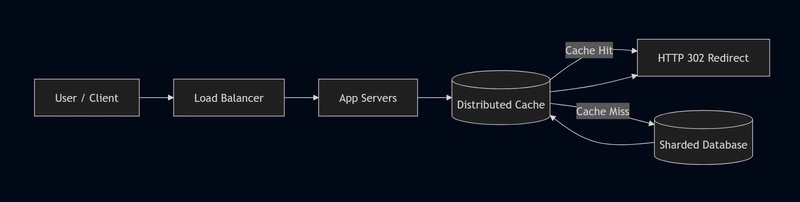
We start with a load balancer distributing traffic across multiple application servers. This horizontal scaling approach ensures we can handle increased load by simply adding more servers. But the real performance boost comes from our cache layer.
Since most requests are read operations (redirecting short URLs), we place a cache between our application servers and database. This means frequently accessed URLs can be served directly from memory, dramatically reducing database load and improving response times.
For storage, we have two solid options:
- Key-Value databases (like Redis or DynamoDB) - Natural fit for simple URL mappings
- SQL databases - Better if we need analytics or complex constraints
The Math Behind Short URLs
How short should our URLs be? This isn't just an aesthetic question—it's a mathematical constraint.
Let's say we generate K new URLs per second and want to store them for 10 years. That's:
K × 60 × 60 × 24 × 365 × 10 total URLs
With 62 possible characters (26 lowercase + 26 uppercase + 10 digits), we can calculate the minimum length needed:
62^n ≥ K × 60 × 60 × 24 × 365 × 10
With n = 7, we get approximately 3.5 trillion combinations—more than enough for most applications.
Bottleneck Analysis: Where Systems Break
The Hot Key Problem
Imagine our service goes viral and millions of users click the same shortened URL simultaneously. Where does the system fail first? The cache.
When many users request the same key, we face the hot key problem. Traditional horizontal scaling doesn't help because the same key maps to the same cache node. Solutions include:
- Cache replicas - Multiple copies of the same data
- CDN layer - Distribute read load geographically
- Consistent hashing - Spread hot keys across multiple nodes
The Write Bottleneck
Now consider the opposite scenario: massive write traffic as users create new short URLs. Every write must go through the primary database node, creating a throughput bottleneck.
The solution? Database sharding. But simple modulo-based sharding causes problems when adding new shards—you'd need to redistribute massive amounts of data. Instead, use consistent hashing to minimize data movement during scaling.
The ID Collision Challenge
With horizontally scaled application servers, two servers might generate the same short URL. How do we prevent collisions?
Several approaches work:
- Random Base62 generation + collision check - Simple but potentially slow
- Centralized ID generator - Single point of failure
- Distributed ID service - Complex coordination
- Redis atomic counter (INCR) - Fast and reliable
Why TinyURL Matters
TinyURL exemplifies why it's called the "Hello World" of system design. It teaches us:
- Scalability patterns - Horizontal scaling, caching, sharding
- Performance optimization - Cache strategies, CDN usage
- Reliability engineering - Handling hot keys, preventing collisions
- Trade-off analysis - Every solution has costs and benefits
These concepts apply to virtually every large-scale system. Whether you're building a social media platform, e-commerce site, or messaging service, the principles you learn from TinyURL design will serve you well.

The next time you encounter a system design problem, remember TinyURL. Its simplicity is deceptive—it's a microcosm of the challenges you'll face in real-world distributed systems. Master this, and you're well on your way to designing robust, scalable applications.
Want to see these principles in action? Modern development tools are making it easier than ever to implement and test these patterns. For instance, you can now trigger deployments, scaling operations, and provisioning directly from your editor using tools like Cursor connected to platforms like Heroku through the MCP protocol. This integration eliminates the constant context-switching between terminals, dashboards, and code editors, letting you focus on the architecture rather than the tooling.

Comments
Please log in or register to join the discussion