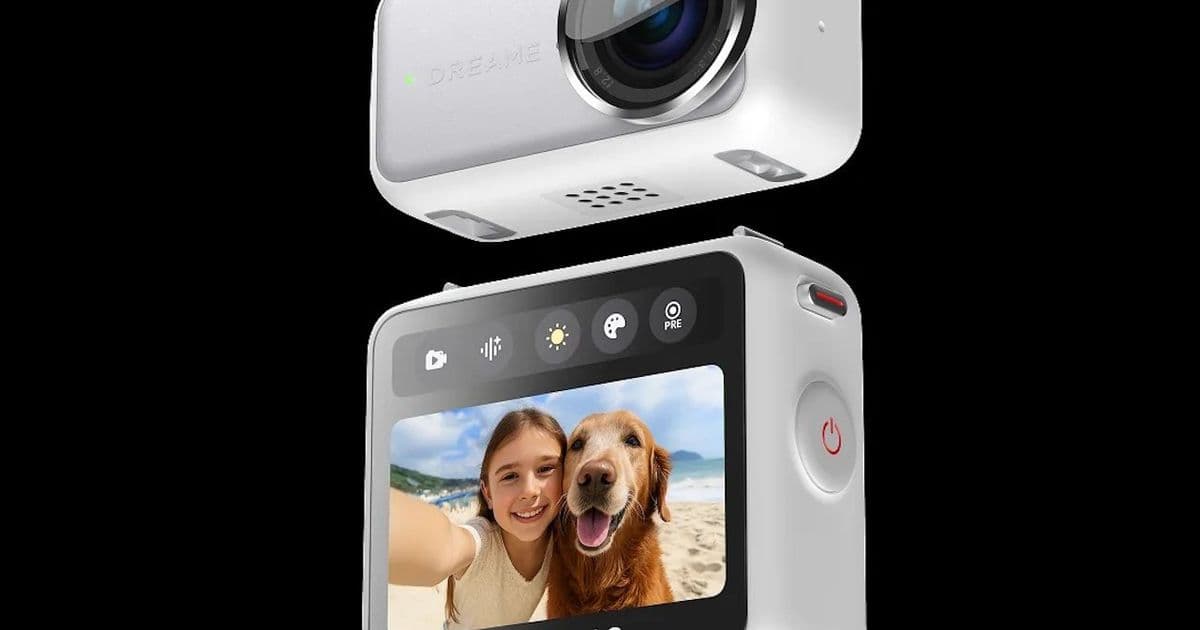
Dreame enters the action camera arena with the Leaptic Cube, featuring a removable 8K camera module, AI-powered features, and unconventional wireless operation that redefines mounting flexibility for content creators.

Dreame's Leaptic Cube represents one of the most radical redesigns of action camera form factors in recent years. Unlike traditional barrel-shaped competitors, its core innovation lies in a detachable 8K camera module that communicates wirelessly with the main body. This fundamentally changes how creators approach mounting options, allowing the camera sensor to be positioned up to 30 meters away from the recording unit while maintaining a 90-minute operational window.
The camera module itself houses a sizable 1/1.3-inch 50MP sensor capable of capturing 13.5 stops of dynamic range – notably wider than GoPro Hero 12's 12 stops. Paired with a 155-degree f/2.8 lens (slightly wider than DJI Osmo Action 4's 155-degree FOV), it records 10-bit P-Log footage for HDR post-processing flexibility. When docked conventionally, the integrated 2.27-inch touchscreen controls the system with up to 200 minutes of runtime.
Performance extends beyond hardware through a 4nm AI processor implementing real-time computational photography. Scene optimization dynamically adjusts exposure profiles similar to smartphone computational photography, while AI Natural Beauty processing offers skin-tone refinement without the plasticky look common in budget action cameras. Moko voice recognition accepts conversational commands like "start recording with horizon leveling" without rigid phrasing, and gesture controls provide silent operation when needed.
Compared to segment leaders: The Leaptic Cube's wireless detachment capability has no direct equivalent in DJI or GoPro's lineup. While Osmo Action 4 offers superior low-light performance with its 1/1.3-inch sensor, Dreame matches the sensor size while adding removable functionality. GoPro's Enduro battery still leads in cold-weather performance, but Dreame counters with greater mounting versatility. Storage is competitive at 128GB built-in plus 1TB microSD expansion, matching flagship rivals.
This device targets specialized creators: Adventure filmmakers needing impossible mounting positions (e.g., helmet cam detached from backpack recorder), vloggers using wireless operation for dynamic perspective shifts, and technical users leveraging 10-bit color grading. Casual users may find the dual-unit system cumbersome compared to DJI Osmo Action 4's simplicity, while professionals will appreciate the P-Log workflow integration.
Pricing remains unannounced, but signups are open at Leaptic's official site. If positioned below $400, this could disrupt the mid-range action camera market. Until availability, the DJI Osmo Action 4 remains the most capable conventional alternative with proven stabilization and image quality.
Potential limitations include wireless interference risks in crowded RF environments and the absence of waterproof ratings for the detached module. How Dreame addresses these concerns will determine its viability against established players when units ship later this year.
Comments
Please log in or register to join the discussion