
ZDNET's hands-on review reveals the $2,066 DT Research 323MD tablet as a specialized powerhouse, blending military-grade durability with anti-microbial features for healthcare and industrial use. Despite its niche focus, this Windows device surprises with capable performance, hot-swappable batteries, and modular accessories—proving that rugged tech can excel beyond conventional limits.
When Jack Wallen of ZDNET first unboxed the DT Research 323MD tablet, he expected just another rugged device. What he discovered was a meticulously engineered Windows beast tailored for environments where failure isn't an option—hospitals, clean rooms, and industrial settings where sanitation and resilience are paramount. Priced at $2,066 and available through CDW, this isn't your average consumer tablet; it's a purpose-built tool featuring an anti-microbial keyboard coating, IP65 water/dust resistance, and MIL-STD-810H certification for shock and vibration tolerance. As Wallen notes, 'This tablet is as durable as it is versatile,' with specs including a 13.3” 1000-nit display, Intel i5 or i7 processors, and up to 16GB RAM.
Why This Tablet Stands Apart in a Crowded Market
Beyond its brawn, the 323MD targets critical sectors with unique certifications: ANSI/AAMI ES60601-1 for antimicrobial enclosures (vital for infection control), NIST compliance, and operational tolerance from -10°C to 65°C. Wallen tested it under real-world pressures, installing resource-heavy local AI tools like Ollama and Misty. While intensive tasks caused expected lag, the tablet held its ground—a testament to its Intel U-series CPU and robust thermal design. The modularity shines too: hot-swappable batteries, removable SSDs, and optional accessories like RFID badge readers streamline workflows in high-stakes environments. As Wallen observed, 'The attached handle and magnetic keyboard integration make it effortlessly portable, while the rubberized coating shrugs off spills and debris.'
Practical Trade-Offs and Industry Implications
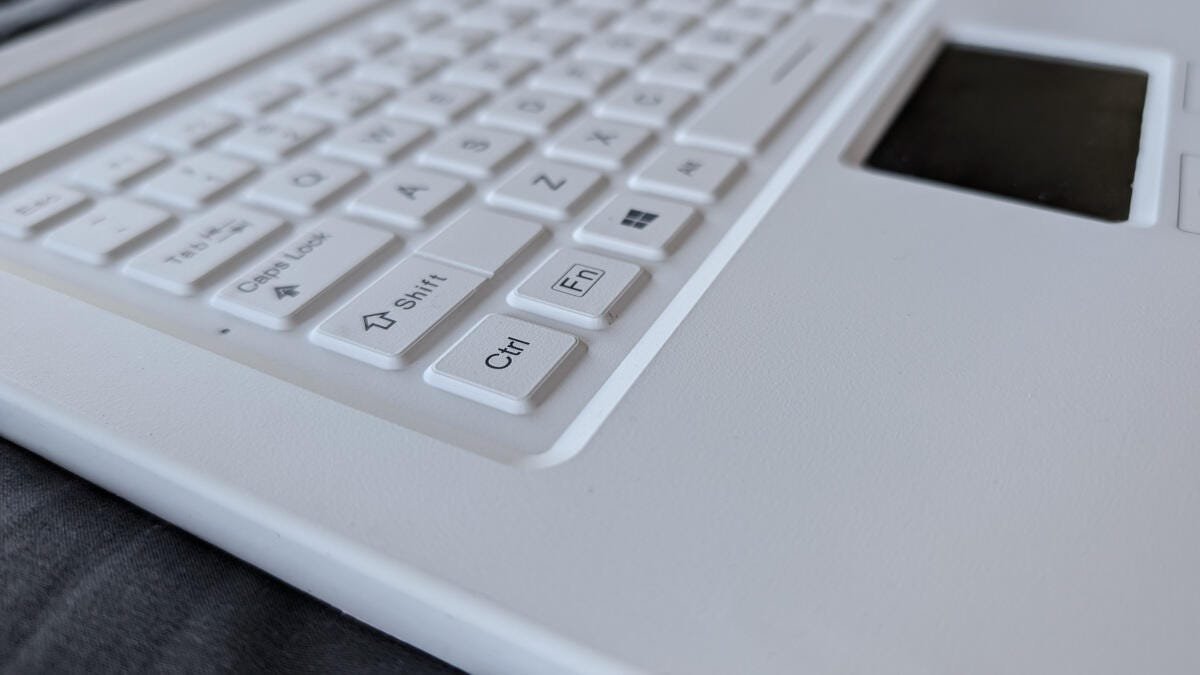
For all its strengths, the anti-microbial keyboard proved challenging for extended typing—'frustrating, even,' admits Wallen—though a standard keyboard alternative salvaged the experience. This highlights a broader truth: specialized tools prioritize function over comfort. Yet in healthcare or food production, where contamination risks loom, such compromises are justified. The dual-frequency RFID login also underscores a security-forward approach, reducing touchpoints in sterile zones. Wallen's testing reveals how devices like this address gaps in tech ecosystems, enabling safer, more efficient operations where everyday gadgets falter. As industries face rising demands for hygienic, reliable hardware, the 323MD exemplifies innovation that bridges IT and operational needs—without sacrificing Windows 11 IoT’s familiarity.
Ultimately, the DT Research 323MD isn’t for casual users, but its blend of brute-force durability and adaptable performance makes it a compelling investment for sectors where downtime is catastrophic. In Wallen’s words, 'It may not blow you away with raw speed, but its protective features and modular design set a new benchmark for purpose-driven computing.' For tech leaders eyeing the future of industrial and medical IT, this tablet proves that sometimes, niche is necessary.
Source: ZDNET review by Jack Wallen
Comments
Please log in or register to join the discussion