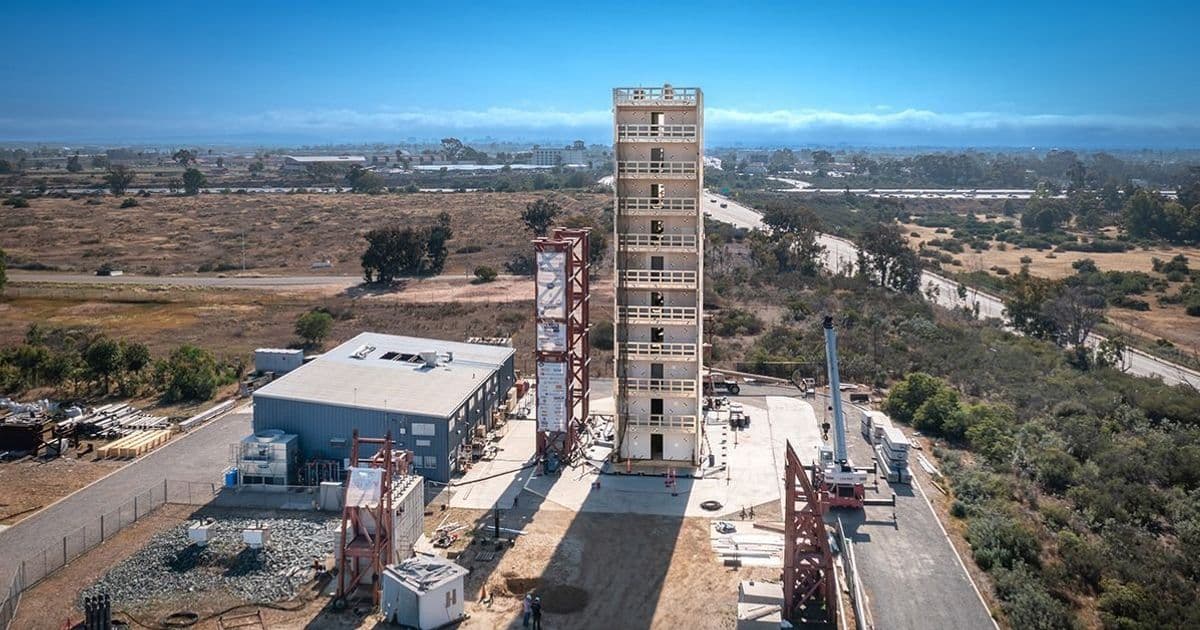

Engineers successfully subjected a groundbreaking 10-story cold-formed steel building to rigorous earthquake simulations, including replicating the 1989 Loma Prieta quake. The tests, conducted on one of the world's largest shake tables, challenge current height restrictions and demonstrate the material's resilience, potentially enabling safer, taller construction in seismic zones.
Shaking the Foundations: 10-Story Steel Building Withstands Major Quake Simulations
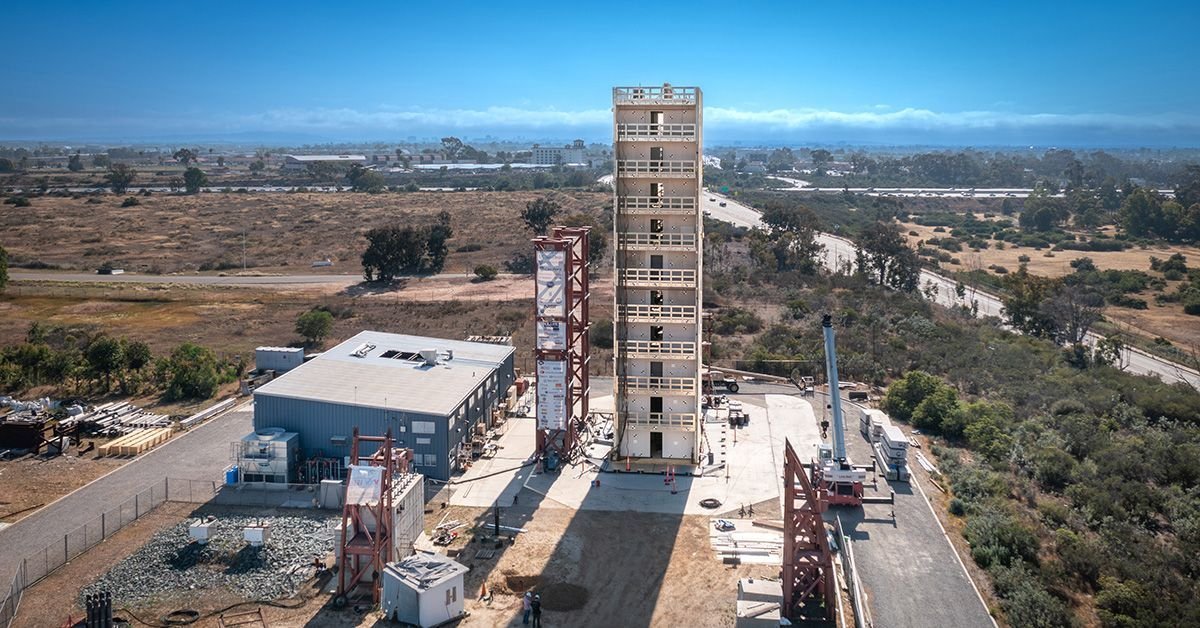
"Three, two, one!" The command echoed as the tallest steel-framed structure ever earthquake-tested began swaying violently on UC San Diego's massive shake table. This 10-story, 100-foot colossus, constructed from lightweight cold-formed steel (CFS), endured simulations of destructive earthquakes like the 1989 Loma Prieta event (magnitude 6.9). The ambitious goal? To determine if building codes limiting CFS structures to just 65 feet (6 stories) can be safely doubled to 100 feet (10 stories), even in high-risk seismic areas.
Testing the Limits: A Structural Breakthrough
The tests leveraged the unique capabilities of the NSF-funded shake table at UC San Diego – the only outdoor facility globally capable of testing structures exceeding 90 feet. After 18 progressively intense earthquake simulations, including three exceeding typical design requirements, the results were decisive.
"The building performed very well," stated Professor Tara Hutchinson, the project lead from UC San Diego's Department of Structural Engineering. "Despite the intense shaking, the load-bearing structural system retained its integrity. The stairs, critical for evacuation and designed to move with the building, remained functional."
This resilience is pivotal. Nearly a thousand sensors embedded within the structure captured detailed data on acceleration, displacement, and strain. This dataset promises to revolutionize building codes and empower designers to utilize CFS for taller, more resilient structures.
The Material Advantage: Lightweight, Sustainable, and Resilient
CFS offers compelling benefits driving this research:
- Lightweight & Efficient: Enables modular, Lego-like construction, drastically reducing build times.
- Sustainable: Composed of 60-70% recycled metal.
- Non-Combustible: Unlike wood, it doesn't fuel fires – a critical factor in post-earthquake scenarios.
- Resilient: Demonstrated ability to withstand extreme seismic forces.
"CFS has a lot of really great features that are going to benefit resilient communities in the future," Hutchinson emphasized.
The NSF Upgrade: Simulating Real-World Chaos
A crucial factor in the test's realism was a recent $17 million NSF upgrade enabling the shake table to move in six degrees of freedom (6DOF) – up/down, east/west, north/south, plus roll, pitch, and yaw. Previously limited to one direction, the table now replicates the complex, multi-directional chaos of actual earthquakes.
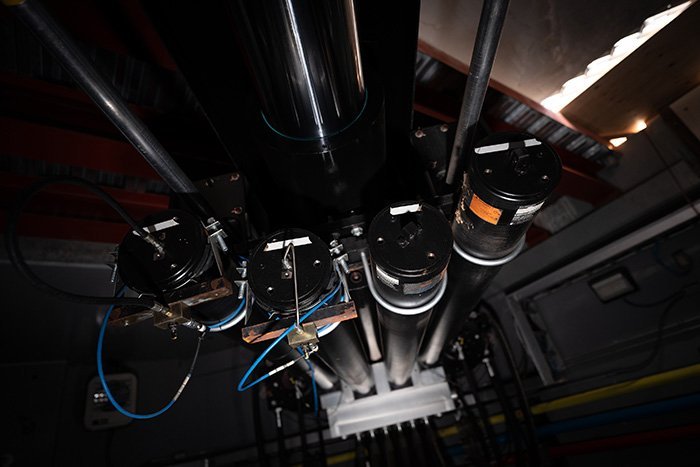
"Recordings from past earthquakes show that the ground doesn’t shake in one direction—it moves back and forth, up and down, side to side and can even wobble," explained Professor Joel Conte, a lead researcher. "Here we are able to simulate what we call near-real world earthquake conditions."
During testing, researchers observed significant twisting in the building – motion impossible to simulate without the 6DOF capability.
"The motions that we saw today demonstrated why that table upgrade was critical to the science that we do here," said Professor Ben Schafer (Johns Hopkins University), CFS10 project co-lead.
Beyond the Quake: Fire Tests and Industry Support
The research isn't finished. The team is now preparing for live-fire tests on the seismically damaged building, led by Professor Richard Emberley (Cal Poly-San Luis Obispo). These tests will analyze temperature, smoke, and particulate spread – simulating dangerous "fire-following-earthquake" scenarios where gas leaks ignite blazes. CFS's non-combustible nature provides a significant safety advantage here.
The landmark project, funded by the NSF (#1663569, #1663348), U.S. Department of Housing and Urban Development, California Seismic Safety Commission, California Office of Emergency Services, and NIST, also garnered massive industry backing. Key supporters include the American Iron and Steel Institute, Steel Framing Industry Association, American Institute of Steel Construction, ClarkDietrich, Clark Construction, and others.
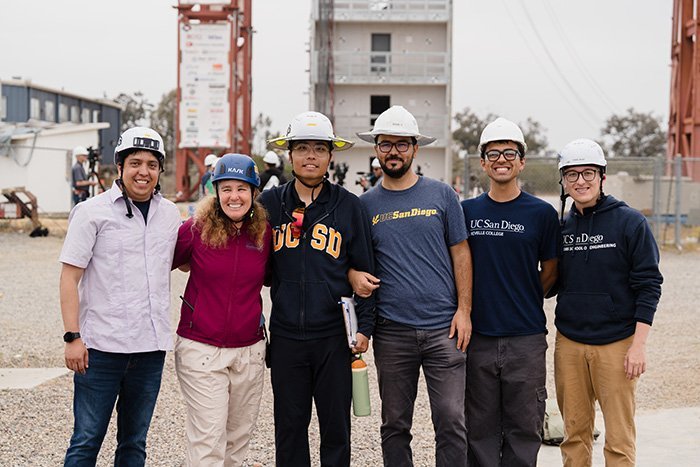 Part of the UC San Diego research team on the CFS 10 project. Photo: Daniel Orren/University of California San Diego
Implications for the Built Environment
The successful seismic performance of this 10-story CFS structure signals a potential paradigm shift. Pending final analysis of the vast sensor data and fire test results, building codes could evolve, permitting significantly taller, safer, and more sustainable buildings in earthquake-prone regions worldwide. This research directly addresses the growing need for resilient, efficient urban infrastructure, proving that innovative materials and advanced testing can redefine what's structurally possible.
Source: UC San Diego Today (Adapted for technical audience)
Comments
Please log in or register to join the discussion