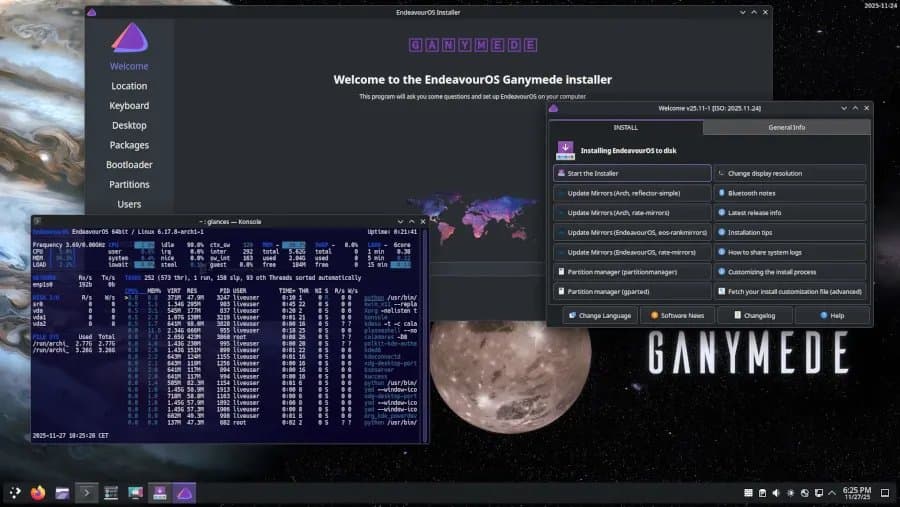
The latest EndeavourOS release marks a significant transition for NVIDIA users on Arch-based systems, dropping legacy GPU support in favor of the open kernel modules, while the distribution itself solidifies its position with a fresh LTS kernel and updated graphics stack.
EndeavourOS has kicked off 2026 with its first ISO refresh, version 2026.01.12 "Ganymede Neo." This release isn't just a routine package update; it represents a pivotal moment for users with NVIDIA hardware, as the distribution aligns with a major upstream shift in the NVIDIA driver ecosystem. For homelab builders and enthusiasts who rely on Arch Linux's rolling nature but want a more guided setup, this release provides a stable snapshot with updated core components.
The foundation of this release is the Linux 6.18.4 LTS kernel. Long-Term Support kernels are critical for stability in homelab servers and workstations, providing a predictable base for months or years. Linux 6.18 brings performance improvements, better hardware support for newer devices, and security patches. For those running virtual machines, containers, or bare-metal servers, this LTS kernel ensures compatibility with recent enterprise and consumer hardware while minimizing the risk of regressions that can come with more aggressive kernel updates.
Graphics drivers see a substantial update. The Mesa 25.3.3 stack is included, which is essential for AMD and Intel integrated graphics, as well as for Vulkan and OpenGL performance on open-source drivers. The X.Org Server 21.1.21 update addresses various bugs and improves compatibility with modern display setups. Firefox 146 is bundled, keeping the web browser current with the latest security and feature updates. The Calamares 26.0.1.1.5 installer is also refreshed, which is key for new users installing the distribution, offering a polished and straightforward graphical installation experience.
The NVIDIA Open Module Transition: What It Means for Your GPU
The most consequential change in this release is the move to NVIDIA's open kernel modules. EndeavourOS, following the upstream Arch Linux package changes, is now using the NVIDIA R590 series driver with the open kernel modules. This is a significant departure from the long-standing proprietary-only driver model that NVIDIA has used for decades.
The Trade-off: Legacy Support vs. Openness
This shift comes with a hard cutoff for hardware support. The new driver stack only supports NVIDIA GPUs from the Turing architecture and newer. This means:
- Supported: GeForce GTX 1650/1660, RTX 20-series (2060, 2070, 2080), RTX 30-series, RTX 40-series, and all newer professional and consumer cards.
- No Longer Supported: All GPUs from the Pascal (GTX 10-series) and older architectures, including the popular GTX 900 and 700 series cards.
For homelab builders, this is a critical consideration. Many older servers and workstations still use Pascal-based Quadro or GeForce cards for GPU passthrough in virtual machines or for light compute tasks. If you're running a homelab with a GTX 1080 Ti for a Plex server with hardware transcoding or a dedicated VM for gaming, this release of EndeavourOS will not boot with the NVIDIA driver for that card. You would need to either stick with an older ISO, use the nouveau open-source driver (which lacks performance and feature parity), or upgrade your hardware.
Why the Change?
NVIDIA's move to open kernel modules is part of a broader strategy to improve integration with the Linux ecosystem. The open kernel modules allow for better debugging, community contributions to the kernel-side code, and potentially improved support for features like GPU virtualization (SR-IOV) and better integration with the Linux kernel's power management. The user-space libraries and CUDA components remain proprietary, but the kernel interface is now open. This should, in theory, lead to more stable and performant drivers in the long run, especially for newer hardware.
Build Recommendations and Considerations
For users planning to deploy EndeavourOS 2026.01.12, here are some practical recommendations:
Verify GPU Compatibility: Before installing, check your NVIDIA GPU's architecture. If you have a GTX 1080, GTX 1070, or any older card, this release will not provide the proprietary NVIDIA driver. You may need to use an older EndeavourOS ISO or consider a distribution that still packages the legacy NVIDIA driver.
Homelab Server Setup: For a headless or server-focused installation, the Linux 6.18 LTS kernel is an excellent choice. It provides a stable base for Docker containers, Kubernetes clusters, and virtualization platforms like Proxmox or KVM. The updated Mesa drivers are less critical for a headless server but are important if you're using the GPU for compute tasks or have a desktop environment installed.
Desktop and Workstation Use: For a daily-driver desktop, the updated graphics stack (Mesa 25.3.3, X.Org 21.1.21) ensures good performance for AMD and Intel users. NVIDIA users with Turing or newer cards will benefit from the open kernel modules, which should offer better stability and potentially lower latency. The inclusion of Firefox 146 keeps the browser secure and performant.
Installation and Updates: The Calamares installer makes the initial setup straightforward. After installation, remember that EndeavourOS is a rolling release. While this ISO provides a stable snapshot, regular
pacman -Syuupdates will keep you on the latest packages. The move to the open NVIDIA modules is now the default, so future updates will continue on this path.
The Bigger Picture: Linux Distributions and NVIDIA
EndeavourOS's adoption of the open NVIDIA modules reflects a larger trend in the Linux ecosystem. Distributions like Fedora and openSUSE have already made similar moves. This shift is driven by both community pressure for openness and NVIDIA's own strategic goals to improve Linux support. For users, it means a more unified driver experience across distributions, but it also forces hardware upgrades as older cards are phased out of official support.
For homelab enthusiasts, this is a reminder that hardware lifecycle management is part of the game. As Linux distributions evolve, so do the requirements for the hardware they support. The move to open kernel modules is a net positive for the future of Linux graphics, but it does create a clear dividing line for GPU owners.
You can download the new EndeavourOS 2026.01.12 ISO and find more details on their official website. For those interested in the technical details of the NVIDIA open kernel modules, NVIDIA provides documentation on their developer blog.
Comments
Please log in or register to join the discussion