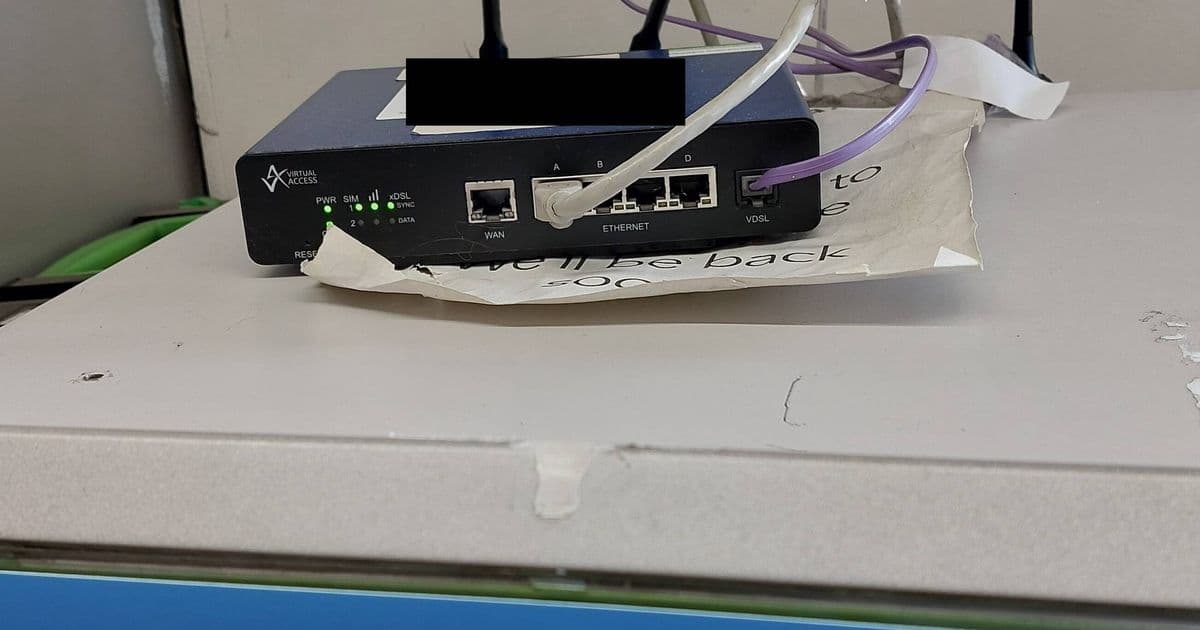
An unsecured router mounted on an ATM with exposed ports and cables creates a serious security vulnerability that could enable man-in-the-middle attacks, vandalism, or service disruption.
An ATM in an undisclosed location has become a textbook example of how not to secure financial infrastructure, with a router mounted directly on the machine and exposed to public access. The setup, spotted by a vigilant Register reader, features a Virtual Access GW6650V series router connected to the ATM with multiple cables running to both the machine and a wall socket.
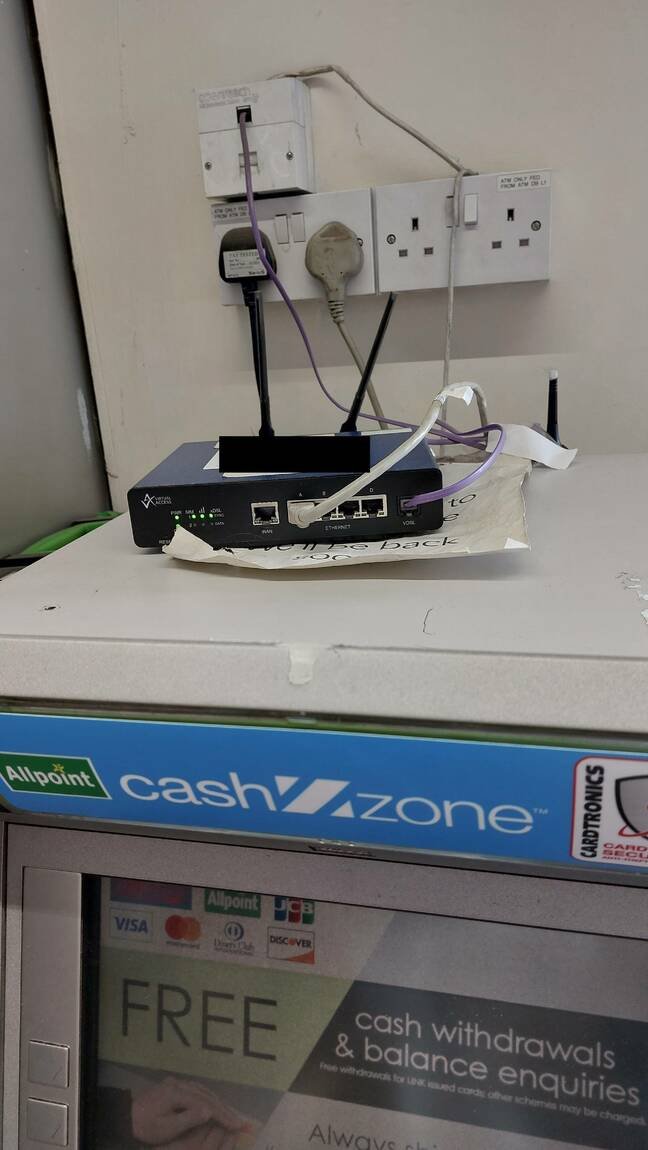
The hardware itself isn't the problem - the GW6650V is actually a solid choice for ATM connectivity, offering dual SIM slots for failover, advanced security features, and 802.11n Wi-Fi that's more than adequate for financial transactions. The router's specifications include "Advanced Security" and is marketed as a "Cost-effective business grade router" with specific applications for financial and ATM use.
However, the installation creates multiple vulnerabilities that security experts would immediately flag:
Physical Security Risks
- Exposed Ethernet ports accessible to anyone
- Visible cabling that could be tampered with
- Device mounted in a location where the public can physically access it
- No apparent protective casing or security measures
Attack Vectors
- Man-in-the-middle attacks become trivial with exposed network ports
- Power interruption is possible given the visible power connections
- Physical damage from vandals or curious individuals
- Potential for unauthorized device connection
Real-world Consequences Beyond the obvious security implications, the exposed setup invites non-technical threats. A vandal could easily disrupt service with chewing gum or other debris. A curious child might damage the equipment with sticky fingers or snacks. The visible power connections suggest the device could be easily disconnected or powered down.
The situation exemplifies a common problem in physical security: even the most secure hardware becomes vulnerable when poorly installed. While the router's software and security features may be robust, leaving it exposed to public access negates those protections entirely.
This type of oversight isn't uncommon in the industry. Similar incidents have been documented with Windows operating systems appearing in unexpected places - from Windows 2000 on ticket machines to Windows 10 on information displays. However, this case is particularly concerning because it involves financial infrastructure where security breaches could have immediate monetary consequences.
The exposed ATM router serves as a reminder that security is only as strong as its weakest link, and in this case, that weakness is the physical installation rather than the technology itself.
Comments
Please log in or register to join the discussion