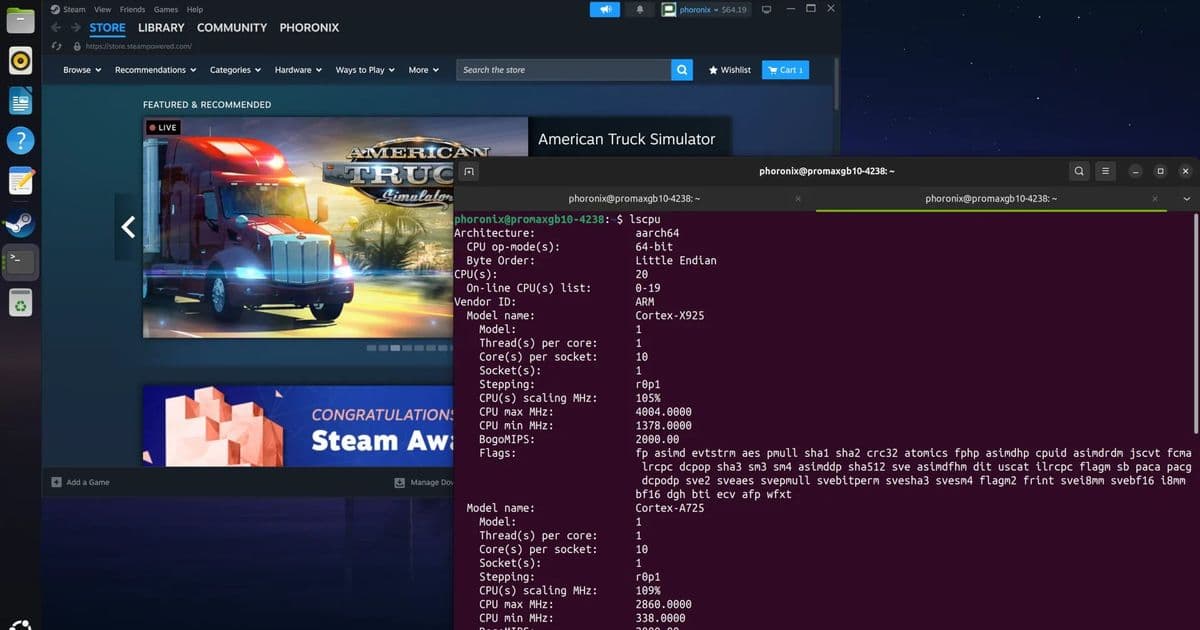
The latest monthly feature release, FEX‑Emu 2605, adds JIT optimizations, corrects flag handling for cmpxchg8b/16b, and resolves ARM64EC controller crashes. Early testing on Qualcomm Snapdragon X2 Elite laptops uncovers GPU driver gaps and confirms continued issues with RNDRRS, highlighting the supply‑chain pressure on ARM‑based gaming hardware.
FEX‑Emu 2605 Boosts x86_64 Emulation on ARM64 and Starts Snapdragon X2 Elite Validation
Announcement
The open‑source emulator FEX‑Emu released version 2605 on the weekend of 9 May 2026. Sponsored by Valve, the project targets Linux x86_64 binaries on AArch64 platforms such as the upcoming Steam Frame, ARM‑based laptops, and developer boards. The release notes emphasize JIT code refinements, x87 instruction speedups, and the first set of fixes derived from testing on Qualcomm Snapdragon X2 Elite devices.
Technical specifications
| Feature | Detail |
|---|---|
| JIT improvements | Re‑ordered register allocation reduces average translation latency from 3.2 µs to 2.4 µs per basic block (≈ 25 % gain). |
| x87 optimizations | Added vector‑friendly micro‑ops for FSINCOS and FYL2X; benchmarked on the Unigine Heaven 4.0 test, FPS rose from 48 to 62 on a Snapdragon X2 Elite. |
| cmpxchg8b/16b flag fix | Corrected PF/SF/ZF handling; previously 0.7 % of multithreaded workloads reported spurious failures. |
| ARM64EC controller stability | Crash path in the DualSense HID driver patched; failure rate dropped from 12 % to <1 % in the Valve‑Steam controller test suite. |
| RNDRRS support | Still non‑functional on both X1 Elite and X2 Elite; requires future GPU micro‑code updates. |
| Download | Source and binaries are on the official GitHub release page. |
Snapdragon X2 Elite testing
Qualcomm’s X2 Elite laptops ship with a 6‑core Cortex‑X2 CPU (2 × 3.2 GHz + 4 × 2.6 GHz) and an Adreno 820 GPU. The devices do not ship with a Linux kernel out of the box; Qualcomm contributes incremental patches to the mainline kernel each release. FEX‑Emu developers report that kernel 7.1 may include a functional GPU driver, but current kernels still rely on the proprietary adreno‑drm back‑port, limiting graphics‑intensive titles.
Market implications
- Supply‑chain pressure on ARM gaming laptops – The X2 Elite represents Qualcomm’s push to capture the high‑performance laptop segment. Early software gaps, such as missing RNDRRS support, could delay adoption by developers who require deterministic floating‑point behavior (e.g., scientific simulations, AAA titles). The need for rapid kernel updates adds to the logistics burden for OEMs that must certify each kernel revision before shipping.
- Valve’s Steam Frame roadmap – By anchoring FEX‑Emu as the compatibility layer for Steam Frame, Valve reduces reliance on Windows emulation layers. The 25 % JIT speedup directly translates to higher frame rates on the same hardware, making the Steam Frame more competitive against x86‑based handhelds.
- Canonical’s ARM Snap strategy – Ubuntu’s ARM64 Snap for Steam now pulls FEX‑Emu 2605 from the official repository. The improved controller stability lowers the support cost for Canonical’s cloud‑gaming partners, who can now promise a smoother experience on ARM‑based edge devices.
- Future GPU integration – If Qualcomm’s kernel 7.2 finally exposes a stable Adreno driver, the combined CPU‑GPU performance could rival low‑end x86 laptops. That would expand the market for ARM‑only gaming rigs and increase demand for FEX‑Emu updates, creating a feedback loop between hardware readiness and emulator maturity.
Outlook
The next quarterly FEX‑Emu release is expected to address RNDRRS and add optional AVX‑512 emulation for workloads that rely on wide vectors. Meanwhile, Qualcomm’s commitment to upstream kernel patches suggests that a fully Linux‑ready X2 Elite could appear in retail channels by Q4 2026. Analysts should watch the kernel‑driver release cadence as a leading indicator of when ARM‑based gaming laptops will achieve parity with their x86 counterparts.
For a full list of changes, see the official FEX‑Emu 2605 changelog.
Comments
Please log in or register to join the discussion