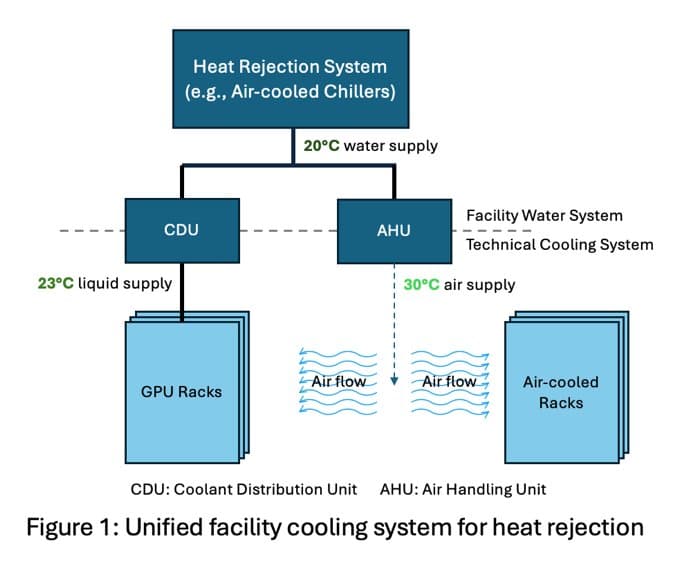
Microsoft's zonal cooling strategy addresses the thermal management challenges of modern AI datacenters by creating independent cooling zones for different hardware types, enabling efficiency gains, performance improvements, and sustainability goals.
The rapid advancement of artificial intelligence is fundamentally transforming datacenter infrastructure, creating unprecedented thermal management challenges. As AI accelerators increasingly require liquid cooling while traditional systems remain air-cooled, datacenter operators face a complex balancing act between performance, efficiency, and sustainability. Microsoft has responded with an innovative zonal cooling strategy designed to handle this diversity of cooling requirements in its next-generation AI datacenters.
The Cooling Dilemma in Modern Datacenters
Modern datacenters now support a heterogeneous mix of IT equipment, each with distinct thermal profiles. High-performance GPUs and AI accelerators, which can exceed 1 kW per unit, require liquid cooling as air cooling becomes impractical at these power densities. The superior heat dissipation capabilities of liquid cooling allow for coolant supply temperatures as high as 45°C without sacrificing peak performance.
Conversely, general-purpose hardware including CPU-based compute, storage, and networking systems remain predominantly air-cooled, requiring much lower supply temperatures—around 30°C—for optimal efficiency. This divergence creates a significant challenge when using traditional unified cooling approaches.
The limitations of a single-temperature facility water system become increasingly apparent as the proportion of liquid-cooled equipment grows. For instance, with a 90:10 liquid-to-air ratio for NVIDIA GB300 servers, a unified system would overcool the majority of equipment, leading to substantial energy waste. This inefficiency directly impacts Power Usage Effectiveness (PUE), a critical metric for datacenter efficiency.
Zonal Cooling: A Flexible Solution
Microsoft's zonal cooling strategy addresses these challenges by implementing multiple independent water loops, each supplying coolant at different temperatures precisely matched to the requirements of specific equipment types. This approach allows for targeted cooling rather than applying a one-size-fits-all solution.
At the facility level, this implementation typically involves two distinct temperature zones: one loop maintaining lower temperatures for air-cooled equipment and human comfort, while another loop supplies higher-temperature coolant to liquid-cooled AI accelerators. This separation enables operators to precisely match cooling supply to each zone's requirements, avoiding the inefficiency of over-cooling all equipment to the lowest common denominator.
The flexibility of zonal cooling extends beyond facility-level implementation. Microsoft is exploring multiple layers of zonal cooling:
- Facility-level: Two distinct temperature zones within a datacenter
- Row-level: Tailoring coolant temperature for each row based on deployed hardware
- Rack-level: Enabling multiple temperature zones within a single rack
- Chip-level: Applying zonal cooling inside the server, such as using colder coolant for a GPU's high-bandwidth memory while supplying warmer coolant for the SoC and CPUs
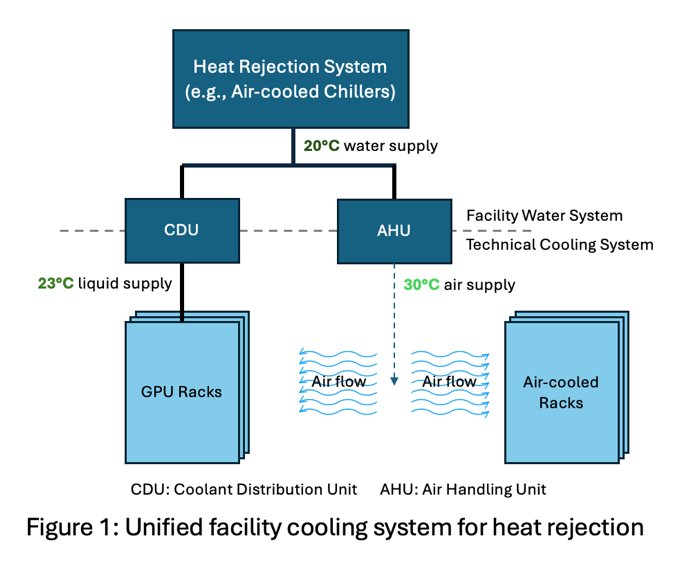
Microsoft is currently implementing facility-level zonal cooling in its next-generation AI datacenters scheduled to go live in 2028 and beyond, while researching the other three approaches in laboratory environments. This facility-level implementation alone is expected to reduce PUEs by up to 10%, representing a significant improvement in energy efficiency.
Benefits of Zonal Cooling Architecture
The advantages of zonal cooling extend beyond simple temperature management. This approach delivers multiple strategic benefits for modern datacenters:
Improved Energy Efficiency and Sustainability
By reducing unnecessary cooling loads, zonal cooling improves energy efficiency as measured by annualized PUE. Lower PUE translates directly to energy savings and reduced carbon emissions, aligning with Microsoft's commitment to becoming carbon negative. The targeted cooling approach also supports Microsoft's goal to eliminate water evaporation as a cooling method in next-generation datacenters.
Increased Server Density
Tailored zonal cooling reduces peak cooling power demand during the hottest days, which in turn lowers peak PUE. This reduction allows datacenter designers to reserve power for future lower water temperature requirements, add more servers within the same utility power envelope, or contract less utility power per datacenter. The result is higher computational capacity within the same physical footprint.
Enhanced Performance
Strategic control of coolant temperatures unlocks higher chip performance without sacrificing efficiency. Colder loops allow GPUs and CPUs to sustain elevated clock speeds through safe overclocking, while optimized memory cooling supports greater stacking density and increased bandwidth. This performance boost is particularly valuable for AI workloads where every improvement in computational efficiency matters.
Future-Proof Flexibility
With independent zones, operators can easily adjust coolant supply temperatures or reconfigure zones as new generations of hardware with varied cooling requirements emerge. This flexibility ensures compatibility with future innovations while maintaining optimal performance. For example, future AI accelerators may require different liquid temperature ranges, while general-purpose equipment requirements may remain unchanged. Zonal cooling accommodates these evolving needs without requiring complete infrastructure overhauls.
Implementation Considerations
Successfully implementing zonal cooling requires careful planning and coordination across multiple dimensions:
- Infrastructure Design: The physical layout must accommodate multiple independent cooling loops and their distribution systems
- Control Systems: Sophisticated monitoring and control mechanisms are needed to manage different temperature zones
- Workload Placement: Strategic placement of different hardware types within appropriate cooling zones
- Energy Management: Coordinating cooling strategies with overall energy consumption and peak demand management
{{IMAGE:2}}
Microsoft's approach emphasizes the importance of starting with facility-level zonal cooling while researching more granular implementations. This staged approach allows for practical deployment while continuing to innovate in laboratory environments.
Looking Ahead: The Future of Datacenter Cooling
Zonal cooling represents a significant evolution in datacenter thermal management. As AI workloads continue to grow and hardware becomes increasingly diverse, the need for flexible, efficient cooling solutions will only intensify. The zonal approach provides a foundation for building datacenters that can adapt to changing requirements without sacrificing performance or sustainability.
Microsoft's commitment to zonal cooling in its 2028+ datacenter generation demonstrates the practical viability of this approach. As the industry continues to push boundaries in performance and sustainability, zonal cooling will likely become a standard strategy for next-generation datacenters.
The success of this approach will depend on continued innovation in cooling technologies, hardware design that embraces thermal diversity, and sophisticated control systems that optimize cooling delivery across multiple zones. For organizations planning long-term datacenter strategies, understanding and preparing for zonal cooling architectures will be increasingly important as AI workloads continue to drive infrastructure evolution.
For more technical details on Microsoft's cooling strategies, you can explore their Azure Architecture Blog or their sustainability initiatives.
Comments
Please log in or register to join the discussion