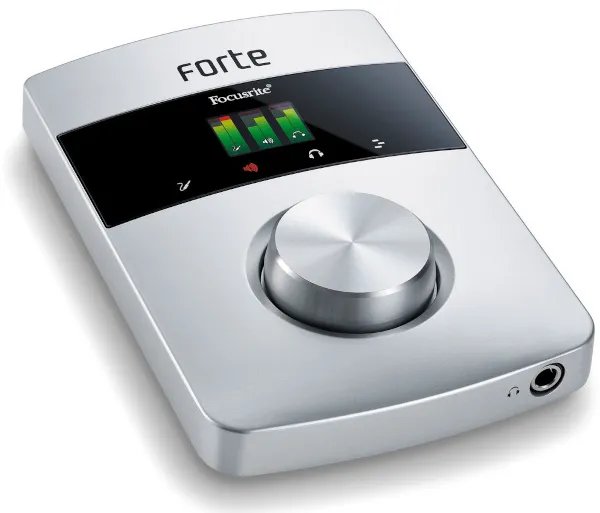
After years of community effort, the discontinued Focusrite Forte portable audio interface will finally be supported in the mainline Linux kernel, extending support for Focusrite's Scarlett family of devices.
The Focusrite Forte, a compact 2-in/4-out USB audio interface that ceased production years ago, is receiving official mainline Linux kernel support in the upcoming 7.0 release. The necessary patches have been merged into the kernel's sound subsystem development tree and are slated for inclusion during the 6.20~7.0 merge window this February.
A Community-Driven Addition
The Forte's Linux support follows a pattern seen across Focusrite's product line, where open-source community contributions have gradually extended kernel-level driver support to the company's USB audio hardware. Unlike vendor-provided drivers that often rely on proprietary firmware blobs or closed-source user-space components, this implementation integrates directly into the ALSA sound subsystem through the existing Scarlett USB mixer driver infrastructure.
The patch essentially extends the snd-usb-audio driver family, adding specific device identification and control logic for the Forte's unique hardware configuration. This approach means the interface will function out-of-the-box on most distributions without requiring manual driver installation or third-party software.
Technical Specifications and Legacy
The Focusrite Forte was originally marketed as a premium portable solution for Windows and macOS users, featuring:
- 24-bit/192kHz audio resolution - Professional-grade digital conversion suitable for studio recording
- Two remote-controlled microphone preamplifiers - Focusrite's signature preamp design with digitally controlled gain staging
- 2 inputs, 4 outputs - Flexible routing for monitoring and recording scenarios
- USB 2.0 connectivity - Bus-powered design for true portability
Introduced in the early 2010s, the Forte competed in a crowded market of portable interfaces. Its distinctive metal chassis and integrated cable management earned positive reviews, but the device was ultimately discontinued as Focusrite streamlined its product lineup around the Scarlett series.
Market Implications
For Linux audio professionals and hobbyists, this announcement carries practical weight beyond mere driver availability. The used market for audio interfaces has become increasingly important as hardware cycles accelerate. A device like the Forte, which can be found on secondary markets for $100-150, represents significant value compared to current-generation interfaces costing $200-400.
The timing matters too. As of early 2026, many USB audio interfaces from the 2010s remain functionally sound but lack modern driver support. The Forte's inclusion in mainline Linux extends the usable lifespan of perfectly capable hardware, aligning with broader sustainability trends in electronics.
How It Works
The Scarlett driver family, now including the Forte, operates at the kernel level through USB Audio Class 2.0 protocols with vendor-specific extensions. When connected, the device presents itself as a standard USB audio device, but Focusrite's control features—like preamp gain, phantom power, and monitor mixing—require additional driver logic to manipulate the hardware's proprietary command set.
The patch adds the Forte's USB VID/PID identifiers to the driver's device table and implements the specific control mappings for its hardware. This means users will have access to:
- Hardware monitoring with direct monitoring capabilities
- Sample rate and clock source selection
- Preamp gain control (likely through ALSA mixer controls)
- Phantom power switching
- Hardware loopback routing
Availability and Installation
Users running current Linux distributions will need to wait for kernel 7.0's release, expected in mid-2026, or manually compile the patched kernel from source. For those running rolling-release distributions like Arch Linux or kernel PPA users on Ubuntu, earlier adoption may be possible once the patches reach stable kernel branches.
The inclusion also benefits Linux-based digital audio workstations like Ardour, REAPER (via Wine), and Bitwig Studio, which will gain native hardware support without requiring additional configuration.
This addition demonstrates how community reverse-engineering efforts continue to bridge the gap between professional audio hardware and Linux, one device at a time. While major manufacturers like Focusrite haven't officially embraced Linux, the open-source community's persistent work ensures that capable hardware doesn't become obsolete solely due to driver limitations.
Comments
Please log in or register to join the discussion