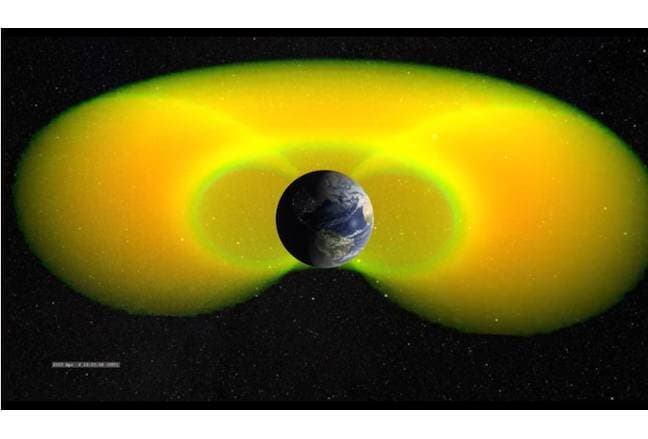
NASA's Van Allen Probe A re-entered Earth's atmosphere eight years early after unexpected solar activity increased atmospheric drag, highlighting the growing risks of space debris and the challenges of orbital decay.
NASA's Van Allen Probe A has made an unexpected return to Earth, re-entering the atmosphere over the Pacific Ocean eight years ahead of schedule due to heightened solar activity that increased atmospheric drag on the spacecraft.
Launched in 2012 as part of a two-spacecraft mission to study Earth's Van Allen radiation belts, the probe completed its primary mission in 2019 when it exhausted its fuel supply. At that point, NASA estimated the spacecraft would remain in orbit until approximately 2034. However, the current solar cycle has proven significantly more active than anticipated, causing satellites to experience greater atmospheric drag and faster orbital decay than planned.
The spacecraft re-entered Earth's atmosphere at 0637 EDT on March 11, 2026, over the eastern Pacific Ocean at approximately 2° south latitude and 255.3 degrees east longitude. The US Space Force confirmed the re-entry location, noting that while most of the spacecraft likely burned up during atmospheric entry, some components may have survived.
NASA calculated a 1 in 4,200 chance that debris from the 1,323-pound spacecraft could cause injury to someone on Earth. This risk exceeds US government guidelines, which state that the risk of human casualty from uncontrolled re-entry should be less than 1 in 10,000. The agency had estimated re-entry would occur at 1945 EDT on March 10, with a 24-hour uncertainty window.
This early return is part of a broader pattern affecting multiple spacecraft. NASA's Swift observatory is also experiencing faster-than-expected orbit decay, prompting the agency to plan a rescue mission. The Hubble Space Telescope's orbit is decaying as well, though it remains in no immediate danger of uncontrolled re-entry.
The Van Allen Probe A's early return underscores the challenges space agencies face in predicting orbital decay, particularly during periods of heightened solar activity. The spacecraft's twin, Van Allen Probe B, is not expected to re-enter until around 2030.
This incident adds to the growing concern about space debris and uncontrolled re-entries. In 2024, a pallet of batteries jettisoned from the International Space Station made an uncontrolled re-entry, and China has faced criticism for allowing rocket stages and other debris to fall back to Earth without control.
The Van Allen Probes were originally designed for a two-year mission but operated successfully for seven years, providing valuable data about the radiation belts that protect Earth from solar radiation. Their early return serves as a reminder of the dynamic nature of Earth's space environment and the need for improved orbital debris mitigation strategies as solar activity continues to exceed expectations.
Comments
Please log in or register to join the discussion