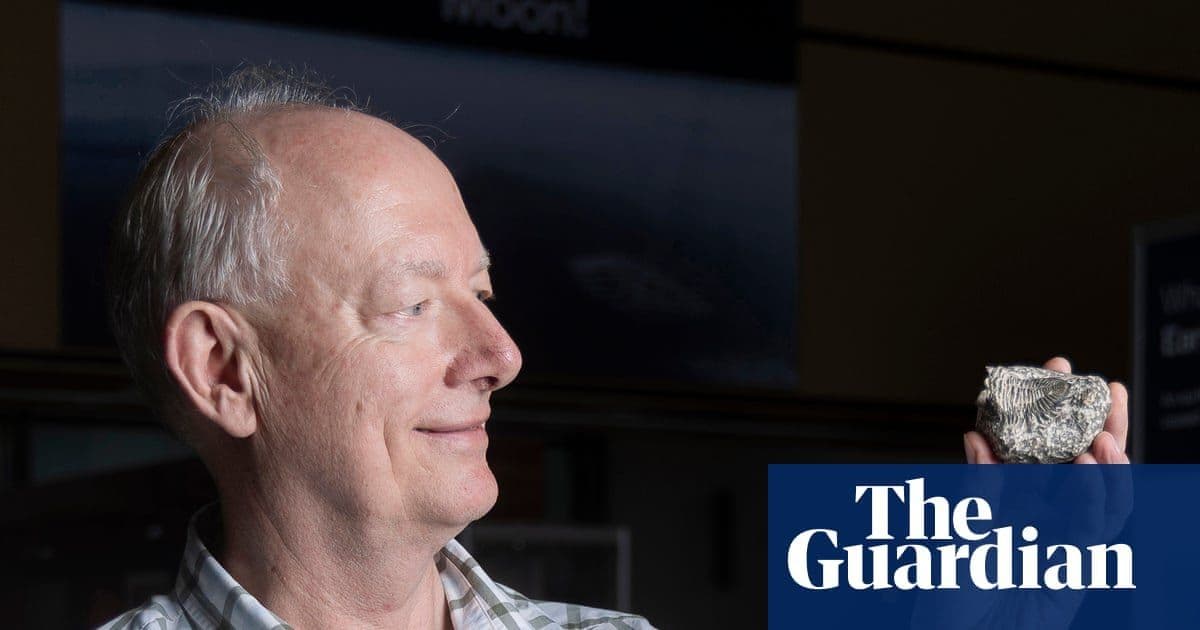
Craig Munns transformed his life at 62 by pursuing a degree in paleontology, proving it's never too late to follow your passion for science.
At 62, Craig Munns made a decision that would transform his life: he enrolled in university to study paleontology, despite having no prior degree and multiple careers behind him. Three years later, at 65, he's living his dream, spending his days examining long-vanished life forms and contributing to our understanding of Earth's ancient past.
Munns' journey is captured in a striking photograph by Hilary Wardhaugh for The Guardian, showing him surrounded by geological treasures: amethyst crystals, smoky quartz, an ammonite cast, a model of a crystalline mineral lattice, a fossilised ammonite, and desert rose gypsum. The image perfectly encapsulates his new life's work - a man who found his true calling later in life, surrounded by the physical evidence of millions of years of Earth's history.
What makes Munns' story particularly compelling is that he represents a growing trend of older adults returning to education to pursue long-held passions. Unlike many who follow linear career paths, Munns had already experienced several careers but felt something was missing. His decision to become a paleontologist demonstrates that intellectual curiosity and the desire to contribute to scientific knowledge don't diminish with age - if anything, they can become more pronounced.
The field of paleontology itself offers unique opportunities for those willing to start later in life. Unlike some sciences that require decades of specialized training from a young age, paleontology combines fieldwork, laboratory analysis, and theoretical research in ways that can accommodate diverse backgrounds and life experiences. Munns' varied career history likely provides him with perspectives and problem-solving approaches that complement traditional scientific training.
His story resonates beyond the scientific community, appearing in The Guardian's "A new start after 60" series, which highlights individuals who've made significant life changes later in life. In an era where people are living and working longer, Munns' example challenges conventional notions about career timelines and educational trajectories. It suggests that the traditional model of education-work-retirement may be giving way to more fluid, multi-stage lives where people feel empowered to reinvent themselves at any age.
For aspiring paleontologists or anyone considering a similar late-career pivot, Munns' journey offers both inspiration and a practical roadmap. His success likely required not just passion for the subject but also the courage to return to student life, the discipline to master new material, and the resilience to navigate an academic environment where he might have been older than many of his instructors. Yet the rewards - working with ancient specimens, contributing to scientific knowledge, and finding fulfillment in a long-desired field - appear to have made the journey worthwhile.
The broader implications of stories like Munns' extend to how society views aging, education, and career development. As populations in many countries age, we may need to reconsider how we structure education, careers, and retirement. Munns demonstrates that with the right support systems and personal determination, people can make meaningful contributions to fields like science regardless of when they start. His story suggests that the scientific community, and indeed all knowledge-based fields, might benefit from being more open to diverse career paths and life experiences.
In a world where headlines often focus on conflict and crisis - from Middle East tensions to political developments - stories like Munns' provide a different kind of news: the quiet triumph of human potential and the enduring appeal of scientific discovery. His journey reminds us that while global events may dominate the news cycle, individual stories of transformation and learning continue to unfold, offering hope and inspiration to others who might be contemplating their own new beginnings, regardless of their age.
Comments
Please log in or register to join the discussion