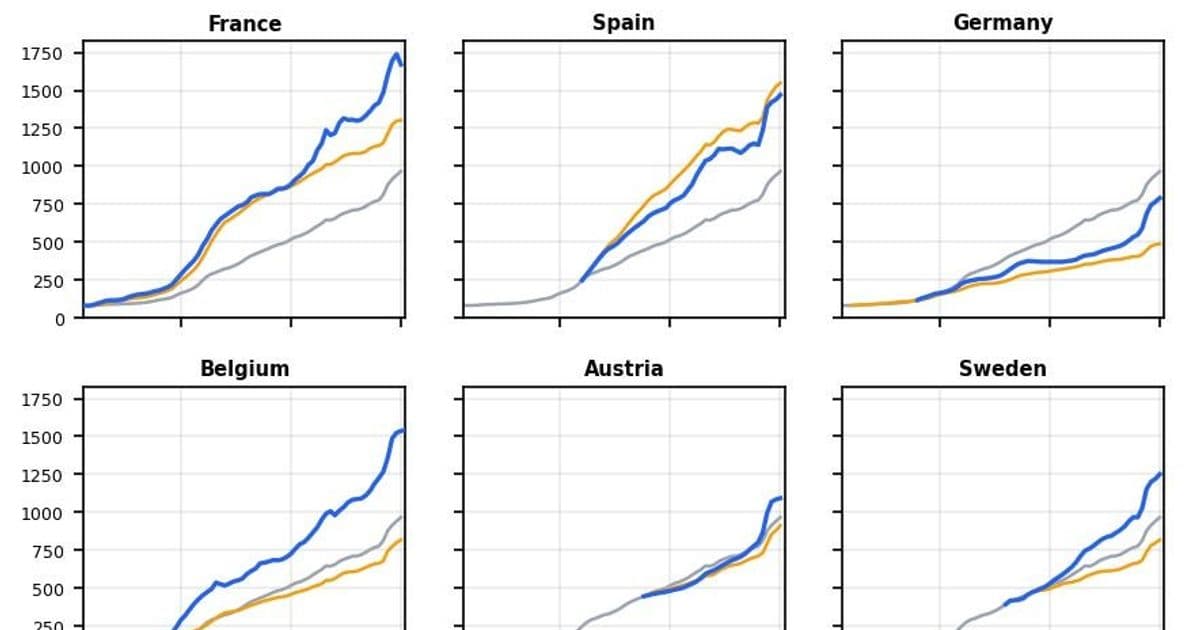
A comprehensive analysis of construction cost trends across time and geography reveals a consistent pattern: construction costs rarely fall relative to overall inflation, extending back to the late 19th century. This mirrors stagnant construction productivity trends and suggests fundamental structural challenges in the construction industry that transcend technological and economic changes.
The Persistent Puzzle of Construction Costs: Why Building Rarely Gets Cheaper
The relationship between construction activity and economic progress presents one of the most enduring puzzles in industrial development. While manufacturing, agriculture, and most other sectors have experienced consistent productivity gains and cost reductions over time, the construction industry stands apart as a domain where progress seems perpetually stalled. Brian Potter's examination of construction cost trends across more than a century reveals not merely a contemporary challenge but a persistent historical pattern that defies conventional economic expectations.
The Historical Constancy of Rising Construction Costs
When analyzing construction cost indexes from the late 19th century through the present day, a striking pattern emerges: construction costs virtually never fall relative to overall inflation. This observation holds true regardless of whether we examine output indexes tracking finished buildings or input indexes measuring construction materials and labor. The Turner Building Cost Index, dating back to 1915, shows costs rising faster than inflation in four of five ten-year periods between 1915 and 1965. Similarly, the National Highway Construction Cost Index reveals consistent cost increases since 1915.
What makes this pattern particularly noteworthy is its persistence across different economic eras, technological revolutions, and policy environments. The construction industry has witnessed the transition from horse-drawn equipment to mechanization, from manual drafting to Building Information Modeling (BIM), from local construction practices to globalized supply chains—yet the fundamental cost trajectory remains remarkably consistent.
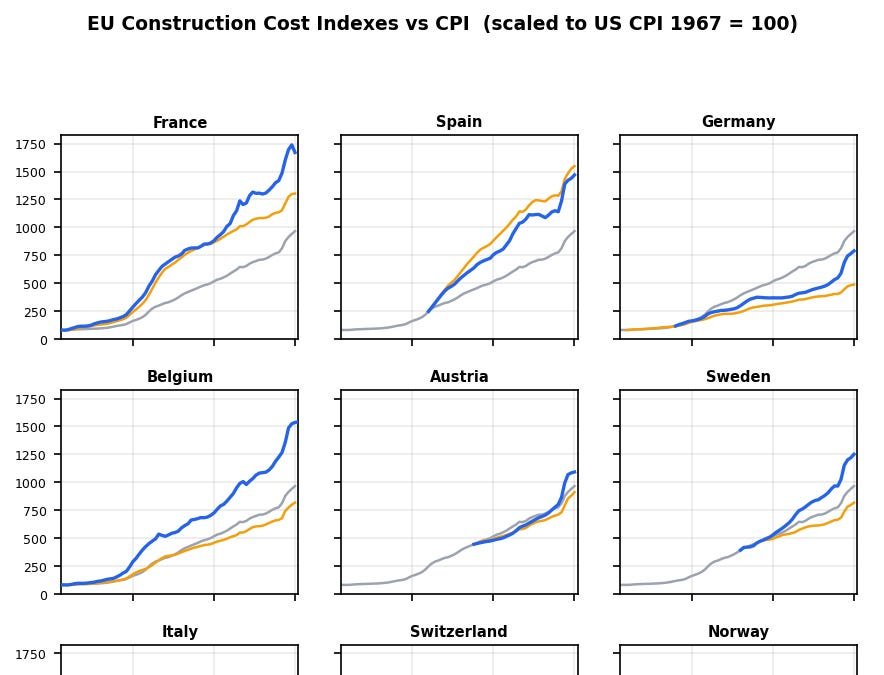
The international data corroborates this observation. Across Europe, Asia, and North America, construction costs tend to rise at or above the rate of overall inflation. The Eurostat Construction Producer Price Index for 36 European countries, the UK's BIS construction output price index dating to 1955, and Japan's Construction Cost Deflator since 1960 all demonstrate similar patterns. This global consistency suggests the issue lies not with local market conditions or national policies but with something more fundamental to the nature of construction itself.
Productivity Stagnation as a Mirror to Cost Trends
The cost trends Potter identifies closely parallel the construction productivity trends he previously examined. While the productivity analysis suggested the problem dated back to the 1960s, the cost data pushes this timeline further back, indicating that construction's economic challenges extend well into the late 19th and early 20th centuries. The correlation between stagnant productivity and rising costs suggests these phenomena are not merely coincidental but causally connected.
In most industries, productivity gains naturally translate to lower costs as firms become more efficient at producing the same output with fewer inputs. The construction industry appears to have broken this fundamental economic relationship. Without consistent productivity improvements, the industry has lacked the mechanism by which other sectors have achieved substantial cost reductions. This represents a profound deviation from standard economic development patterns.
The granularity of Potter's analysis reveals that even at the level of individual construction tasks, costs tend to rise rather than fall. The RSMeans estimating guide data from 1954, 1985, and 2023 shows that while specific task costs vary, the average increase aligns with overall inflation. This suggests that the cost stagnation isn't merely an aggregate phenomenon but permeates the industry at its most fundamental operational level.
Methodological Considerations and Measurement Challenges
Examining construction cost trends requires careful consideration of methodological limitations. Potter distinguishes between output indexes, which track the cost of finished buildings, and input indexes, which measure the cost of construction inputs. While output indexes more directly reflect what we actually care about—the cost of completed structures—both types tend to track each other closely.
One significant challenge is adjusting for quality improvements. A modern building may cost more per square foot than an older one, but it may also be built to higher standards, incorporate more advanced technologies, or better meet contemporary expectations. Some indexes, like the Census Bureau's Constant Quality Index, attempt to account for these differences, but most do not. This means that some portion of rising costs may reflect genuine improvements in building quality rather than pure inflation.
The issue of changing output mix presents another methodological complexity. As the types of construction being built change over time, cost indexes must be carefully constructed to avoid distortion. Potter notes that index producers typically address this by adjusting the weighting of different elements to reflect current construction practices, making cost indexes potentially more resilient to this problem than productivity metrics.
The Exceptional Period: 1975-1995
One notable exception to the general pattern of rising construction costs is the period from 1975 to 1995, when most indexes show lower rates of increase or even declines relative to inflation. This period coincides with several significant economic and structural changes:
- The oil shocks of the 1970s and subsequent energy efficiency concerns
- The advent of personal computers and early digital technologies in construction
- Economic recessions in the early 1980s and early 1990s
- Potential measurement artifacts from how indexes were constructed during this period
The fact that this period stands out as exceptional underscores the robustness of the general trend. If construction costs were naturally subject to the same deflationary pressures as other sectors, we would expect to see more frequent and prolonged periods of cost reduction, rather than this single anomalous window.
International Comparisons and Global Patterns
The international data Potter presents reveals a remarkably consistent pattern across diverse economic and political systems. Whether examining market economies like the United States and the United Kingdom, or state-directed economies like those in parts of Asia, construction costs tend to rise rather than fall relative to overall inflation.
This global consistency suggests that the challenges facing the construction industry are not primarily the result of specific policy choices, market structures, or cultural factors. Instead, they appear to stem from something more fundamental about the nature of construction as an economic activity.
The comparison between different countries also reveals some variations in the magnitude of cost increases. Some European and Asian countries show slightly more instances where construction costs rose slower than inflation, though these remain the minority cases. These variations may reflect differences in construction practices, regulatory environments, or the specific composition of construction output in different economies.
Implications for Housing Affordability and Urban Development
The persistent tendency of construction costs to rise rather than fall has profound implications for housing affordability and urban development. If construction costs naturally increase over time, efforts to make housing more affordable must focus on other aspects of the housing ecosystem—land use regulations, financing mechanisms, tax policies, and the distribution of existing housing stock.
This reality challenges conventional approaches to addressing housing affordability that focus primarily on reducing construction costs through technological innovation or process improvements. While such efforts may yield modest gains, they face an uphill battle against a century-long trend of rising construction costs.
The pattern also has implications for infrastructure development and urban expansion. If building consistently becomes more expensive over time, cities may face increasing challenges in maintaining and expanding their infrastructure. This could contribute to urban decay, infrastructure deterioration, and reduced economic mobility—particularly for lower-income populations.
Potential Explanations and Counter-Perspectives
Several potential explanations have been proposed for the construction industry's unusual economic performance:
Labor Intensity: Construction remains one of the most labor-intensive industries, and labor productivity has generally stagnated across many sectors. Unlike manufacturing, where automation has dramatically reduced labor requirements, construction has proven remarkably resistant to labor-saving technologies.
Project Customization: Unlike mass-produced goods, most construction projects are unique to some degree, limiting opportunities for standardization and economies of scale. Each building site presents unique challenges that require customized solutions.
Regulatory Complexity: Construction is subject to extensive regulation, with requirements that vary by location and change over time. This regulatory burden may increase costs without necessarily improving quality or safety.
Fragmented Industry Structure: The construction industry consists of numerous small firms rather than a few large players, potentially limiting investment in research and development and economies of scale.
On-site Production: Unlike manufacturing, which occurs in controlled factory environments, construction happens on-site under variable conditions, making it difficult to control quality and efficiency.
Counter-perspectives suggest that the focus on cost trends may miss important nuances. Some argue that rising construction costs reflect improvements in building quality, safety, and sustainability rather than pure inefficiency. Others point to the increasing complexity of modern buildings, which incorporate more systems, technologies, and performance requirements than earlier structures.
The Path Forward: Rethinking Construction Economics
The persistent pattern of rising construction costs challenges us to rethink fundamental assumptions about how the construction industry operates and how it might evolve. Rather than expecting construction to follow the same deflationary trajectory as other sectors, we may need to develop new frameworks for understanding construction economics and improving housing affordability.
Potential approaches might include:
Alternative Construction Methods: Modular construction, 3D printing, and other off-site construction techniques may offer pathways to cost reduction that more traditional methods have failed to achieve.
Policy Innovation: Land use reforms, streamlined permitting processes, and innovative financing mechanisms may address housing affordability without requiring construction costs to fall.
Technology Integration: While past technological advances have failed to transform construction economics, emerging technologies like robotics, AI, and advanced materials may yet unlock productivity gains.
Industry Consolidation: Greater consolidation in the construction industry might enable larger investments in research, development, and technology adoption.
Performance-Based Standards: Shifting from prescriptive regulations to performance-based standards could allow for more innovation while maintaining safety and quality.
Conclusion
The examination of construction cost trends across more than a century reveals a persistent pattern that defies conventional economic expectations. Construction costs rarely fall relative to overall inflation, a pattern that extends back to the late 19th century and is observed across diverse countries and economic systems. This trend mirrors the construction productivity stagnation Potter previously identified and suggests fundamental structural challenges in the industry.
Understanding this pattern is crucial for developing effective policies to address housing affordability, infrastructure development, and urban growth. Rather than expecting construction to follow the same deflationary trajectory as other sectors, policymakers and industry stakeholders may need to develop new approaches that account for the unique economic characteristics of construction.
The persistence of rising construction costs across time, geography, and technological change suggests that the solutions to construction's economic challenges may lie not in incremental improvements to existing practices but in more fundamental rethinking of how we design, build, and regulate the built environment. As we confront the challenges of urbanization, climate change, and housing affordability, this understanding becomes increasingly vital.
For those interested in exploring these issues further, Brian Potter's Construction Physics newsletter offers ongoing analysis of buildings, infrastructure, and industrial technology. The historical cost indexes Potter examined provide valuable resources for researchers and policymakers seeking to understand long-term trends in construction economics.
Comments
Please log in or register to join the discussion