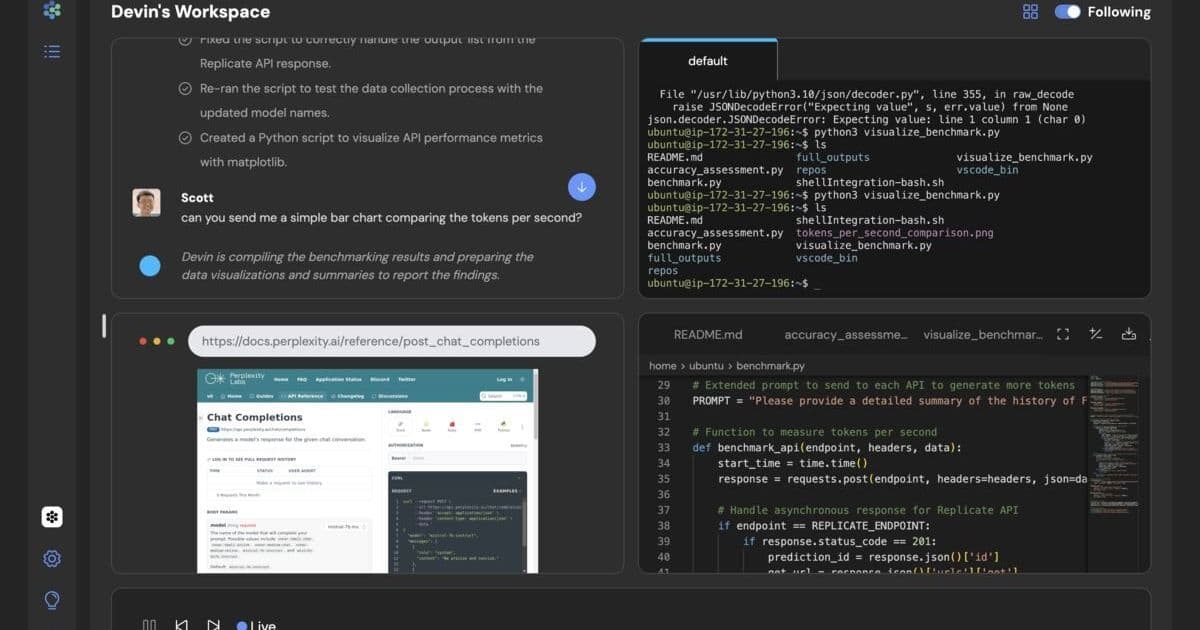
AI coding firm Cognition is reportedly in talks to raise hundreds of millions at a $25B valuation, more than doubling its previous valuation in just months, as investors pour billions into AI-powered development tools.
Reports indicate that AI coding startup Cognition is in early discussions to raise hundreds of millions of dollars at a $25 billion valuation, a significant jump from its $10.2 billion valuation announced just last September. This potential valuation surge highlights the intense competition and investor enthusiasm surrounding AI-powered coding assistants that promise to transform software development.
The timing of these talks comes amid a flurry of activity in the AI coding space, with several companies achieving remarkable valuations. Anthropic, another AI firm focused on coding assistance, recently reached a $1 trillion valuation on Forge Global, surpassing OpenAI's $880 billion valuation on the same platform. These staggering numbers suggest that investors see fundamental shifts in how software will be created in the coming years.
"What we're witnessing is the early stages of a fundamental transformation in software development," said tech analyst Sarah Chen. "These AI coding tools aren't just autocomplete on steroids; they represent a new paradigm where human developers collaborate with AI agents to build software faster and potentially more efficiently."
Cognition, which has gained attention for its AI-powered coding assistant Devin, appears to be capitalizing on this shift. The company's technology aims to automate complex programming tasks, from writing entire functions to debugging and testing code. If the reported $25 billion valuation materializes, it would place Cognition among the highest-valued private AI companies, reflecting investor confidence in the market for AI-powered development tools.
The competitive landscape in AI coding is heating up rapidly. Microsoft has been working to boost GitHub Copilot's popularity, even reportedly considering acquiring Cursor, another AI coding startup. Meanwhile, OpenAI's latest GPT-5.5 model has shown particular strength in "agentic coding," according to the company, suggesting that major tech players are also heavily investing in this space.
Not everyone is convinced these valuations are justified. "There's a significant gap between current capabilities and the transformative potential being promised," cautioned software engineering professor Michael Torres. "While these tools can certainly assist with coding tasks, the notion that they'll replace developers or create orders-of-magnitude productivity improvements remains largely unproven at scale."
The economics of these AI coding tools also raise questions. OpenAI recently priced GPT-5.5 at $5 per million input tokens and $30 per million output tokens for standard access, with premium versions costing significantly more. These prices, double those of GPT-5.4, could limit adoption, especially for individual developers and smaller companies.
For developers, the rapid evolution of AI coding tools presents both opportunities and challenges. On one hand, these tools can automate repetitive tasks, suggest solutions, and help bridge knowledge gaps. On the other hand, they may require new ways of thinking about programming and potentially disrupt traditional career paths.
"The most successful developers won't be those who can out-code AI, but those who can effectively collaborate with these tools," suggested Elena Rodriguez, a senior developer at a leading tech firm. "This means developing new skills around prompt engineering, system design, and understanding the limitations and biases of AI coding assistants."
The surge in valuations also reflects broader trends in AI investment. As established players like OpenAI and Anthropic reach sky-high valuations, investors are looking to newer, potentially more agile companies that might offer better returns. The AI coding sector, with its clear value proposition and growing adoption, has become a particularly attractive area for investment.
Looking ahead, the AI coding space is likely to see continued consolidation and innovation. Companies will need to demonstrate not just technical capabilities but also clear ROI for users. The question remains whether these AI coding tools will deliver on their transformative promises or become another overhyped technology cycle.
For now, the massive valuations being discussed for companies like Cognition suggest that investors believe the former is more likely. As these tools continue to evolve and integrate into developer workflows, we may be witnessing the early stages of a fundamental shift in how software is created, maintained, and innovated.
Comments
Please log in or register to join the discussion