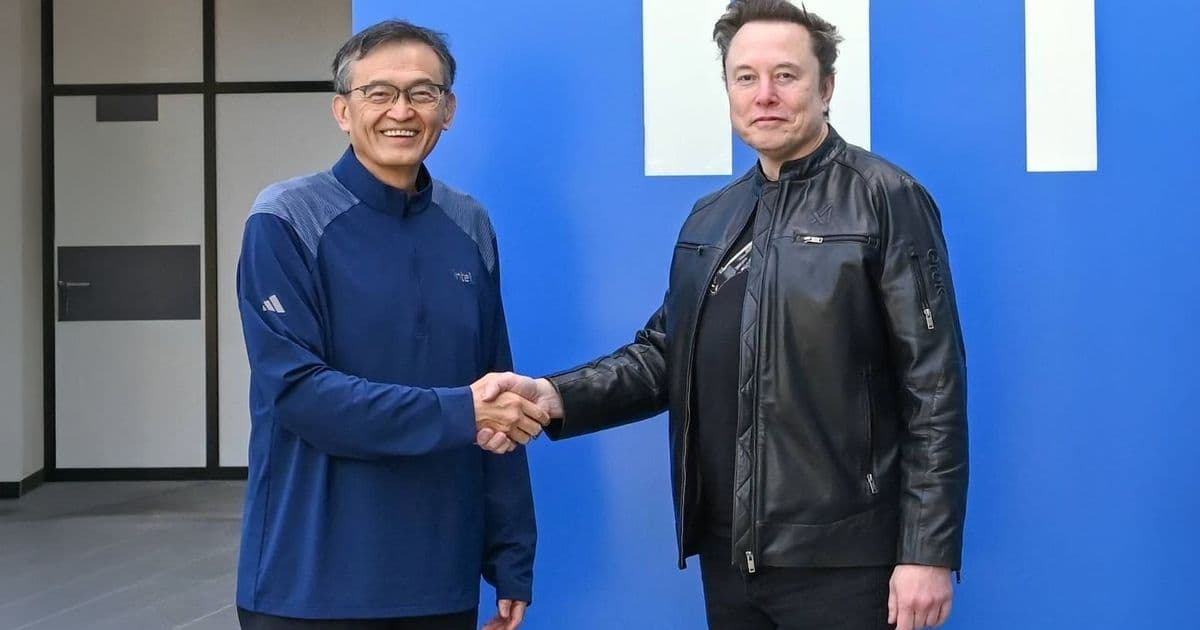
Intel CEO Lip-Bu Tan's effusive praise for Elon Musk as an ideal chipmaking partner reveals deeper struggles in Intel's foundry ambitions, where conventional process development has failed to stem losses. The TeraFab collaboration, likely centered on licensing Intel's risky 14A node, represents a bid to import Tesla's manufacturing velocity into semiconductor production—a high-stakes experiment to overcome the foundry model's core economics.
Intel's recent earnings call took an unexpected turn when CEO Lip-Bu Tan declared he could 'think of no better partner than Elon Musk' to revolutionize chip manufacturing. While the headline grabber was the Musk endorsement, the substantive news lies in what this partnership reveals about Intel's dire straits in the foundry business and its willingness to explore radical alternatives to traditional semiconductor R&D.
The context is grim: Intel Foundry reported a -45% operating margin for Q1 2026, a slight improvement from the -71.7% low in Q2 2025 but still deeply unprofitable. This isn't merely a temporary setback; it reflects a structural challenge where Intel's massive investments in next-generation nodes like 14A (expected 2027) aren't translating to market traction. TSMC's dominance—bolstered by its $165 billion U.S. investment push—has left Intel Foundry scrambling for relevance, with revenue declining last year despite aggressive node roadmaps.
Enter TeraFab, the mysterious vehicle through which Musk's Tesla and SpaceX interests are engaging with Intel. Though details remain scarce, the partnership almost certainly involves licensing Intel's 14A node. This represents a significant departure from norm: instead of Intel bearing the full R&D burden and risk for its most advanced process, it would offload early adoption to a partner willing to pay for access. For Intel, this provides immediate non-dilutive revenue and validates the node's viability—a critical confidence signal for other foundry customers. For TeraFab, licensing 14A avoids the $20+ billion+ cost and 3-5 year timeline of developing a leading-edge node from scratch, potentially accelerating their chip production timeline.
But Tan's comments hint at ambitions beyond simple licensing. His reference to 'refactoring silicon process technology' and 'unconventional ways to improve manufacturing efficiency' suggests aspirations to co-innovate on fab operations. This is where Musk's expertise becomes intriguing. Tesla's Gigafactories pioneered radical manufacturing principles: modular design, vertical integration, relentless focus on throughput (vehicles per hour), and treating the factory itself as the product. Applying these to semiconductor fabs—where a single line can cost $20 billion and take years to optimize—could address the foundry industry's Achilles' heel: the enormous time and capital required to reach high-volume manufacturing (HVM).
Consider the numbers: TSMC takes roughly 24 months from risk production to HVM for a new node. If Intel and TeraFab could cut that to 18 months through Musk-style manufacturing innovations (e.g., parallelizing tool installation, AI-driven yield learning, or standardized fab 'kits'), the economic impact would be massive. A 25% reduction in ramp time translates to hundreds of millions in additional revenue per fab line and significantly improved risk-adjusted returns on the colossal capex required for leading-edge nodes.
Of course, risks abound. Musk's management style—characterized by aggressive timelines and public volatility—may clash with semiconductor manufacturing's need for extreme process discipline and quiet, sustained execution. The 14A node itself remains unproven in volume production; Intel's internal struggles with 7nm/4nm equivalents raise questions about whether the technology is ready for external partners. Moreover, focusing on manufacturing efficiency assumes the node design is fundamentally sound—a big if given Intel's recent process delays.
Nonetheless, the partnership underscores a growing industry truth: the traditional IDM/foundry dichotomy is breaking down as the cost of pushing Moore's Law exceeds what any single entity can bear. Intel's willingness to entertain 'unconventional' approaches with Musk signals not just desperation, but a pragmatic recognition that future advances may require rethinking not just transistors, but the very factories that make them. Whether this yields a new model for semiconductor manufacturing or becomes another cautionary tale remains to be seen—but for a foundry business bleeding red ink, exploring the uncharted is suddenly preferable to doubling down on the familiar.
Comments
Please log in or register to join the discussion