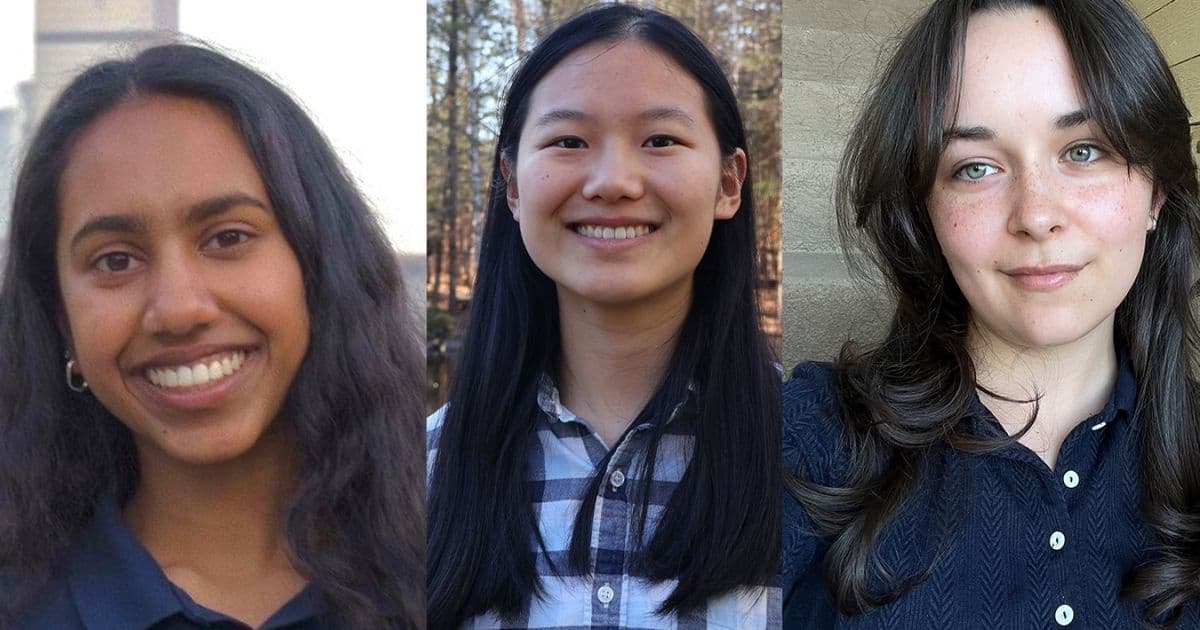
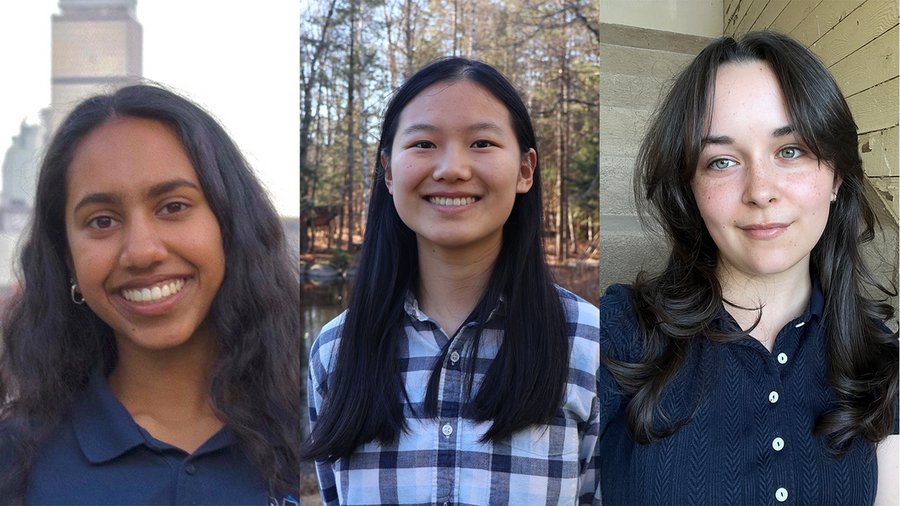
Three MIT rising seniors have been named 2026 Barry Goldwater Scholars, recognizing their exceptional research achievements and potential in scientific fields. Deeksha Kumaresh (biological engineering), Anna Liu (chemistry), and Charlotte Myers (physics and astronomy) were selected from among 5,000 nominees for this prestigious scholarship that supports future leaders in science, technology, engineering, and mathematics.
The Massachusetts Institute of Technology has announced that three rising seniors have been selected as 2026 Barry Goldwater Scholars, a prestigious national award recognizing exceptional undergraduate achievement in science, technology, engineering, and mathematics. Deeksha Kumaresh, Anna Liu, and Charlotte Myers were chosen from an estimated 5,000 nominees across the United States, with only 454 students ultimately receiving this honor. The Goldwater Scholarship, established in 1989, has become the preeminent undergraduate award for students pursuing research careers in these fields, with many recipients going on to become leading scientists, engineers, and mathematicians.
Deeksha Kumaresh: Biological Engineering and Cancer Research
Deeksha Kumaresh, a third-year biological engineering major, conducts research at the Hammond Lab within MIT's Koch Institute for Integrative Cancer Research. Her work focuses on the self-assembly of polymeric nanomaterials, with particular emphasis on using electrostatics and complementary interactions to create multifunctional materials with highly controlled architectures.
The Hammond Research Group's approach represents a sophisticated intersection of materials science and biological engineering. By manipulating molecular interactions at the nanoscale, researchers can design materials that respond to specific biological environments—potentially enabling targeted drug delivery systems that minimize side effects while maximizing therapeutic efficacy. This research has significant implications for cancer treatment, where the challenge of delivering therapeutics precisely to tumor cells while sparing healthy tissue remains a critical hurdle.
"Hands down, the mentors I've encountered have been the most significant part of my MIT journey," Kumaresh notes. "I'm also extremely grateful to the Hammond Lab, which has provided a supportive environment where I can make mistakes, learn, and grow as a researcher."
Kumaresh is mentored by Paula Hammond, dean of the School of Engineering, Institute Professor, and professor of chemical engineering. Her career goals include pursuing an MD/PhD and eventually leading a bioengineering research lab focused on predicting the efficacy and side effects of cancer therapies through systems-level computational and biological preclinical models.
The significance of Kumaresh's work extends beyond academic research. The development of precisely controlled nanomaterials could transform how we approach cancer treatment, potentially reducing the systemic toxicity associated with conventional chemotherapy while improving therapeutic outcomes. Her research exemplifies the kind of interdisciplinary work that bridges fundamental materials science with direct clinical applications.
Learn more about the Hammond Lab at MIT Koch Institute and their work on polymeric nanomaterials.
Anna Liu: Advancing Synthetic Chemistry
Anna Liu, a third-year chemistry major, conducts research in the Radosevich Group, which focuses on developing new catalysts, strategies, and reagents for synthetic chemistry. By designing and synthesizing novel molecular compounds with unknown structures and functions, the group aims to uncover fundamental principles that enable new chemical transformations.
Liu's research represents the cutting edge of synthetic chemistry, a field that underpins countless industrial processes from pharmaceutical manufacturing to materials production. The ability to create new chemical pathways and reactions has direct implications for developing more sustainable synthetic methods, reducing waste, and creating molecules with specific properties for targeted applications.
"Going through the Goldwater application process gave me a deeper understanding of my research project and helped me reflect on my intrinsic motivations to pursue research," Liu explains. "I'm excited to use what I've learned to keep growing as a researcher."
Mentored by Professor of Chemistry Alexander Radosevich, Liu plans to pursue a PhD in organic or inorganic chemistry with the goal of eventually leading research that develops sustainable synthetic transformations informed by fundamental mechanistic studies. Her work contributes to the broader scientific community's efforts to create more environmentally friendly chemical processes—a critical need as industries worldwide seek to reduce their environmental impact.
The Radosevich Group's approach to synthetic chemistry demonstrates how fundamental research can lead to practical applications. By understanding the underlying principles of chemical reactions, researchers can design more efficient processes that require less energy, produce fewer byproducts, and create valuable compounds with minimal environmental impact.
Explore more about the Radosevich Group and their research in synthetic chemistry.
Charlotte Myers: Machine Learning and Dark Matter Physics
Charlotte Myers, a third-year physics and astronomy major, conducts research at two prestigious MIT institutions: the Kavli Institute for Astrophysics and Space Research, where she applies machine learning to model galactic structure, and the Center for Theoretical Physics, where she studies theoretical models of dark matter. Her research bridges computational methods and theoretical physics to tackle one of the most fundamental questions in modern science: the nature of dark matter.
Myers' approach exemplifies the increasingly interdisciplinary nature of physics research. By combining machine learning techniques with astrophysical modeling, she can analyze complex datasets that would be intractable through traditional methods. This computational approach allows researchers to identify patterns in galactic structure that may provide clues about dark matter distribution and properties.
"I find it deeply rewarding to engage with open questions in physics, and I am excited to continue pursuing this work in graduate school and beyond," Myers shares. "Receiving this scholarship has given me both the resources and the confidence to continue on that path, even when progress is not always linear."
Mentored by Assistant Professor of Physics Lina Necib, Myers plans to pursue a PhD in theoretical physics with a focus on cosmology and astroparticle physics, particularly the fundamental physics of dark matter. Her research interests span multiple scales—from the distribution of dark matter on galactic scales to particle-level models that attempt to identify the specific particles that constitute dark matter.
The application of machine learning to astrophysics represents a significant advancement in how scientists approach complex problems in the universe. By developing algorithms that can identify patterns in vast amounts of observational data, researchers can test theoretical models more rigorously and potentially discover phenomena that would otherwise remain hidden.
Learn more about the Kavli Institute for Astrophysics and Space Research and their work on galactic structure and dark matter.
The Goldwater Scholarship and Its Impact
The Barry Goldwater Scholarship and Excellence in Education Foundation has supported outstanding undergraduates in STEM fields since 1989. The scholarship provides financial support to students who demonstrate exceptional potential for research careers in mathematics, the natural sciences, and engineering.
For Kumaresh, Liu, and Myers, the recognition comes with both financial support and the validation of their research potential. "Receiving this scholarship has been incredibly meaningful, because it offered me the chance to reflect critically on my post-graduate goals and receive recognition for my journey for them," Kumaresh explains.
The selection process is highly competitive, with nominees evaluated on their academic achievements, research experience, and commitment to careers in STEM fields. The fact that MIT consistently produces multiple Goldwater Scholars each year speaks to the institute's commitment to undergraduate research and its ability to identify and nurture exceptional talent.
The impact of the Goldwater Scholarship extends beyond the financial support. Scholars become part of a community of like-minded researchers who often collaborate and support each other throughout their careers. As Liu notes, "Earning this scholarship has welcomed me into a tight-knit community where I've already found so much guidance. Everyone is genuinely curious about everyone else's interests and are eager to lend a hand however they can."
Broader Implications for STEM Education and Research
The achievements of these three scholars highlight several important trends in STEM education and research. First, they demonstrate the value of interdisciplinary approaches to complex problems. Kumaresh's work combines materials science with biological applications, Liu's research bridges fundamental chemistry with sustainable practices, and Myers' work connects machine learning with theoretical physics.
Second, their success underscores the importance of mentorship in scientific development. Each scholar acknowledges the critical role their mentors have played in their development as researchers. This highlights the need for institutions to invest in faculty who are not only excellent researchers but also committed to teaching and mentoring undergraduate students.
Finally, the recognition these students have received points to the growing importance of undergraduate research experiences in STEM education. By engaging in research early in their academic careers, students like Kumaresh, Liu, and Myers develop the critical thinking skills, technical expertise, and research mindset necessary for successful careers in scientific fields.
As these scholars move on to graduate studies and beyond, their work has the potential to address some of society's most pressing challenges—from developing more effective cancer treatments to creating sustainable chemical processes and understanding the fundamental nature of our universe. The Goldwater Scholarship not only recognizes their past achievements but also invests in their future potential to contribute to scientific knowledge and technological innovation.
For more information about the Barry Goldwater Scholarship, visit the official Barry Goldwater Scholarship and Excellence in Education Foundation website.
Comments
Please log in or register to join the discussion